Feutz Erika, Biswas Prasanta K, Ndeketa Latif, Ogwel Billy, Onwuchekwa Uma, Sarwar Golam, Sultana Shazia, Peñataro Yori Pablo, Acebedo Alyssa, Ahmed Naveed, Ahmed Imran, Atlas Hannah E, Awuor Alex O, Bhuiyan Md Amirul Islam, Conteh Bakary, Diawara Oualy, Elwood Sarah, Fane Moussa, Hossen Md Ismail, Ireen Mahzabeen, Jallow Abdoulie F, Karim Mehrab, Kosek Margaret N, Kotloff Karen L, Lefu Clement, Liu Jie, Maguire Rebecca, Qamar Farah Naz, Ndalama Maureen, Ochieng John Benjamin, Okonji Caleb, Paredes Loyda Fiorella Zegarra, Pavlinac Patricia B, Perez Karin, Qureshi Sonia, Schiaffino Francesca, Traore Moussa, Tickell Kirkby D, Wachepa Richard, Witte Desiree, Cornick Jennifer, Jahangir Hossain M, Khanam Farhana, Olortegui Maribel Paredes, Omore Richard, Sow Samba O, Yousafzai Mohammad Tahir, Galagan Sean R
Department of Global Health, University of Washington, Seattle, Washington, USA.
International Centre for Diarrhoeal Disease Research, Bangladesh, Dhaka, Bangladesh.
Open Forum Infect Dis. 2024 Mar 25;11(Suppl 1):S48-S57. doi: 10.1093/ofid/ofad573. eCollection 2024 Mar.
Rigorous data management systems and planning are essential to successful research projects, especially for large, multicountry consortium studies involving partnerships across multiple institutions. Here we describe the development and implementation of data management systems and procedures for the Enterics For Global Health (EFGH) surveillance study-a 7-country diarrhea surveillance study that will conduct facility-based surveillance concurrent with population-based enumeration and a health care utilization survey to estimate the incidence of -associated diarrhea in children 6 to 35 months old.
The goals of EFGH data management are to utilize the knowledge and experience of consortium members to collect high-quality data and ensure equity in access and decision-making. During the planning phase before study initiation, a working group of representatives from each EFGH country site, the coordination team, and other partners met regularly to develop the data management systems for the study.
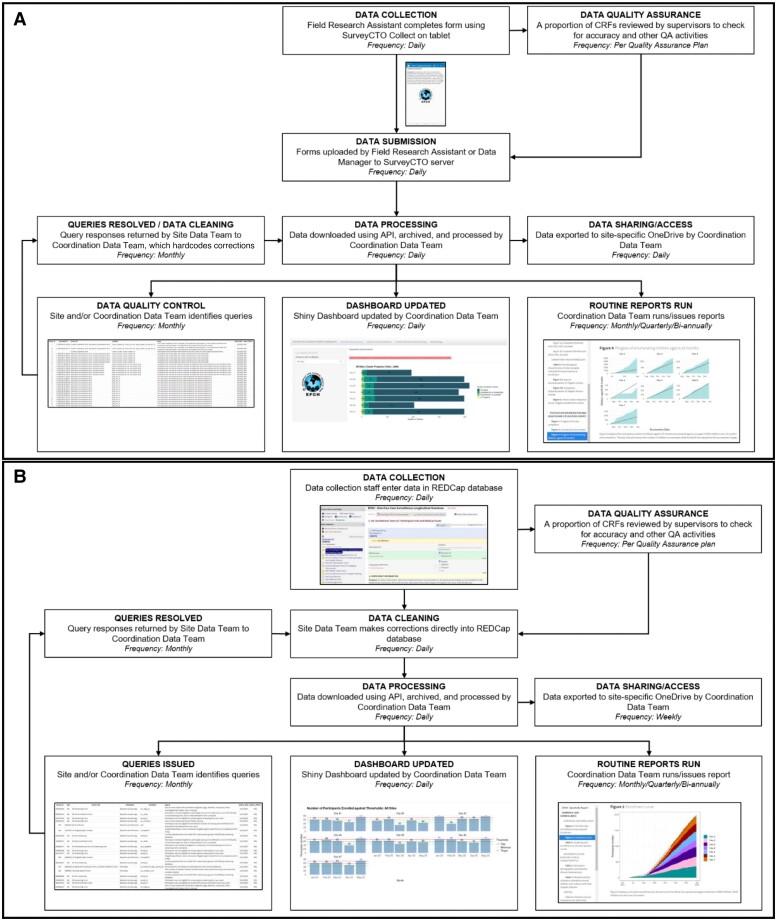
This resulted in the Data Management Plan, which included selecting REDCap and SurveyCTO as the primary database systems. Consequently, we laid out procedures for data processing and storage, study monitoring and reporting, data quality control and assurance activities, and data access. The data management system and associated real-time visualizations allow for rapid data cleaning activities and progress monitoring and will enable quicker time to analysis.
Experiences from this study will contribute toward enriching the sparse landscape of data management methods publications and serve as a case study for future studies seeking to collect and manage data consistently and rigorously while maintaining equitable access to and control of data.
严格的数据管理系统和规划对于成功的研究项目至关重要,特别是对于涉及多个机构合作的大型多国联合研究。在此,我们描述了全球肠道健康(EFGH)监测研究的数据管理系统和程序的开发与实施——这是一项在7个国家开展的腹泻监测研究,将在基于设施的监测同时进行基于人群的人口普查和医疗保健利用调查,以估计6至35个月大儿童与腹泻相关的发病率。
EFGH数据管理的目标是利用联合成员的知识和经验收集高质量数据,并确保在获取和决策方面的公平性。在研究启动前的规划阶段,来自每个EFGH国家站点的代表、协调团队和其他合作伙伴组成的工作组定期开会,为该研究开发数据管理系统。
这产生了数据管理计划,其中包括选择REDCap和SurveyCTO作为主要数据库系统。因此,我们制定了数据处理和存储、研究监测和报告、数据质量控制和保证活动以及数据访问的程序。数据管理系统及相关的实时可视化功能允许进行快速的数据清理活动和进度监测,并将加快分析时间。
本研究的经验将有助于丰富数据管理方法出版物的稀缺领域,并为未来寻求一致且严格地收集和管理数据,同时保持数据公平获取和控制的研究提供案例研究。