Jiang Yuyue
University of California, Santa Barbara, Santa Barbara, CA, United States.
Front Psychiatry. 2024 Mar 12;15:1348474. doi: 10.3389/fpsyt.2024.1348474. eCollection 2024.
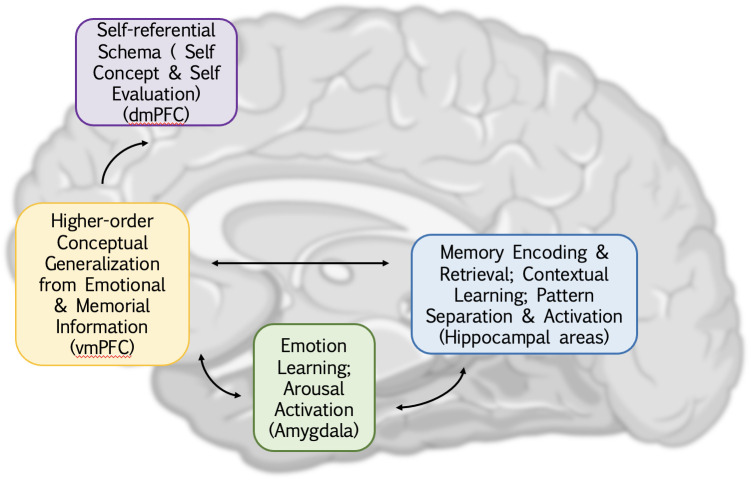
The widely acknowledged cognitive theory of depression, developed by Aaron Beck, focused on biased information processing that emphasizes the negative aspects of affective and conceptual information. Current attempts to discover the neurological mechanism underlying such cognitive and affective bias have successfully identified various brain regions associated with severally biased functions such as emotion, attention, rumination, and inhibition control. However, the neurobiological mechanisms of how individuals in depression develop this selective processing toward negative is still under question. This paper introduces a neurological framework centered around the frontal-limbic circuit, specifically analyzing and synthesizing the activity and functional connectivity within the amygdala, hippocampus, and medial prefrontal cortex. Firstly, a possible explanation of how the positive feedback loop contributes to the persistent hyperactivity of the amygdala in depression at an automatic level is established. Building upon this, two hypotheses are presented: hypothesis 1 revolves around the bidirectional amygdalohippocampal projection facilitating the amplification of negative emotions and memories while concurrently contributing to the impediment of the retrieval of opposing information in the hippocampus attractor network. Hypothesis 2 highlights the involvement of the ventromedial prefrontal cortex in the establishment of a negative cognitive framework through the generalization of conceptual and emotional information in conjunction with the amygdala and hippocampus. The primary objective of this study is to improve and complement existing pathological models of depression, pushing the frontiers of current understanding in neuroscience of affective disorders, and eventually contributing to successful recovery from the debilitating affective disorders.
由亚伦·贝克提出的广为人知的抑郁症认知理论,聚焦于强调情感和概念信息负面方面的有偏差的信息处理。目前,为发现这种认知和情感偏差背后的神经机制所做的尝试,已成功识别出与多种有偏差的功能(如情绪、注意力、反刍和抑制控制)相关的各个脑区。然而,抑郁症患者如何形成这种对负面信息的选择性处理的神经生物学机制仍存在疑问。本文介绍了一个以额叶 - 边缘回路为中心的神经学框架,具体分析和综合了杏仁核、海马体和内侧前额叶皮质内的活动及功能连接。首先,建立了一个关于正反馈回路如何在自动层面导致抑郁症中杏仁核持续过度活跃的可能解释。在此基础上,提出了两个假设:假设1围绕双向杏仁核 - 海马体投射展开,它促进负面情绪和记忆的放大,同时阻碍海马体吸引子网络中相反信息的检索。假设2强调腹内侧前额叶皮质通过与杏仁核和海马体联合对概念和情感信息进行泛化,从而参与负面认知框架的建立。本研究的主要目标是改进和补充现有的抑郁症病理模型,推动当前对情感障碍神经科学理解的前沿,最终有助于从使人衰弱的情感障碍中成功康复。