Department of Tropical Medicine, Federal University of Pernambuco, Recife, Brazil.
Department of Immunology, Aggeu Magalhães Institute, Recife, Brazil.
Front Immunol. 2024 Mar 12;15:1280877. doi: 10.3389/fimmu.2024.1280877. eCollection 2024.
BACKGROUND/INTRODUCTION: Adipose tissue (AT) has been highlighted as a promising reservoir of infection for viruses, bacteria and parasites. Among them is , which causes Chagas disease. The recommended treatment for the disease in Brazil is Benznidazole (BZ). However, its efficacy may vary according to the stage of the disease, geographical origin, age, immune background of the host and sensitivity of the strains to the drug. In this context, AT may act as an ally for the parasite survival and persistence in the host and a barrier for BZ action. Therefore, we investigated the immunomodulation of T. cruzi-infected human AT in the presence of peripheral blood mononuclear cells (PBMC) where BZ treatment was added.
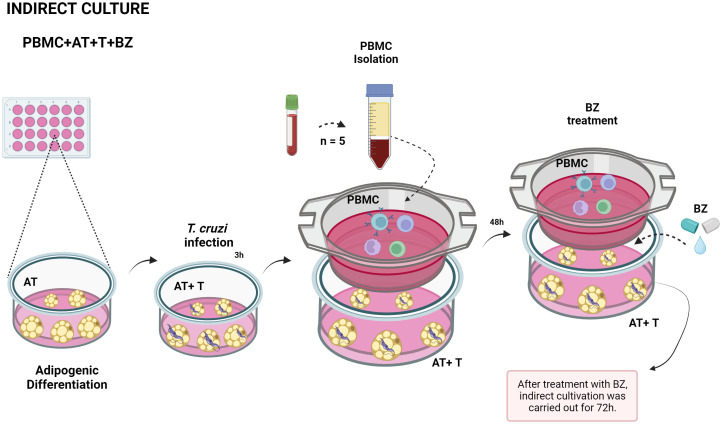
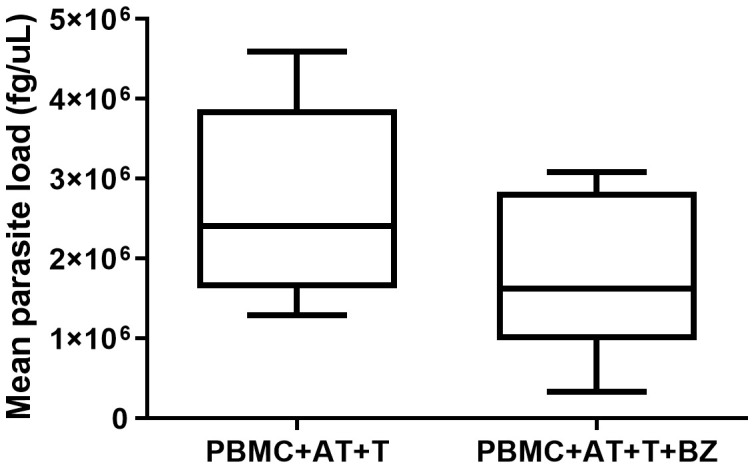
We performed indirect cultivation between T. cruzi-infected adipocytes, PBMC and the addition of BZ. After 72h of treatment, the supernatant was collected for cytokine, chemokine and adipokine assay. Infected adipocytes were removed to quantify T. cruzi DNA, and PBMC were removed for immunophenotyping.
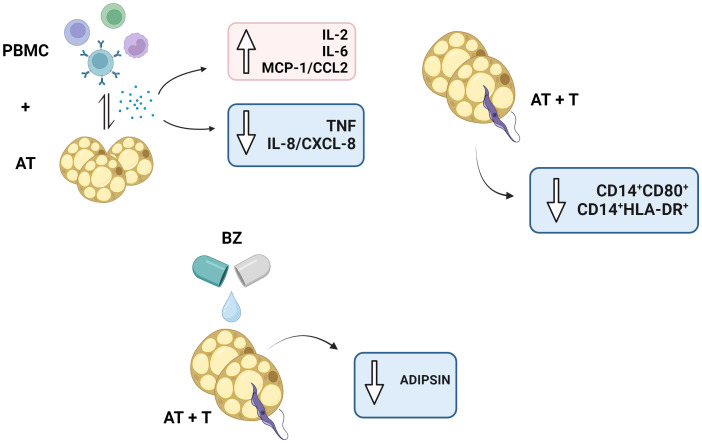
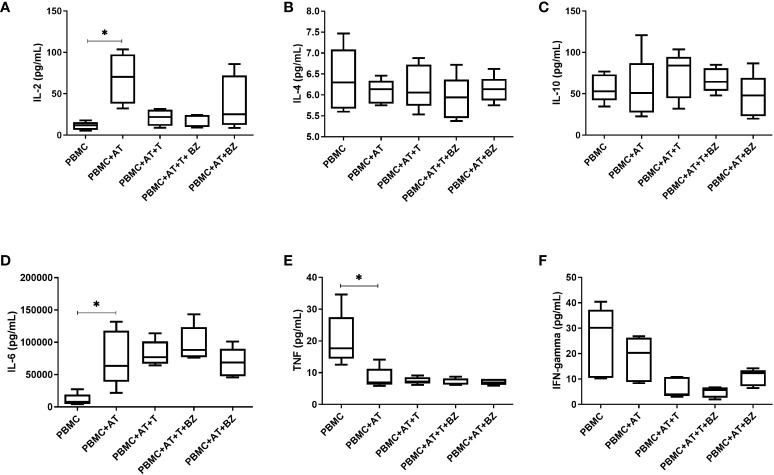
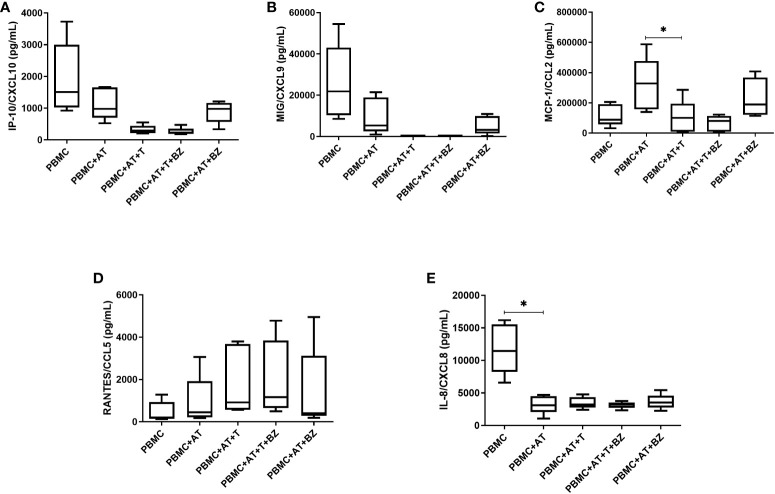
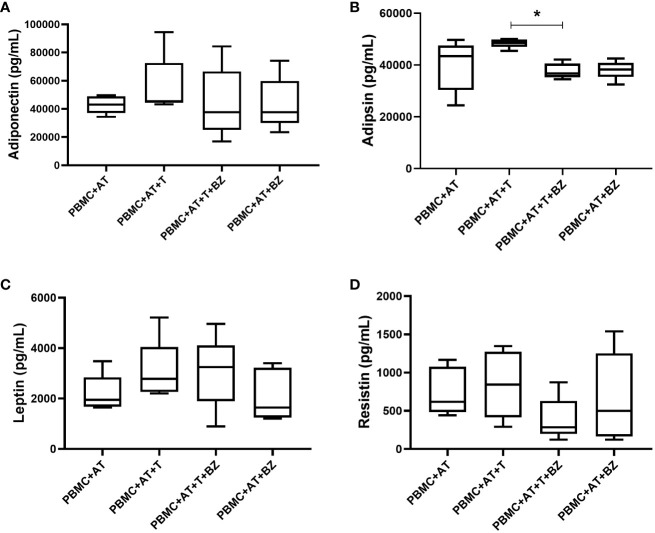
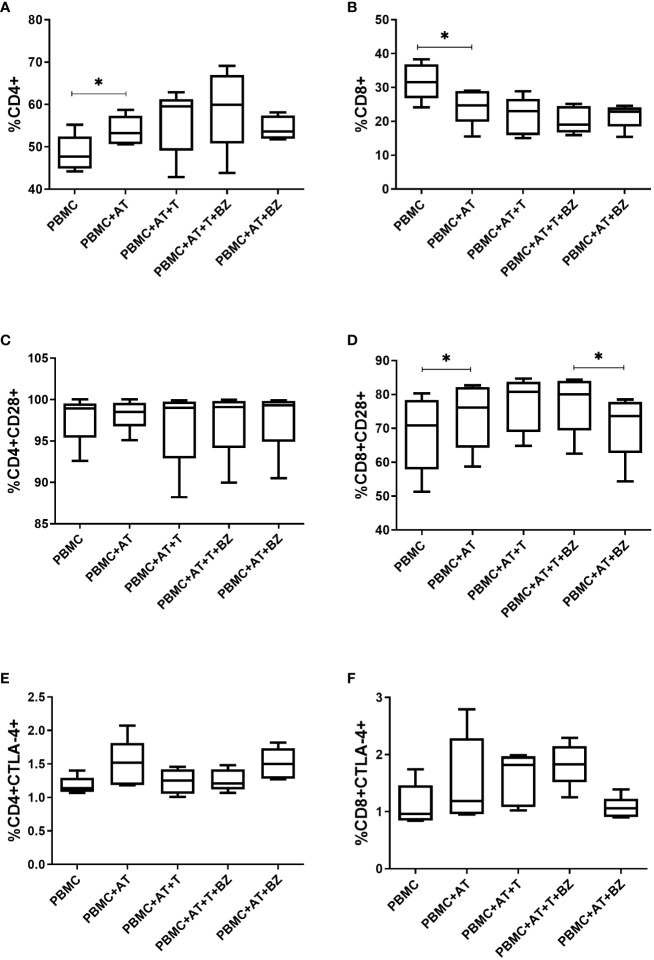
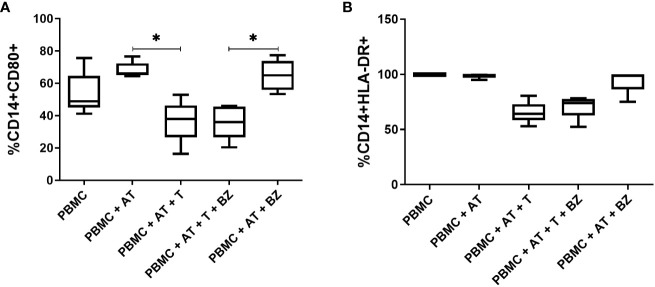
Our findings showed elevated secretion of interleukin (IL)-6, IL-2 and monocyte chemoattractant protein-1 (MCP-1/CCL2) in the AT+PBMC condition compared to the other controls. In contrast, there was a decrease in tumor necrosis factor (TNF) and IL-8/CXCL-8 in the groups with AT. We also found high adipsin secretion in PBMC+AT+T compared to the treated condition (PBMC+AT+T+BZ). Likewise, the expression of CD80+ and HLA-DR+ in CD14+ cells decreased in the presence of T. cruzi.
Thus, our findings indicate that AT promotes up-regulation of inflammatory products such as IL-6, IL-2, and MCP-1/CCL2. However, adipogenic inducers may have triggered the downregulation of TNF and IL-8/CXCL8 through the peroxisome proliferator agonist gamma (PPAR-g) or receptor expression. On the other hand, the administration of BZ only managed to reduce inflammation in the microenvironment by decreasing adipsin in the infected culture conditions. Therefore, given the findings, we can see that AT is an ally of the parasite in evading the host's immune response and the pharmacological action of BZ.
背景/引言:脂肪组织(AT)已被突出为病毒、细菌和寄生虫感染的有希望的储库。其中包括引起恰加斯病的克氏锥虫。巴西对该病的推荐治疗方法是苯硝唑(BZ)。然而,其疗效可能因疾病阶段、地理来源、年龄、宿主的免疫背景和菌株对药物的敏感性而异。在这种情况下,AT 可能是寄生虫在宿主中存活和持续存在的盟友,也是 BZ 作用的障碍。因此,我们研究了在添加 BZ 的情况下,感染的人脂肪组织中的 T. cruzi 对人外周血单核细胞(PBMC)的免疫调节作用。
我们在 T. cruzi 感染的脂肪细胞、PBMC 之间进行间接培养,并添加 BZ。治疗 72 小时后,收集上清液用于细胞因子、趋化因子和脂肪因子测定。去除感染的脂肪细胞以定量 T. cruzi DNA,并去除 PBMC 进行免疫表型分析。
与其他对照组相比,AT+PBMC 条件下白细胞介素(IL)-6、IL-2 和单核细胞趋化蛋白-1(MCP-1/CCL2)的分泌升高。相反,在 AT 组中,肿瘤坏死因子(TNF)和 IL-8/CXCL-8 减少。我们还发现与治疗条件(PBMC+AT+T+BZ)相比,T+AT+PBMC 组中 adipsin 分泌增加。同样,在存在 T. cruzi 的情况下,CD14+细胞中 CD80+和 HLA-DR+的表达减少。
因此,我们的研究结果表明,AT 促进了促炎产物如 IL-6、IL-2 和 MCP-1/CCL2 的上调。然而,脂肪生成诱导剂可能通过过氧化物酶体增殖物激活受体-γ(PPAR-g)或受体表达下调 TNF 和 IL-8/CXCL8。另一方面,BZ 的给药仅通过减少感染培养条件下的 adipsin 来降低炎症,从而在微环境中发挥作用。因此,鉴于这些发现,我们可以看到 AT 是寄生虫逃避宿主免疫反应和 BZ 药理作用的盟友。