Nishizawa Yusaku, Kawamoto Tatsuo, Ikeda Hiroshi
Division of Biomaterials, Department of Oral Functions, Kyushu Dental University, Kitakyushu 803-8580, Japan.
Division of Orofacial Functions and Orthodontics, Department of Health Improvement, Kyushu Dental University, Kitakyushu 803-8580, Japan.
J Funct Biomater. 2024 Mar 14;15(3):71. doi: 10.3390/jfb15030071.
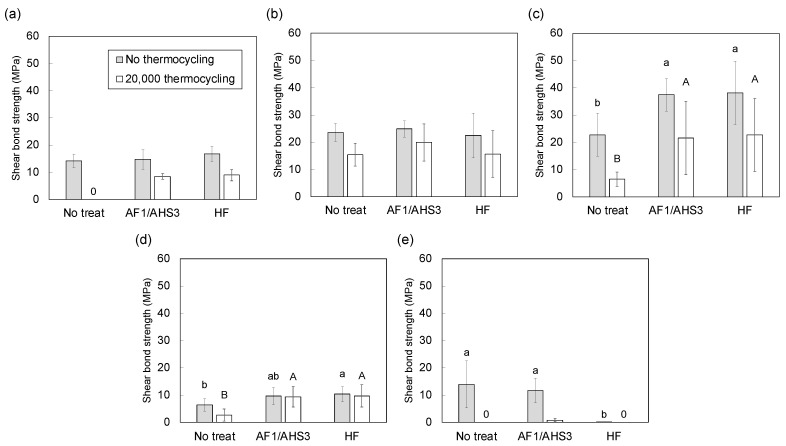
Hydrofluoric acid (HF) is commonly used as an etchant for the pretreatment of dental computer-aided design/computer-aided manufacturing (CAD-CAM) materials, such as glass-ceramics and resin composites. Despite its effectiveness, the harmful and hazardous nature of HF has raised significant safety concerns. In contrast, ammonium fluoride (AF) is known for its relatively low toxicity but has limited etching capability. This study explored the potential of ammonium hydrogen sulfate (AHS), a low-toxicity and weak acid, to enhance the etching ability of aqueous AF solutions for the bonding pretreatment of CAD-CAM materials. This study investigated five types of aesthetic CAD-CAM materials: lithium disilicate glass, feldspathic porcelain, polymer-infiltrated ceramic networks, resin composites, and zirconia. Seven experimental etchants were prepared by varying the amount of AHS added to aqueous AF solutions, with each etchant used to etch the surfaces of the respective CAD-CAM materials. The treated surfaces were analyzed using scanning electron microscopy and confocal laser scanning microscopy. Additionally, the shear bond strength (SBS) of the CAD-CAM materials treated with a luting agent (resin cement) was evaluated. The results indicated that the AF1/AHS3 (weight ratio AF:AHS = 1:3) etchant had the most substantial etching effect on the surfaces of silica-containing materials (lithium disilicate glass, feldspathic porcelain, polymer-infiltrated ceramic networks, and resin composites) but not on zirconia. The SBS of the materials treated with the AF1/AHS3 etchant was comparable to that of the commercial HF etchant. Hence, an AF/AHS mixed solution could effectively etch silica-containing CAD-CAM materials, thereby enhancing their bonding capabilities.
氢氟酸(HF)通常用作牙科计算机辅助设计/计算机辅助制造(CAD-CAM)材料(如玻璃陶瓷和树脂复合材料)预处理的蚀刻剂。尽管其效果显著,但HF的有害和危险性质引发了重大安全担忧。相比之下,氟化铵(AF)以其相对较低的毒性而闻名,但蚀刻能力有限。本研究探索了低毒性弱酸硫酸氢铵(AHS)增强AF水溶液对CAD-CAM材料粘结预处理蚀刻能力的潜力。本研究调查了五种美学CAD-CAM材料:二硅酸锂玻璃、长石质瓷、聚合物渗透陶瓷网络、树脂复合材料和氧化锆。通过改变添加到AF水溶液中的AHS量制备了七种实验蚀刻剂,每种蚀刻剂用于蚀刻相应CAD-CAM材料的表面。使用扫描电子显微镜和共聚焦激光扫描显微镜对处理过的表面进行分析。此外,还评估了用粘结剂(树脂水门汀)处理的CAD-CAM材料的剪切粘结强度(SBS)。结果表明,AF1/AHS3(AF与AHS的重量比=1:3)蚀刻剂对含硅材料(二硅酸锂玻璃、长石质瓷、聚合物渗透陶瓷网络和树脂复合材料)的表面具有最显著的蚀刻效果,但对氧化锆没有蚀刻效果。用AF1/AHS3蚀刻剂处理的材料的SBS与市售HF蚀刻剂相当。因此,AF/AHS混合溶液可以有效地蚀刻含硅的CAD-CAM材料,从而提高它们的粘结能力。