Yamamoto Yasushi, Ito Daiki, Akatsuka Honoka, Noguchi Hiroki, Matsushita Arisa, Kinekawa Hyuga, Nagano Hirotaka, Yoshino Akihiro, Taga Keijiro, Shervani Zameer, Yamamoto Masato
Department of Life Science and Applied Chemistry, Graduate School of Engineering, Nagoya Institute of Technology, Nagoya 466-8555, Japan.
Food & Energy Security Research & Product Centre, Sendai 980-0871, Japan.
Membranes (Basel). 2024 Feb 27;14(3):62. doi: 10.3390/membranes14030062.
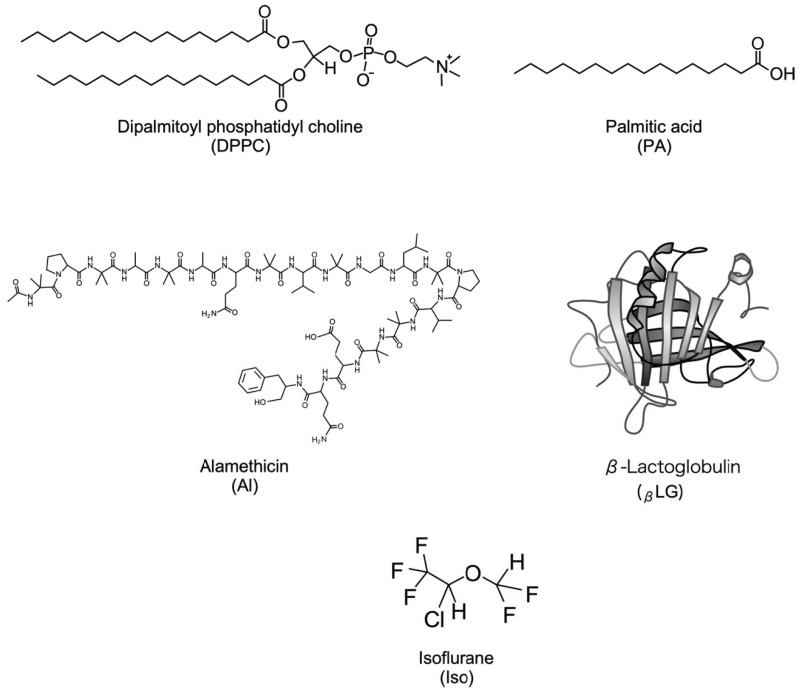
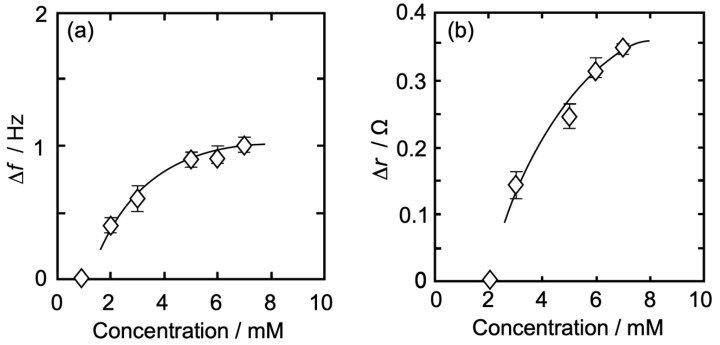
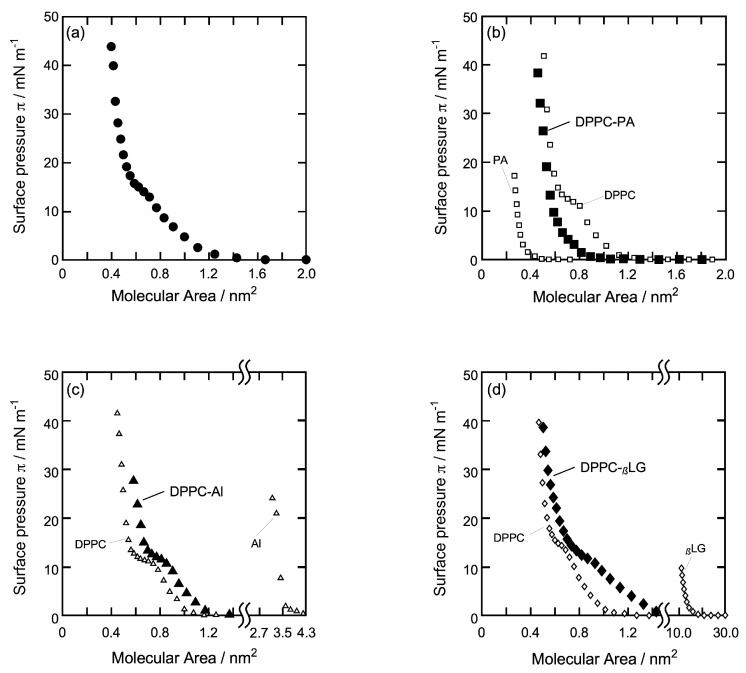
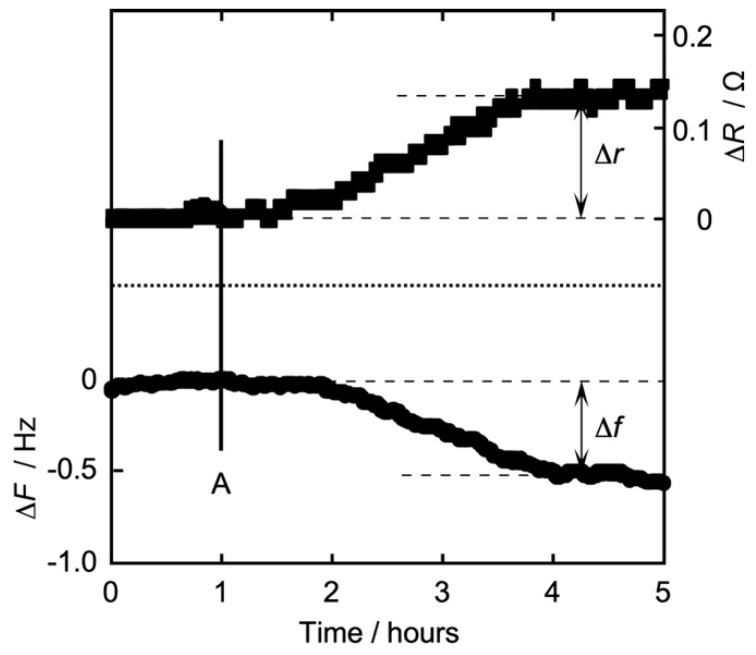
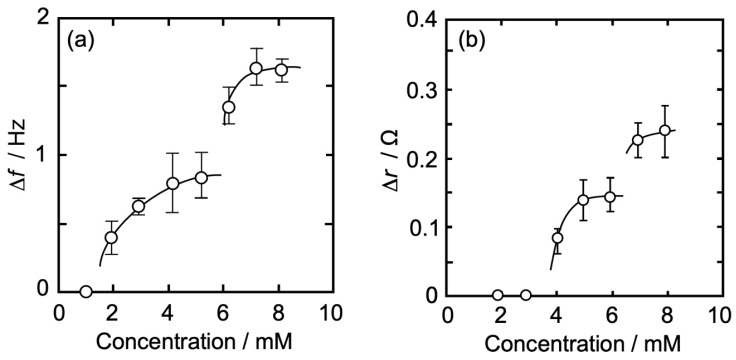
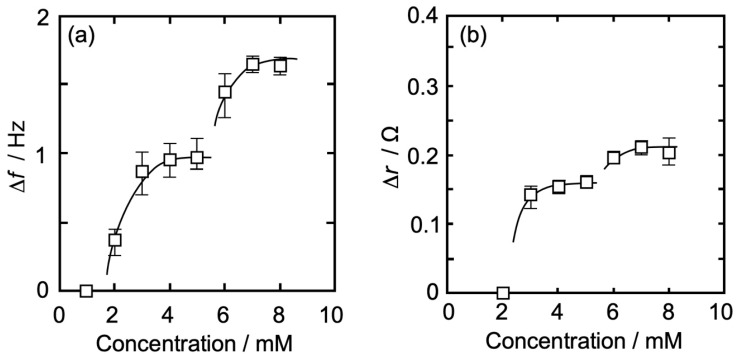
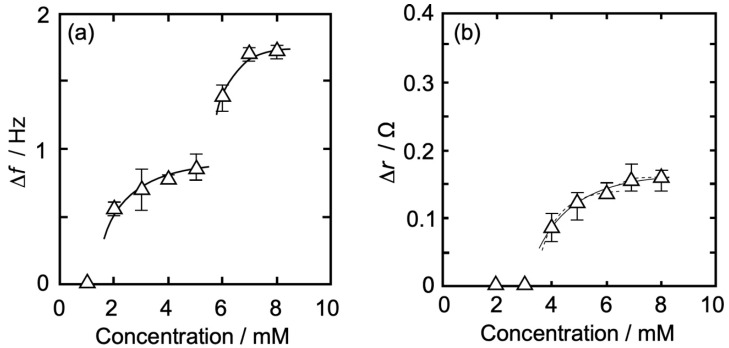
The interaction between anesthetic Isoflurane (Iso) and model-biomembrane on the water surface has been investigated using quartz crystal microbalance (QCM) and quartz crystal impedance (QCI) methods. The model-biomembranes used were dipalmitoyl phosphatidyl choline (DPPC), DPPC-palmitic acid (PA) mixture (DPPC:PA = 8:2), DPPC-Alamethicin (Al) mixture (DPPC:Al = 39:1), and DPPC--Lactoglobulin (LG) mixture (DPPC:LG = 139:1) monolayers, respectively. The quartz crystal oscillator (QCO) was attached horizontally to each monolayer, and QCM and QCI measurements were performed simultaneously. It was found that Iso hydrate physisorbed on each monolayer/water interface from QCM and changed those interfacial viscosities from QCI. With an increase in Iso concentration, pure DPPC, DPPC-PA mixed, and DPPC-Al mixed monolayers showed a two-step process of Iso hydrate on both physisorption and viscosity, whereas it was a one-step for the DPPC-LG mixed monolayer. The viscosity change in the DPPC-LG mixed monolayer with the physisorption of Iso hydrate was much larger than that of other monolayers, in spite of the one-step process. From these results, the action mechanism of anesthetics and their relevance to the expression of anesthesia were discussed, based on the "release of interfacial hydrated water" hypothesis on the membrane/water interface.
使用石英晶体微天平(QCM)和石英晶体阻抗(QCI)方法研究了麻醉剂异氟烷(Iso)与水面上的模型生物膜之间的相互作用。所使用的模型生物膜分别是二棕榈酰磷脂酰胆碱(DPPC)、DPPC-棕榈酸(PA)混合物(DPPC:PA = 8:2)、DPPC-阿拉霉素(Al)混合物(DPPC:Al = 39:1)和DPPC-乳球蛋白(LG)混合物(DPPC:LG = 139:1)单层膜。将石英晶体振荡器(QCO)水平附着在每个单层膜上,并同时进行QCM和QCI测量。结果发现,通过QCM可知异氟烷水合物在每个单层膜/水界面上发生物理吸附,并通过QCI改变了这些界面粘度。随着异氟烷浓度的增加,纯DPPC、DPPC-PA混合和DPPC-Al混合单层膜在物理吸附和粘度方面均显示出异氟烷水合物的两步过程,而DPPC-LG混合单层膜则为一步过程。尽管是一步过程,但DPPC-LG混合单层膜中异氟烷水合物物理吸附引起的粘度变化远大于其他单层膜。基于膜/水界面上的“界面结合水释放”假说,讨论了麻醉剂的作用机制及其与麻醉表现的相关性。