Department of Animal Science, Biotechnical Faculty, University of Ljubljana, Jamnikarjeva 101, 1000 Ljubljana, Slovenia.
Genes (Basel). 2024 Mar 10;15(3):349. doi: 10.3390/genes15030349.
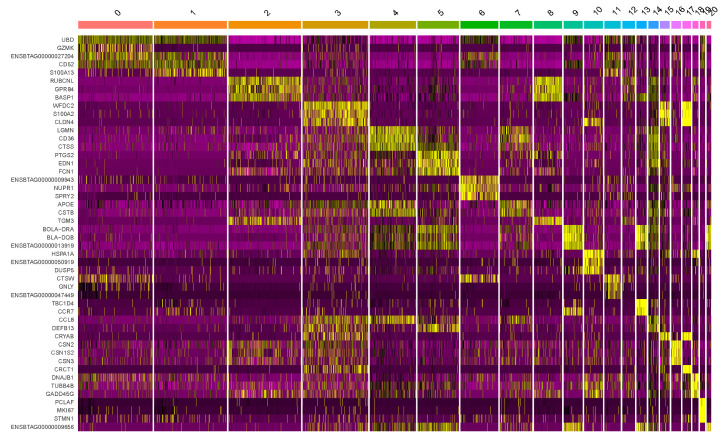
The production of milk by dairy cows far exceeds the nutritional needs of the calf and is vital for the economical use of dairy cattle. High milk yield is a unique production trait that can be effectively enhanced through traditional selection methods. The process of lactation in cows serves as an excellent model for studying the biological aspects of lactation with the aim of exploring the mechanistic base of this complex trait at the cellular level. In this study, we analyzed the milk transcriptome at the single-cell level by conducting scRNA-seq analysis on milk samples from two Holstein Friesian cows at mid-lactation (75 and 93 days) using the 10× Chromium platform. Cells were pelleted and fat was removed from milk by centrifugation. The cell suspension from each cow was loaded on separate channels, resulting in the recovery of 9313 and 14,544 cells. Library samples were loaded onto two lanes of the NovaSeq 6000 (Illumina) instrument. After filtering at the cell and gene levels, a total of 7988 and 13,973 cells remained, respectively. We were able to reconstruct different cell types (milk-producing cells, progenitor cells, macrophages, monocytes, dendritic cells, T cells, B cells, mast cells, and neutrophils) in bovine milk. Our findings provide a valuable resource for identifying regulatory elements associated with various functions of the mammary gland such as lactation, tissue renewal, native immunity, protein and fat synthesis, and hormonal response.
奶牛生产的牛奶远远超过小牛的营养需求,这对于奶牛的经济利用至关重要。高牛奶产量是一种独特的生产特性,可以通过传统的选择方法有效地增强。奶牛的泌乳过程是研究泌乳生物学方面的极好模型,旨在从细胞水平探索这种复杂特性的机制基础。在这项研究中,我们使用 10×Chromium 平台对处于泌乳中期(75 天和 93 天)的两头荷斯坦弗里生奶牛的牛奶样本进行 scRNA-seq 分析,在单细胞水平上分析了牛奶转录组。通过离心将细胞沉淀并从牛奶中去除脂肪。将每个奶牛的细胞悬浮液加载到单独的通道中,分别回收了 9313 和 14544 个细胞。文库样本加载到 NovaSeq 6000(Illumina)仪器的两条通道上。在细胞和基因水平进行过滤后,分别留下了 7988 和 13973 个细胞。我们能够在牛牛奶中重建不同的细胞类型(产奶细胞、祖细胞、巨噬细胞、单核细胞、树突状细胞、T 细胞、B 细胞、肥大细胞和嗜中性粒细胞)。我们的发现为鉴定与乳腺各种功能(如泌乳、组织更新、天然免疫、蛋白质和脂肪合成以及激素反应)相关的调节元件提供了有价值的资源。