Doménech Pablo, Tur-Porcar Ana M, Mestre-Escrivá Vicenta
Faculty of Education, Valencian International University (VIU), Pintor Sorolla, 21, 46002 Valencia, Spain.
Faculty of Psychology, University of Valencia, Avda. Blasco Ibáñez, 21, 46010 Valencia, Spain.
Behav Sci (Basel). 2024 Mar 4;14(3):206. doi: 10.3390/bs14030206.
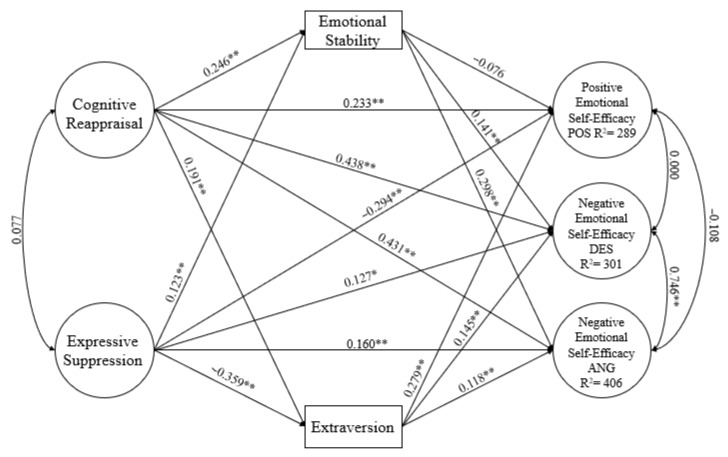
The feeling of emotional self-efficacy helps people understand how to handle positive and negative emotions. Emotion regulation is the process that helps people control their emotions so that they can adapt to the demands of the environment. This study has a twofold aim. First, it examines the relationships among emotion regulation, the personality traits of extraversion and emotional stability, and the feeling of emotional self-efficacy for positive and negative emotions in an adolescent population. Second, it examines the mediating role of personality traits (extraversion and emotional stability) in the relationship between emotion regulation and emotional self-efficacy for positive and negative emotions. The participants were 703 adolescents (49.9% male and 50.1% female) aged between 15 and 18 years ( = 15.86, = 0.30). Significant relationships were observed among emotion regulation, the personality traits of extraversion and emotional stability, and emotional self-efficacy for positive and negative emotions. The structural equation model confirmed the direct link between emotion regulation and emotional self-efficacy and mediation by the personality traits of extraversion and emotional stability. This study confirms that emotional self-efficacy is connected to the emotion regulation strategies that adolescents use. Effective emotion regulation encourages self-perception and emotional coping. The results are discussed in connection to previous research.
情绪自我效能感有助于人们理解如何处理积极和消极情绪。情绪调节是一个帮助人们控制情绪以便能够适应环境需求的过程。本研究有两个目标。第一,考察青少年群体中情绪调节、外向性和情绪稳定性的人格特质以及积极和消极情绪的情绪自我效能感之间的关系。第二,考察人格特质(外向性和情绪稳定性)在情绪调节与积极和消极情绪的情绪自我效能感之间关系中的中介作用。参与者为703名年龄在15至18岁之间的青少年(男性占49.9%,女性占50.1%)(平均年龄 = 15.86,标准差 = 0.30)。在情绪调节、外向性和情绪稳定性的人格特质以及积极和消极情绪的情绪自我效能感之间观察到了显著关系。结构方程模型证实了情绪调节与情绪自我效能感之间的直接联系以及外向性和情绪稳定性人格特质的中介作用。本研究证实情绪自我效能感与青少年使用的情绪调节策略相关。有效的情绪调节鼓励自我认知和情绪应对。研究结果结合先前的研究进行了讨论。