Palmeri Marisa, Bono Kristy, Huang Austin, Gunther Jillian R, Mattes Malcolm D
Rutgers New Jersey Medical School, Newark, New Jersey.
Baylor College of Medicine, Houston, Texas.
Adv Radiat Oncol. 2024 Feb 6;9(5):101460. doi: 10.1016/j.adro.2024.101460. eCollection 2024 May.
Medical student access to radiation oncology (RO) research opportunities is important for stimulating interest in the specialty. The purpose of this study was to assess the publication record during medical school of students who ultimately matched in RO, to characterize the source(s) of their RO mentorship relative to other specialties.
We performed web-based searches to identify manuscripts published during medical school (defined as being published from January 2016 to December 2019) for all RO residents with postgraduate year 2 status in 2020 to 2021. Students with a PhD degree and international graduates were excluded. Characteristics of these publications, the student, and the primary mentor, were assessed.
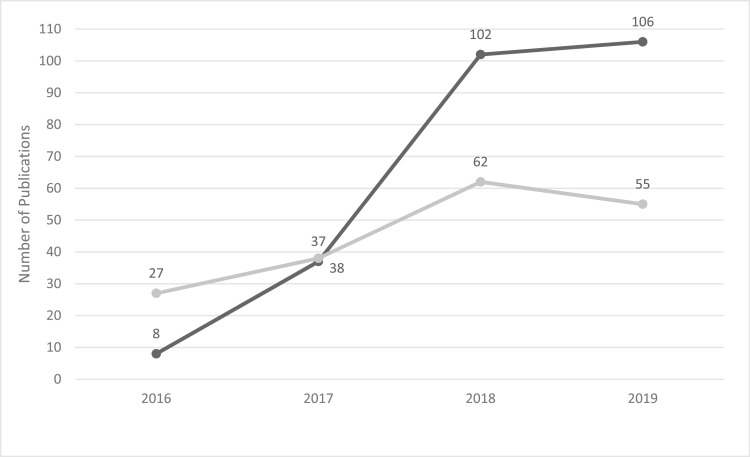
A total of 435 publications were authored by the 148 included residents. In total, 115 (78%) attended a medical school with an affiliated RO residency program. The median number of publications per student was 2 (interquartile range, 1-4), and students' median byline author position was 2 (interquartile range, 1-4). In total, 351 publications (80.7%) were on a cancer-related topic, with 234 (53.8%) published in oncology-oriented journal, and 96 (22.0%) published in RO-oriented journals. There were 294 unique mentors, with 70 mentors (24%) on 2 or more student publications. Most mentors (n = 187, 64%) shared the same institution as the student. Mentors were most commonly radiation oncologists/radiation biologists/medical physicists (n = 153, 52.6%), surgical subspecialists (n = 53, 21%), and medical oncologists (n = 18, 6.2%). Students working with primary RO mentors were more likely to publish in an oncology-oriented journal (79.1% vs 18.2%, < .01) or RO-oriented journal (36.2% vs 2.2%, < .01), compared with students working with non-RO mentors, respectively. A higher percentage of publications with RO mentors occurred in the last 2 years of medical school compared with the first 2 years (64.0% vs 40.9%, respectively, < .01).
Approximately one-half of student publications among future RO residents are published in nononcology journals, and result from mentoring relationships with non-RO physicians.
医学生获得放射肿瘤学(RO)研究机会对于激发他们对该专业的兴趣很重要。本研究的目的是评估最终匹配到RO专业的学生在医学院期间的发表记录,以描述他们相对于其他专业的RO导师来源。
我们进行了基于网络的搜索,以确定2020年至2021年处于研究生二年级的所有RO住院医师在医学院期间(定义为2016年1月至2019年12月发表)发表的手稿。排除拥有博士学位的学生和国际毕业生。评估这些出版物、学生和主要导师的特征。
148名纳入的住院医师共撰写了435篇出版物。总共有115名(78%)学生就读于设有附属RO住院医师培训项目的医学院。每名学生的出版物中位数为2篇(四分位间距,1 - 4),学生的署名作者位置中位数为第2位(四分位间距,1 - 4)。总共有351篇出版物(80.7%)是关于癌症相关主题的,其中234篇(53.8%)发表在肿瘤学导向的期刊上,96篇(22.0%)发表在RO导向的期刊上。有294名不同的导师,其中70名导师(24%)指导了2篇或更多学生的出版物。大多数导师(n = 187,64%)与学生在同一机构。导师最常见的是放射肿瘤学家/放射生物学家/医学物理学家(n = 153,52.6%)、外科亚专科医生(n = 53,21%)和医学肿瘤学家(n = 18,6.2%)。与非RO导师指导的学生相比,由RO主要导师指导的学生更有可能在肿瘤学导向的期刊上发表文章(79.1%对18.2%,P <.01)或在RO导向的期刊上发表文章(36.2%对2.2%,P <.01)。与医学院前两年相比,由RO导师指导的出版物在医学院最后两年的比例更高(分别为64.0%对40.9%,P <.01)。
未来RO住院医师中约一半的学生出版物发表在非肿瘤学期刊上,且是与非RO医生的指导关系的成果。