Cardiovascular Research Center, New York University Grossman School of Medicine, New York, NY 10016.
Department of Anesthesiology and Intensive Care, School of Medicine and Health, Technical University of Munich, Munich 81675, Germany.
Proc Natl Acad Sci U S A. 2024 Apr 9;121(15):e2400675121. doi: 10.1073/pnas.2400675121. Epub 2024 Apr 2.
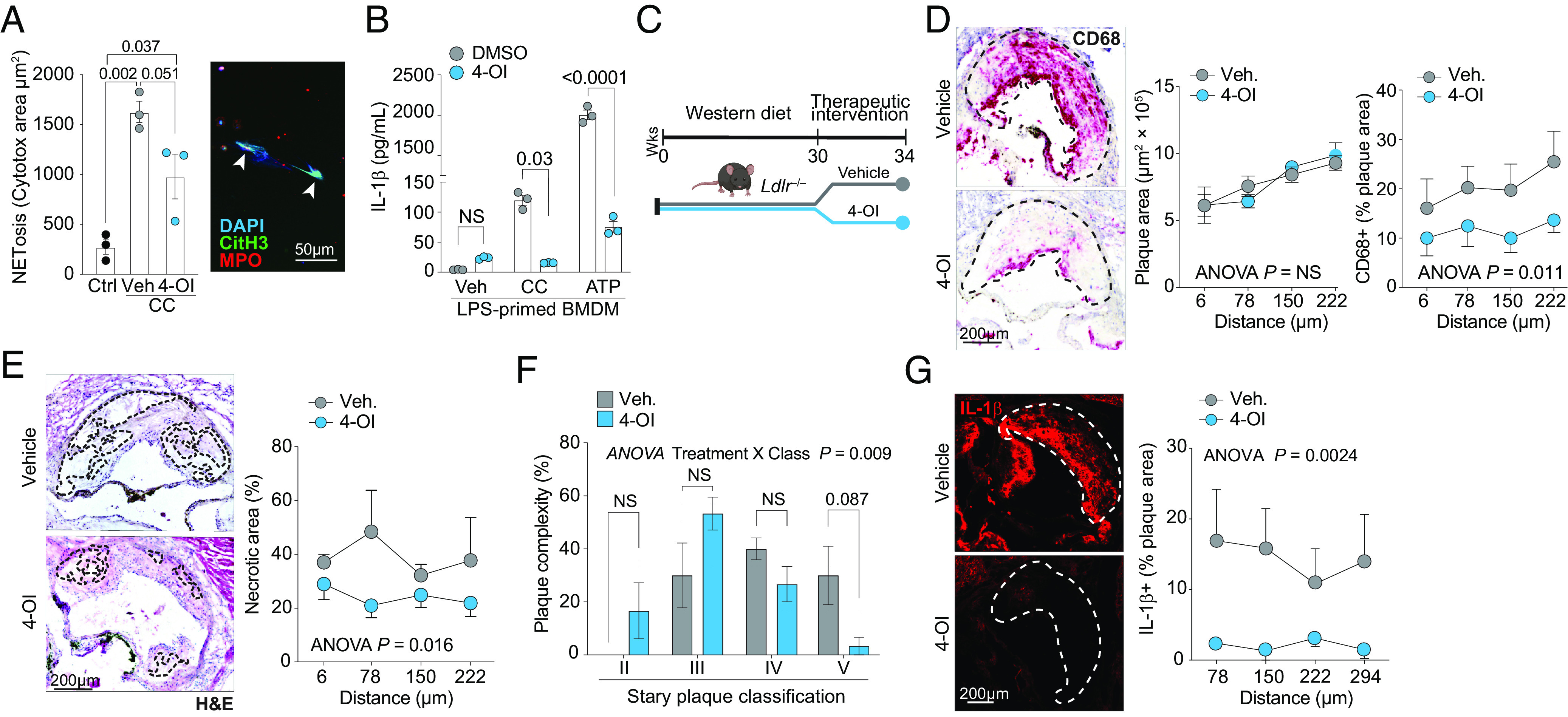
Atherosclerosis is fueled by a failure to resolve lipid-driven inflammation within the vasculature that drives plaque formation. Therapeutic approaches to reverse atherosclerotic inflammation are needed to address the rising global burden of cardiovascular disease (CVD). Recently, metabolites have gained attention for their immunomodulatory properties, including itaconate, which is generated from the tricarboxylic acid-intermediate cis-aconitate by the enzyme Immune Responsive Gene 1 (IRG1/ACOD1). Here, we tested the therapeutic potential of the IRG1-itaconate axis for human atherosclerosis. Using single-cell RNA sequencing (scRNA-seq), we found that is up-regulated in human coronary atherosclerotic lesions compared to patient-matched healthy vasculature, and in mouse models of atherosclerosis, where it is primarily expressed by plaque monocytes, macrophages, and neutrophils. Global or hematopoietic -deficiency in mice increases atherosclerosis burden, plaque macrophage and lipid content, and expression of the proatherosclerotic cytokine interleukin (IL)-1β. Mechanistically, absence of increased macrophage lipid accumulation, and accelerated inflammation via increased neutrophil extracellular trap (NET) formation and NET-priming of the NLRP3-inflammasome in macrophages, resulting in increased IL-1β release. Conversely, supplementation of the -itaconate axis using 4-octyl itaconate (4-OI) beneficially remodeled advanced plaques and reduced lesional IL-1β levels in mice. To investigate the effects of 4-OI in humans, we leveraged an ex vivo systems-immunology approach for CVD drug discovery. Using CyTOF and scRNA-seq of peripheral blood mononuclear cells treated with plasma from CVD patients, we showed that 4-OI attenuates proinflammatory phospho-signaling and mediates anti-inflammatory rewiring of macrophage populations. Our data highlight the relevance of pursuing IRG1-itaconate axis supplementation as a therapeutic approach for atherosclerosis in humans.
动脉粥样硬化是由于血管内脂质驱动的炎症反应未能得到解决,导致斑块形成。为了应对心血管疾病(CVD)不断增加的全球负担,需要采取治疗方法来逆转动脉粥样硬化炎症。最近,代谢物因其免疫调节特性而受到关注,包括衣康酸,它是由酶免疫反应基因 1(IRG1/ACOD1)从三羧酸中间体顺式衣康酸生成的。在这里,我们测试了 IRG1-衣康酸轴对人类动脉粥样硬化的治疗潜力。使用单细胞 RNA 测序(scRNA-seq),我们发现与患者匹配的健康血管相比,在人类冠状动脉粥样硬化病变中上调,在动脉粥样硬化小鼠模型中,主要由斑块单核细胞、巨噬细胞和中性粒细胞表达。在小鼠中,全局或造血-缺乏会增加动脉粥样硬化负担、斑块巨噬细胞和脂质含量以及前动脉粥样硬化细胞因子白细胞介素(IL)-1β的表达。在机制上,缺乏会增加巨噬细胞脂质积累,并通过增加中性粒细胞胞外陷阱(NET)形成和 NET 对巨噬细胞中 NLRP3 炎性体的预刺激来加速炎症,从而增加 IL-1β释放。相反,使用 4-辛基衣康酸(4-OI)补充 -衣康酸轴对小鼠有益地重塑了晚期斑块并降低了病变中的 IL-1β水平。为了研究 4-OI 在人类中的作用,我们利用了 CVD 药物发现的体外系统免疫学方法。使用 CyTOF 和用来自 CVD 患者的血浆处理的外周血单核细胞的 scRNA-seq,我们表明 4-OI 可减弱促炎磷酸化信号并介导巨噬细胞群的抗炎重编程。我们的数据强调了追求 IRG1-衣康酸轴补充作为人类动脉粥样硬化治疗方法的相关性。