Instituto de Microbiología, Colegio de Ciencias Biológicas y Ambientales, Universidad San Francisco de Quito, Quito, Ecuador.
Escuela de Medicina Veterinaria, Colegio de Ciencias de la Salud, Universidad San Francisco de Quito USFQ, Quito, Ecuador.
PLoS Negl Trop Dis. 2024 Apr 3;18(4):e0011671. doi: 10.1371/journal.pntd.0011671. eCollection 2024 Apr.
Leptospirosis is the world's most common zoonotic disease. Mitigation and control rely on pathogen identification and understanding the roles of potential reservoirs in cycling and transmission. Underreporting and misdiagnosis obscure the magnitude of the problem and confound efforts to understand key epidemiological components. Difficulties in culturing hamper the use of serological diagnostics and delay the development of DNA detection methods. As a result, especially in complex ecosystems, we know very little about the importance of different mammalian host species in cycling and transmission to humans.
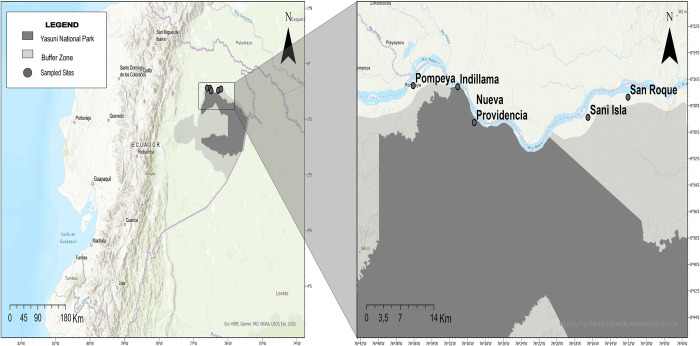
METHODOLOGY/PRINCIPAL FINDINGS: We sampled dogs from five indigenous Kichwa communities living in the Yasuní National Park in the Ecuadorian Amazon basin. Blood and urine samples from domestic dogs were collected to assess the exposure of these animals to Leptospira and to identify the circulating species. Microscopic Agglutination Tests with a panel of 22 different serovars showed anti-leptospira antibodies in 36 sampled dogs (75%), and 7 serogroups were detected. Two DNA-based detection assays revealed pathogenic Leptospira DNA in 18 of 19 dog urine samples (94.7%). Amplicon sequencing and phylogenetic analysis of 16S rRNA and SecY genes from 15 urine samples revealed genetic diversity within two of three different Leptospira species: noguchii (n = 7), santarosai (n = 7), and interrogans (n = 1).
CONCLUSIONS/SIGNIFICANCE: The high prevalence of antibodies and Leptospira DNA provides strong evidence for high rates of past and current infections. Such high prevalence has not been previously reported for dogs. These dogs live in the peridomestic environment in close contact with humans, yet they are free-ranging animals that interact with wildlife. This complex web of interactions may explain the diverse types of pathogenic Leptospira observed in this study. Our results suggest that domestic dogs are likely to play an important role in the cycling and transmission of Leptospira. Future studies in areas with complex ecoepidemiology will enable better parsing of the significance of genotypic, environmental, and host characteristics.
钩端螺旋体病是世界上最常见的人畜共患疾病。减轻和控制依赖于病原体的鉴定和了解潜在宿主在循环和传播中的作用。漏报和误诊掩盖了问题的严重程度,并阻碍了对关键流行病学因素的理解。由于难以培养,血清学诊断受到限制,DNA 检测方法的发展也受到延迟。因此,特别是在复杂的生态系统中,我们对不同哺乳动物宿主在循环和传播给人类方面的重要性知之甚少。
方法/主要发现:我们从生活在厄瓜多尔亚马逊盆地亚苏尼国家公园的五个土着基奇瓦社区中抽取了狗的样本。从家养狗身上采集血液和尿液样本,以评估这些动物对钩端螺旋体的暴露情况,并确定循环的物种。用一组 22 种不同血清型的显微镜凝集试验显示,36 只采样狗中有 36 只(75%)有抗钩端螺旋体抗体,检测到 7 个血清群。两种基于 DNA 的检测方法在 19 只狗尿液样本中的 18 只(94.7%)中发现了致病性钩端螺旋体 DNA。从 15 份尿液样本的 16S rRNA 和 SecY 基因的扩增子测序和系统发育分析显示,在两种不同的钩端螺旋体物种内存在遗传多样性:nogucii(n = 7)、santarosai(n = 7)和 interrogans(n = 1)。
结论/意义:高抗体和钩端螺旋体 DNA 阳性率为过去和现在感染的高发病率提供了有力证据。以前没有报告过狗的这种高发病率。这些狗生活在与人类密切接触的家庭环境中,但它们是自由放养的动物,与野生动物互动。这种复杂的相互作用网络可能解释了本研究中观察到的多种致病性钩端螺旋体。我们的研究结果表明,家养狗可能在钩端螺旋体的循环和传播中发挥重要作用。在具有复杂生态流行病学的地区进行未来研究,将能够更好地解析基因型、环境和宿主特征的意义。