Benitez Aline do Nascimento, Monica Thais Cabral, Miura Ana Carolina, Romanelli Micheline Sahyun, Giordano Lucienne Garcia Pretto, Freire Roberta Lemos, Mitsuka-Breganó Regina, Martins Camila Marinelli, Biondo Alexander Welker, Serrano Isabela Machado, Lopes Thiago Henrique Carneiro Rios, Reis Renato Barbosa, Gomes Jancarlo Ferreira, Costa Federico, Wunder Elsio, Ko Albert Icksang, Navarro Italmar Teodorico
School of Medical Sciences and Institute of Computing, University of Campinas, Campinas, Brazil.
Laboratory of Zoonoses and Public Health, Londrina State University, Londrina, Brazil.
Front Vet Sci. 2021 Jan 8;7:580400. doi: 10.3389/fvets.2020.580400. eCollection 2020.
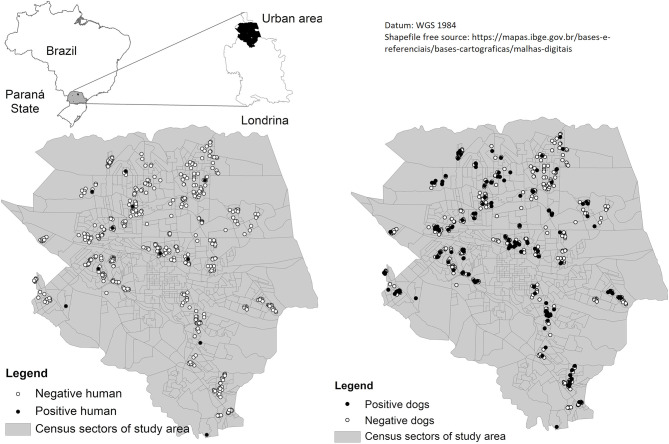
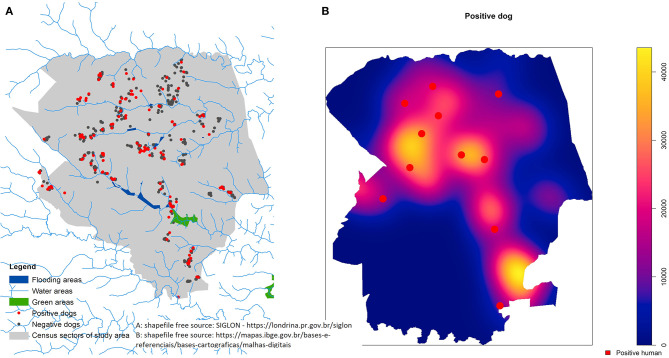
Although leptospirosis has been considered a major concern in urban areas, no study to date has spatially and simultaneously compared both owner and dog serology in households of major cities. Accordingly, the aim of the present study was to assess the seroprevalence of antibodies, evaluate associated risk factors and conduct spatial analyses in 565 randomly selected households, which included 597 dog owners and 729 dogs in Londrina, Southern Brazil. Seropositivity by MAT were detected in in 11/597 (1.84%) owners and in 155/729 (21.26%) dogs. The risk factors were evaluated with logistic regression analysis and spatial factors and case distribution were evaluated with kernel density analyses. The sera of 14/155 (9.03%) dogs reacted for more than one serovar with the same titer. Canicola was the most frequent serogroup, detected in 3/11 (27.27%) owners and 76/155 (49.03%) dogs. The highest titer among the owners was 1:3,200 and was detected in the same household with a titer of 1:800 in the dog. Simultaneous owner-dog seropositivity was found in 7/565 (1.23%) households, with three reacted against serogroup Canicola. Positive owners were detected in 4/565 (0.70%) households and positive dogs were detected in 141/565 (24.95%) households. The associated risks of infection for dogs were different from those associated with infection in owners. Risk analyses for Canicola also identified specific factors of infection. Regardless of owner and dog cases were not statistically clustered, the kernel map has shown dog positivity occurrence in the same hot locations and near positive owners. The dependent variable analysis and logit model suggested a greater likelihood of peri-domiciliary contact with . In conclusion, exposure to infection was significantly higher in dogs than in their owners and human cases spatially overlapped dog cases, implicating dogs as potential environmental sentinels for this disease. In addition, the associated risk may vary according to serogroup, and the observed simultaneous Canicola seropositivity of owner and dog has suggested intradomicile-transmitted infection.
尽管钩端螺旋体病一直被认为是城市地区的一个主要问题,但迄今为止,尚无研究在大城市家庭中对主人和犬类血清学进行空间和同步比较。因此,本研究的目的是评估565个随机选择的家庭中抗体的血清阳性率,评估相关风险因素,并进行空间分析,这些家庭包括巴西南部隆德里纳的597名犬主和729只犬。在597名主人中有11名(1.84%)、729只犬中有155只(21.26%)通过显微凝集试验检测到血清阳性。通过逻辑回归分析评估风险因素,通过核密度分析评估空间因素和病例分布。155只犬中的14只(9.03%)血清与多个血清型反应,且效价相同。犬型是最常见的血清群,在11名主人中的3名(27.27%)以及155只犬中的76只(49.03%)中检测到。主人中的最高效价为1:3200,在同一家庭中犬的效价为1:800。在565个家庭中有7个(1.23%)家庭主人和犬同时血清阳性,其中3个对犬型血清群有反应。在565个家庭中有4个(0.70%)家庭检测到主人阳性,141个(24.95%)家庭检测到犬阳性。犬感染的相关风险与主人感染的相关风险不同。犬型的风险分析也确定了特定的感染因素。无论主人和犬的病例在统计学上是否聚集,核密度图显示犬阳性病例出现在相同的热点地区且靠近阳性主人。因变量分析和逻辑模型表明与住所周围接触的可能性更大。总之,犬感染的暴露率显著高于其主人,且人类病例在空间上与犬病例重叠,这表明犬可能是该疾病潜在的环境哨兵。此外,相关风险可能因血清群而异,观察到的主人和犬同时犬型血清阳性表明存在家庭内传播感染。