Translational Medicine Center, Department of Head and Neck Surgery, Hunan Cancer Hospital, The Affiliated Cancer Hospital of Xiangya School of Medicine, Central South University, Changsha, Hunan, China.
Human Microbiome and Health Group, Department of Microbiology, School of Basic Medical Science, Central South University, Changsha, Hunan, China.
BMC Oral Health. 2024 Apr 4;24(1):411. doi: 10.1186/s12903-024-04181-1.
The oral cavity is home to various ecological niches, each with its own unique microbial composition. Understanding the microbial communities and gene composition in different ecological niches within the oral cavity of oral cancer (OC) patients is crucial for determining how these microbial populations contribute to disease progression.
In this study, saliva and dental plaque samples were collected from patients with OC. Metagenomic sequencing was employed to analyze the microbial community classification and functional composition of the different sample groups.
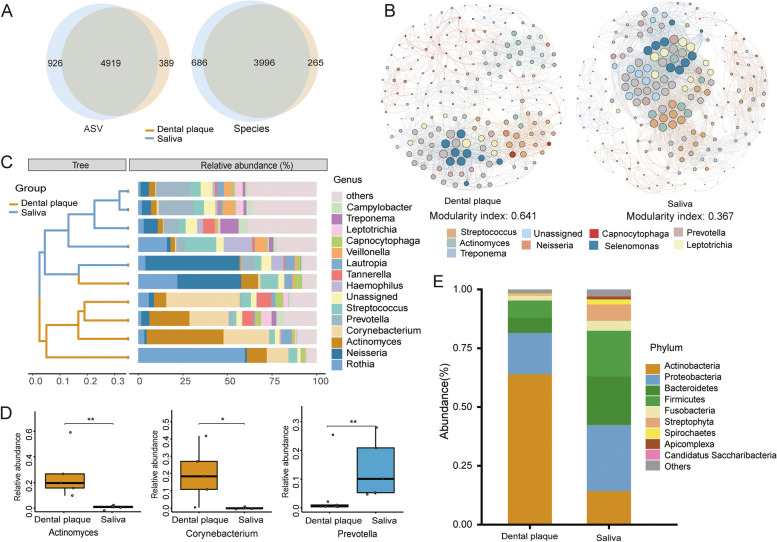
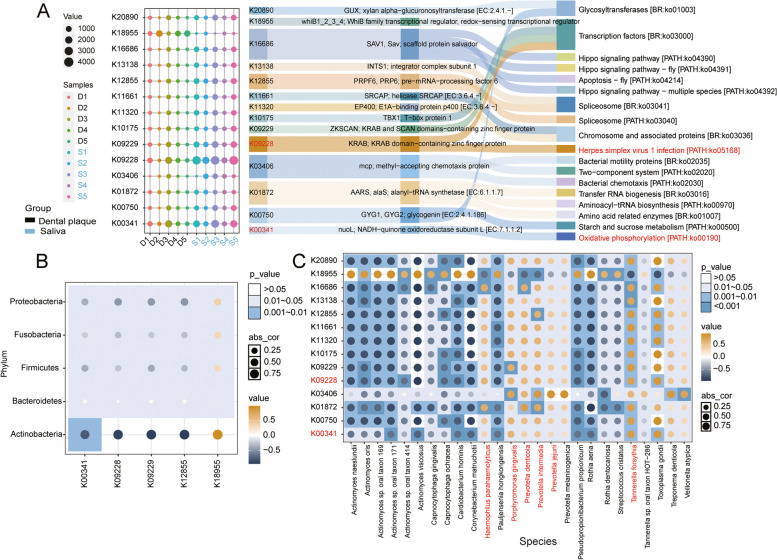
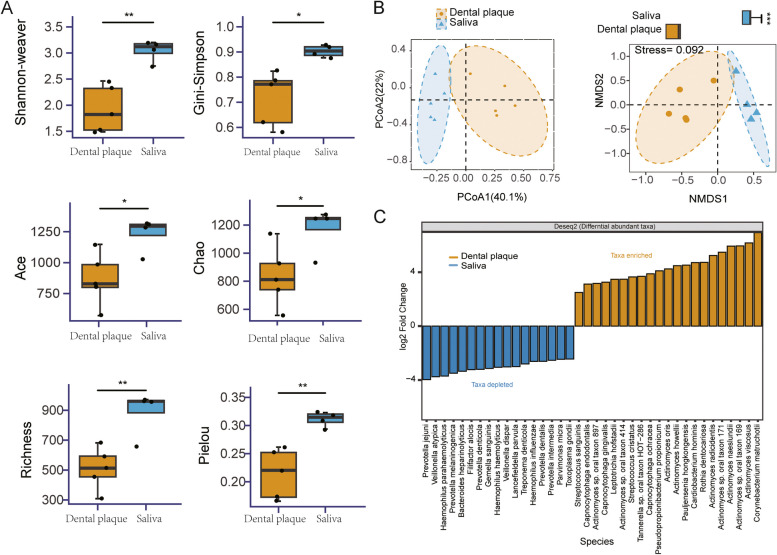
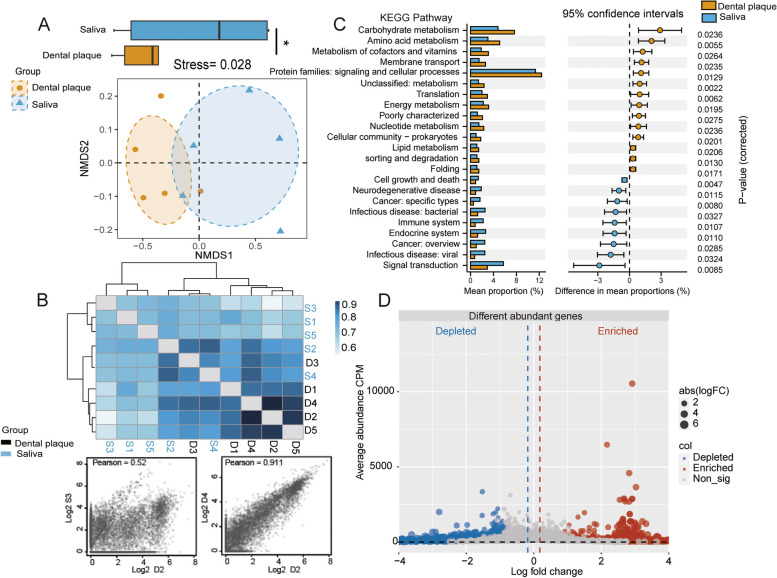
The results of the study revealed significant differences in both the function and classification of microbial communities between saliva and dental plaque samples. The diversity of microbial species in saliva was found to be higher compared to that in plaque samples. Notably, Actinobacteria were enriched in the dental plaque of OC patients. Furthermore, the study identified several inter-group differential marker species, including Prevotella intermedia, Haemophilus parahaemolyticus, Actinomyces radius, Corynebacterium matruchitii, and Veillonella atypica. Additionally, 1,353 differential genes were annotated into 23 functional pathways. Interestingly, a significant correlation was observed between differentially labeled species and Herpes simplex virus 1 (HSV-1) infection, which may be related to the occurrence and development of cancer.
Significant differences in the microbial and genetic composition of saliva and dental plaque samples were observed in OC patients. Furthermore, pathogenic bacteria associated with oral diseases were predominantly enriched in saliva. The identification of inter-group differential biomarkers and pathways provide insights into the relationship between oral microbiota and the occurrence and development of OC.
口腔是各种生态位的家园,每个生态位都有其独特的微生物组成。了解口腔癌(OC)患者口腔不同生态位中的微生物群落和基因组成对于确定这些微生物群体如何促进疾病进展至关重要。
本研究从 OC 患者中采集唾液和牙菌斑样本。采用宏基因组测序分析不同样本组的微生物群落分类和功能组成。
研究结果表明唾液和牙菌斑样本之间的微生物群落功能和分类存在显著差异。与菌斑样本相比,唾液中微生物物种的多样性更高。值得注意的是,OC 患者的牙菌斑中富含放线菌。此外,研究还鉴定出了几个组间差异标记物种,包括中间普氏菌、副溶血性弧菌、放射形放线菌、马库拉放线菌和奇异韦荣球菌。此外,1353 个差异基因被注释到 23 个功能途径中。有趣的是,差异标记物种与单纯疱疹病毒 1(HSV-1)感染之间存在显著相关性,这可能与癌症的发生和发展有关。
OC 患者的唾液和牙菌斑样本的微生物和遗传组成存在显著差异。此外,与口腔疾病相关的病原菌主要富集在唾液中。组间差异生物标志物和途径的鉴定为口腔微生物群与 OC 的发生和发展之间的关系提供了深入了解。