Université de Toulouse, UPS, IUT Paul Sabatier, LBAE EA 4565 (Laboratoire de Biotechnologies Agroalimentaire Et Environnementale), 24 Rue d'Embaquès, Auch, F-32000, France.
Université de Toulouse, UPS, INPT, LAPLACE UMR 5223 (Laboratoire Plasma Et Conversion d'Energie), 118 Route de Narbonne, Toulouse, F-31062, France.
Appl Microbiol Biotechnol. 2024 Apr 5;108(1):286. doi: 10.1007/s00253-024-13123-4.
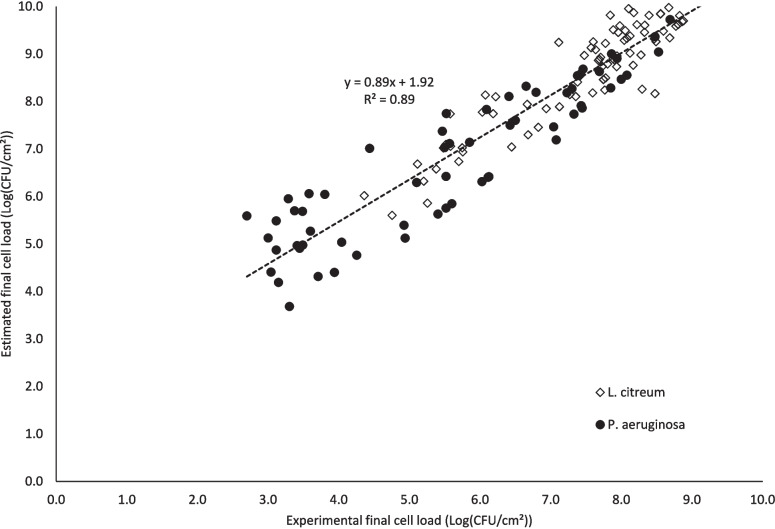
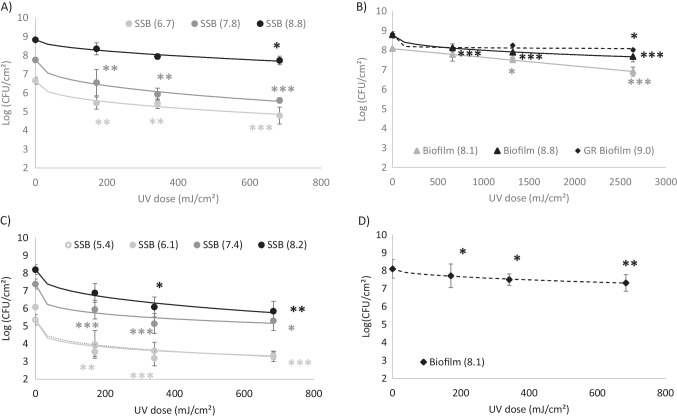
Ultraviolet-C light-emitting diodes (UV-C LEDs) are an emerging technology for decontamination applications in different sectors. In this study, the inactivation of bacterial biofilms was investigated by applying an UV-C LED emitting at 280 nm and by measuring both the influence of the initial cell density (load) and presence of an extracellular matrix (biofilm). Two bacterial strains exposing diverging matrix structures and biochemical compositions were used: Pseudomonas aeruginosa and Leuconostoc citreum. UV-C LED irradiation was applied at three UV doses (171 to 684 mJ/cm) on both surface-spread cells and on 24-h biofilms and under controlled cell loads, and bacterial survival was determined. All surface-spread bacteria, between 10 and 10 CFU/cm, and biofilms at 10 CFU/cm showed that bacterial response to irradiation was dose-dependent. The treatment efficacy decreased significantly for L. citreum surface-spread cells when the initial cell load was high, while no load effect was observed for P. aeruginosa. Inactivation was also reduced when bacteria were grown under a biofilm form, especially for P. aeruginosa: a protective effect could be attributed to abundant extracellular DNA and proteins in the matrix of P. aeruginosa biofilms, as revealed by Confocal Laser Scanning Microscopy observations. This study showed that initial cell load and exopolymeric substances are major factors influencing UV-C LED antibiofilm treatment efficacy. KEY POINTS: • Bacterial cell load (CFU/cm) could impact UV-C LED irradiation efficiency • Characteristics of the biofilm matrix have a paramount importance on inactivation • The dose to be applied can be predicted based on biofilm properties.
紫外线-C 发光二极管 (UV-C LED) 是一种新兴技术,可用于不同领域的消毒应用。在这项研究中,通过应用发射 280nm 紫外线的 UV-C LED 来研究细菌生物膜的失活,同时测量初始细胞密度(负载)和细胞外基质(生物膜)的存在的影响。使用了两种具有不同基质结构和生化组成的细菌菌株:铜绿假单胞菌和柠檬明串珠菌。将 UV-C LED 照射应用于三种 UV 剂量(171 至 684mJ/cm),分别对表面散布细胞和 24 小时生物膜进行照射,并在受控细胞负载下,确定细菌的存活情况。所有表面散布的细菌(10 到 10 CFU/cm)和 10 CFU/cm 的生物膜表明,细菌对辐照的反应是剂量依赖性的。当初始细胞负载较高时,L. citreum 表面散布细胞的处理效果显著降低,而 P. aeruginosa 则没有观察到负载效应。当细菌以生物膜形式生长时,失活也会减少,尤其是对于 P. aeruginosa:通过共聚焦激光扫描显微镜观察发现,生物膜中丰富的细胞外 DNA 和蛋白质可以归因于 P. aeruginosa 生物膜基质的保护作用。本研究表明,初始细胞负载和胞外聚合物是影响 UV-C LED 抗生物膜处理效果的主要因素。关键点:• 细菌细胞负载(CFU/cm)会影响 UV-C LED 辐照效率• 生物膜基质的特性对失活具有至关重要的影响• 可以根据生物膜特性预测要应用的剂量。