Department of Psychiatry and Psychotherapy, Semmelweis University, Budapest, Hungary.
Neurocognitive Research Center, Budapest, National Institute of Mental Health, Neurology, and Neurosurgery, Budapest, Hungary.
Transl Psychiatry. 2024 Apr 5;14(1):179. doi: 10.1038/s41398-024-02891-2.
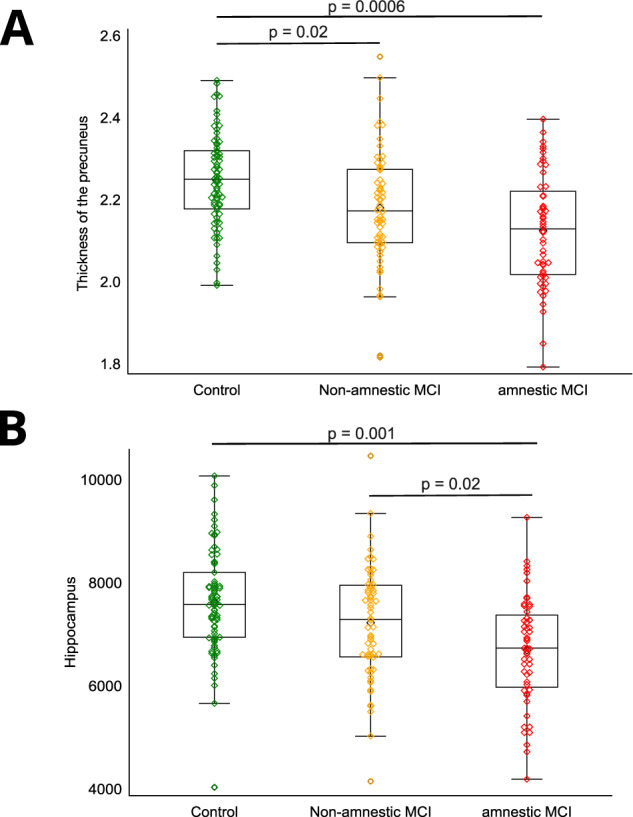
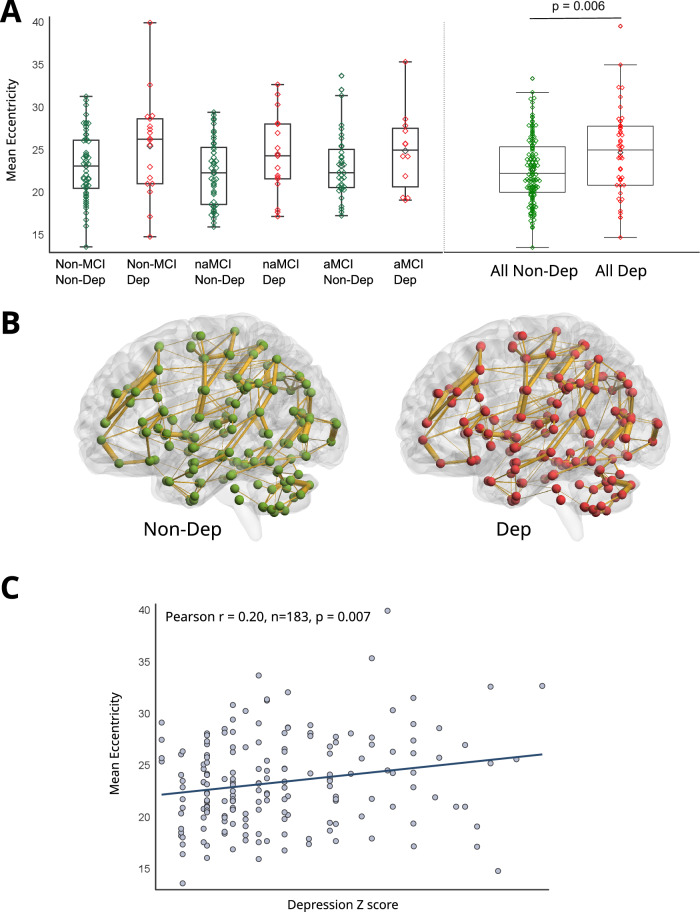
Evidence suggests that depressive symptomatology is a consequence of network dysfunction rather than lesion pathology. We studied whole-brain functional connectivity using a Minimum Spanning Tree as a graph-theoretical approach. Furthermore, we examined functional connectivity in the Default Mode Network, the Frontolimbic Network (FLN), the Salience Network, and the Cognitive Control Network. All 183 elderly subjects underwent a comprehensive neuropsychological evaluation and a 3 Tesla brain MRI scan. To assess the potential presence of depressive symptoms, the 13-item version of the Beck Depression Inventory (BDI) or the Geriatric Depression Scale (GDS) was utilized. Participants were assigned into three groups based on their cognitive status: amnestic mild cognitive impairment (MCI), non-amnestic MCI, and healthy controls. Regarding affective symptoms, subjects were categorized into depressed and non-depressed groups. An increased mean eccentricity and network diameter were found in patients with depressive symptoms relative to non-depressed ones, and both measures showed correlations with depressive symptom severity. In patients with depressive symptoms, a functional hypoconnectivity was detected between the Anterior Cingulate Cortex (ACC) and the right amygdala in the FLN, which impairment correlated with depressive symptom severity. While no structural difference was found in subjects with depressive symptoms, the volume of the hippocampus and the thickness of the precuneus and the entorhinal cortex were decreased in subjects with MCI, especially in amnestic MCI. The increase in eccentricity and diameter indicates a more path-like functional network configuration that may lead to an impaired functional integration in depression, a possible cause of depressive symptomatology in the elderly.
有证据表明,抑郁症状是网络功能障碍的结果,而不是病变病理学。我们使用最小生成树作为图论方法研究了全脑功能连接。此外,我们还检查了默认模式网络、额眶额网络(FLN)、突显网络和认知控制网络的功能连接。所有 183 名老年人都接受了全面的神经心理学评估和 3T 脑 MRI 扫描。为了评估潜在的抑郁症状,使用贝克抑郁量表(BDI)或老年抑郁量表(GDS)的 13 项版本。参与者根据认知状态分为遗忘性轻度认知障碍(MCI)、非遗忘性 MCI 和健康对照组。关于情感症状,将受试者分为抑郁组和非抑郁组。与非抑郁组相比,抑郁症状患者的平均外接圆和网络直径增加,这两个指标均与抑郁症状严重程度相关。在抑郁症状患者中,FLN 中前扣带皮层(ACC)和右侧杏仁核之间存在功能连接不足,这种损伤与抑郁症状严重程度相关。尽管在有抑郁症状的患者中未发现结构差异,但在 MCI 患者中,特别是在遗忘性 MCI 患者中,海马体体积、楔前叶和内嗅皮层的厚度减少。外接圆和直径的增加表明功能网络配置更具路径样,这可能导致抑郁患者的功能整合受损,这可能是老年人抑郁症状的一个原因。