Nguyen Olav Toai Duc, Fotopoulos Ioannis, Markaki Maria, Tsamardinos Ioannis, Lagani Vincenzo, Røe Oluf Dimitri
Department of Clinical Research and Molecular Medicine, Norwegian University of Science and Technology, Trondheim, Norway.
Levanger Hospital, Nord-Trøndelag Hospital Trust, Cancer Clinic, Levanger, Norway.
JTO Clin Res Rep. 2024 Mar 5;5(4):100660. doi: 10.1016/j.jtocrr.2024.100660. eCollection 2024 Apr.
Improving the method for selecting participants for lung cancer (LC) screening is an urgent need. Here, we compared the performance of the Helseundersøkelsen i Nord-Trøndelag (HUNT) Lung Cancer Model (HUNT LCM) versus the Dutch-Belgian lung cancer screening trial (Nederlands-Leuvens Longkanker Screenings Onderzoek (NELSON)) and 2021 United States Preventive Services Task Force (USPSTF) criteria regarding LC risk prediction and efficiency.
We used linked data from 10 Norwegian prospective population-based cohorts, Cohort of Norway. The study included 44,831 ever-smokers, of which 686 (1.5%) patients developed LC; the median follow-up time was 11.6 years (0.01-20.8 years).
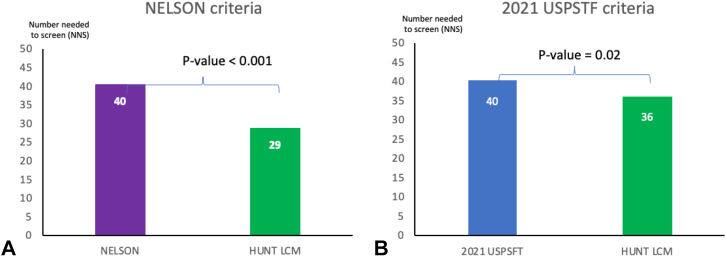
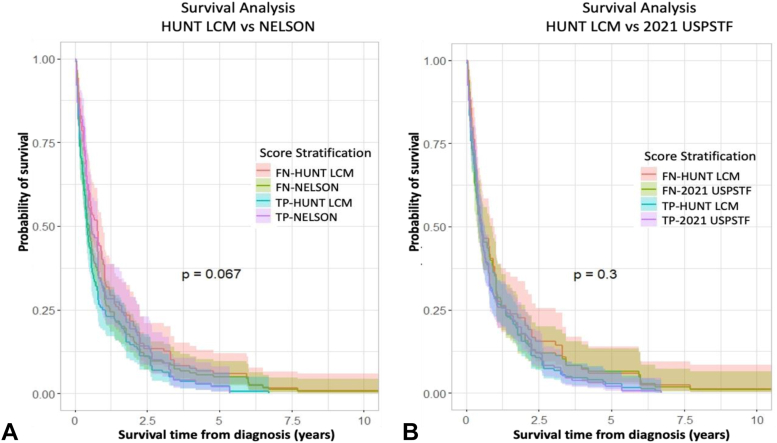
Within 6 years, 222 (0.5%) individuals developed LC. The NELSON and 2021 USPSTF criteria predicted 37.4% and 59.5% of the LC cases, respectively. By considering the same number of individuals as the NELSON and 2021 USPSTF criteria selected, the HUNT LCM increased the LC prediction rate by 41.0% and 12.1%, respectively. The HUNT LCM significantly increased sensitivity ( < 0.001 and = 0.028), and reduced the number needed to predict one LC case (29 versus 40, < 0.001 and 36 versus 40, = 0.02), respectively. Applying the HUNT LCM 6-year 0.98% risk score as a cutoff (14.0% of ever-smokers) predicted 70.7% of all LC, increasing LC prediction rate with 89.2% and 18.9% versus the NELSON and 2021 USPSTF, respectively (both < 0.001).
The HUNT LCM was significantly more efficient than the NELSON and 2021 USPSTF criteria, improving the prediction of LC diagnosis, and may be used as a validated clinical tool for screening selection.
改进肺癌(LC)筛查参与者的选择方法迫在眉睫。在此,我们比较了北特伦德拉格健康调查(HUNT)肺癌模型(HUNT LCM)与荷兰 - 比利时肺癌筛查试验(荷兰 - 鲁汶肺癌筛查研究(NELSON))以及2021年美国预防服务工作组(USPSTF)标准在LC风险预测和效率方面的表现。
我们使用了来自挪威10个基于人群的前瞻性队列——挪威队列的关联数据。该研究纳入了44,831名曾经吸烟者,其中686名(1.5%)患者罹患LC;中位随访时间为11.6年(0.01 - 20.8年)。
6年内,222名(0.5%)个体罹患LC。NELSON标准和2021年USPSTF标准分别预测了37.4%和59.5%的LC病例。在考虑与NELSON标准和2021年USPSTF标准选择相同数量个体的情况下,HUNT LCM的LC预测率分别提高了41.0%和12.1%。HUNT LCM显著提高了敏感性(<0.001和=0.028),并分别降低了预测一例LC病例所需的数量(29对40,<0.001和36对40,=0.02)。将HUNT LCM的6年0.98%风险评分作为临界值(占曾经吸烟者的14.0%)可预测70.7%的所有LC病例,与NELSON标准和2021年USPSTF标准相比,LC预测率分别提高了89.2%和18.9%(均<0.001)。
HUNT LCM比NELSON标准和2021年USPSTF标准显著更有效,改善了LC诊断的预测,可作为一种经过验证的用于筛查选择的临床工具。