Mojtahedi Mahsa, Bruggeman Agnetha E, van Voorst Henk, Ponomareva Elena, Kappelhof Manon, van der Lugt Aad, Hoving Jan W, Dutra Bruna G, Dippel Diederik, Cavalcante Fabiano, Yo Lonneke, Coutinho Jonathan, Brouwer Josje, Treurniet Kilian, Tolhuisen Manon L, LeCouffe Natalie, Arrarte Terreros Nerea, Konduri Praneeta R, van Zwam Wim, Roos Yvo, Majoie Charles B L M, Emmer Bart J, Marquering Henk A
Department of Biomedical Engineering and Physics, Amsterdam UMC, University of Amsterdam, 1105 AZ Amsterdam, The Netherlands.
Department of Radiology and Nuclear Medicine, Amsterdam University Medical Centers, 1105 AZ Amsterdam, The Netherlands.
J Clin Med. 2024 Feb 28;13(5):1388. doi: 10.3390/jcm13051388.
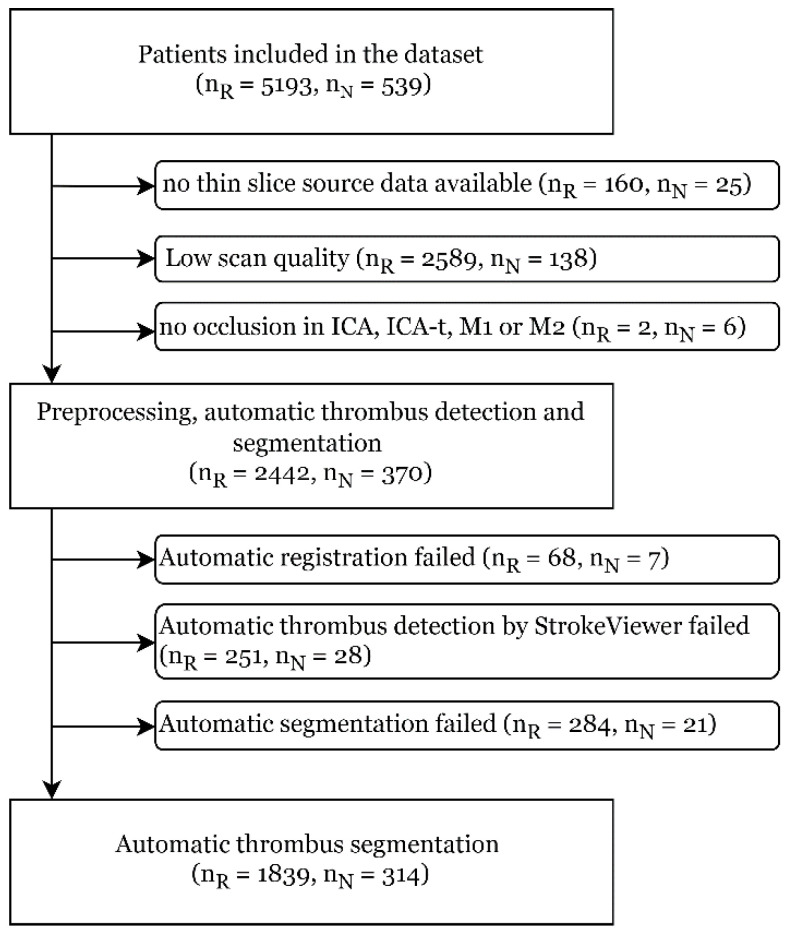
(1) : For acute ischemic strokes caused by large vessel occlusion, manually assessed thrombus volume and perviousness have been associated with treatment outcomes. However, the manual assessment of these characteristics is time-consuming and subject to inter-observer bias. Alternatively, a recently introduced fully automated deep learning-based algorithm can be used to consistently estimate full thrombus characteristics. Here, we exploratively assess the value of these novel biomarkers in terms of their association with stroke outcomes. (2) : We studied two applications of automated full thrombus characterization as follows: one in a randomized trial, MR CLEAN-NO IV ( = 314), and another in a Dutch nationwide registry, MR CLEAN Registry ( = 1839). We used an automatic pipeline to determine the thrombus volume, perviousness, density, and heterogeneity. We assessed their relationship with the functional outcome defined as the modified Rankin Scale (mRS) at 90 days and two technical success measures as follows: successful final reperfusion, which is defined as an eTICI score of 2b-3, and successful first-pass reperfusion (FPS). (3) : Higher perviousness was significantly related to a better mRS in both MR CLEAN-NO IV and the MR CLEAN Registry. A lower thrombus volume and lower heterogeneity were only significantly related to better mRS scores in the MR CLEAN Registry. Only lower thrombus heterogeneity was significantly related to technical success; it was significantly related to a higher chance of FPS in the MR CLEAN-NO IV trial (OR = 0.55, 95% CI: 0.31-0.98) and successful reperfusion in the MR CLEAN Registry (OR = 0.88, 95% CI: 0.78-0.99). (4) : Thrombus characteristics derived from automatic entire thrombus segmentations are significantly related to stroke outcomes.
(1):对于由大血管闭塞引起的急性缺血性卒中,人工评估的血栓体积和通透性与治疗结果相关。然而,对这些特征进行人工评估既耗时又容易受到观察者间偏差的影响。另外,最近引入的基于深度学习的全自动算法可用于持续估计完整的血栓特征。在此,我们探索性地评估这些新型生物标志物与卒中结局之间关联的价值。(2):我们研究了自动全血栓特征分析的两种应用情况如下:一种用于随机试验MR CLEAN - NO IV(n = 314),另一种用于荷兰全国性登记处MR CLEAN登记处(n = 1839)。我们使用自动流程来确定血栓体积、通透性、密度和异质性。我们评估了它们与90天时改良Rankin量表(mRS)定义的功能结局以及以下两项技术成功指标的关系:成功的最终再灌注,定义为eTICI评分2b - 3,以及成功的首次通过再灌注(FPS)。(3):在MR CLEAN - NO IV和MR CLEAN登记处中,较高的通透性均与更好的mRS显著相关。仅在MR CLEAN登记处,较低的血栓体积和较低的异质性与更好 的mRS评分显著相关。仅较低的血栓异质性与技术成功显著相关;在MR CLEAN - NO IV试验中,它与更高的FPS几率显著相关(OR = 0.55,95% CI:0.31 - 0.98),在MR CLEAN登记处与成功再灌注显著相关(OR = 0.88,95% CI:0.78 - 0.99)。(4):从自动全血栓分割得出的血栓特征与卒中结局显著相关。