Ng Shu Hui, Kaur Sharon, Cheah Phaik Yeong, Ong Zhen Ling, Lim Jane, Voo Teck Chuan
School of Medicine and Health Sciences, Monash University Malaysia, Bandar Sunway, Selangor, 47500, Malaysia.
Faculty of Law, University Malaya, Kuala Lumpur, Federal Territory of Kuala Lumpur, 50603, Malaysia.
Wellcome Open Res. 2024 Jun 4;8:391. doi: 10.12688/wellcomeopenres.19572.2. eCollection 2023.
Asia hosts the second-largest international migrant population in the world. In Southeast Asia (SEA), key types of migration are labour migration, forced migration, and environmental migration. This scoping review seeks to identify key themes and gaps in current research on the ethics of healthcare for mobile and marginalised populations in SEA, and the ethics of research involving these populations.
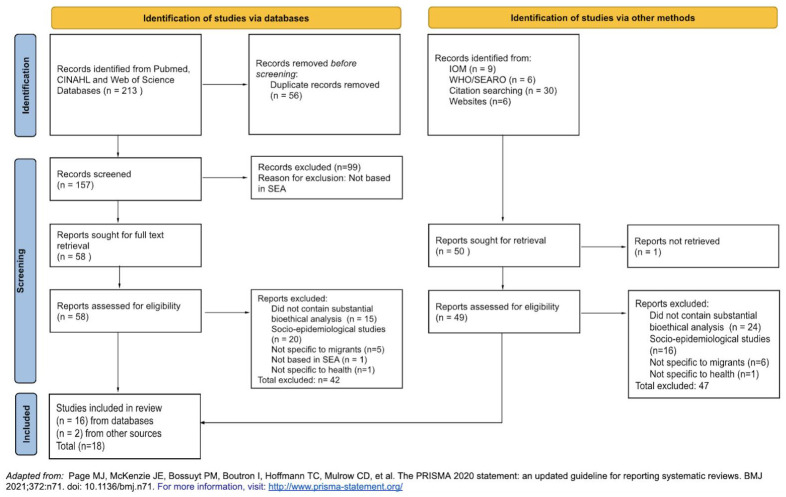
We performed a scoping review using three broad concepts: population (stateless population, migrants, refugees, asylum seekers, internally displaced people), issues (healthcare and ethics), and context (11 countries in SEA). Three databases (PubMed, CINAHL, and Web of Science) were searched from 2000 until May 2023 over a period of four months (February 2023 to May 2023). Other relevant publications were identified through citation searches, and six bioethics journals were hand searched. All searches were conducted in English, and relevant publications were screened against the inclusion and exclusion criteria. Data were subsequently imported into NVivo 14, and thematic analysis was conducted.
We identified 18 papers with substantial bioethical analysis. Ethical concepts that guide the analysis were 'capability, agency, dignity', 'vulnerability', 'precarity, complicity, and structural violence' (n=7). Ethical issues were discussed from the perspective of research ethics (n=9), clinical ethics (n=1) and public health ethics (n=1). All publications are from researchers based in Singapore, Thailand, and Malaysia. Research gaps identified include the need for more research involving migrant children, research from migrant-sending countries, studies on quality of migrant healthcare, participatory health research, and research with internal migrants.
More empirical research is necessary to better understand the ethical issues that exist in the domains of research, clinical care, and public health. Critical examination of the interplay between migration, health and ethics with consideration of the diverse factors and contexts involved is crucial for the advancement of migration health ethics in SEA.
亚洲是世界上第二大国际移民人口所在地。在东南亚,主要的移民类型包括劳务移民、被迫移民和环境移民。本综述旨在确定东南亚流动和边缘化人群医疗保健伦理以及涉及这些人群的研究伦理当前研究中的关键主题和差距。
我们使用三个宽泛概念进行了一项综述:人群(无国籍人群、移民、难民、寻求庇护者、境内流离失所者)、问题(医疗保健与伦理)和背景(东南亚11个国家)。从2000年到2023年5月,在四个月的时间里(2023年2月至2023年5月)检索了三个数据库(PubMed、CINAHL和科学网)。通过引文检索确定了其他相关出版物,并对六种生物伦理学期刊进行了手工检索。所有检索均以英文进行,并根据纳入和排除标准对相关出版物进行筛选。随后将数据导入NVivo 14,并进行了主题分析。
我们确定了18篇进行了大量生物伦理分析的论文。指导分析的伦理概念包括“能力、能动性、尊严”、“脆弱性”、“不稳定、共谋和结构性暴力”(n = 7)。从研究伦理(n = 9)、临床伦理(n = 1)和公共卫生伦理(n = 1)的角度讨论了伦理问题。所有出版物均来自新加坡、泰国和马来西亚的研究人员。确定的研究差距包括需要更多涉及移民儿童的研究、来自移民输出国的研究、关于移民医疗保健质量的研究、参与性健康研究以及与境内移民的研究。
需要进行更多实证研究,以更好地理解研究、临床护理和公共卫生领域存在的伦理问题。批判性审视移民、健康和伦理之间的相互作用,并考虑到所涉及的各种因素和背景,对于推进东南亚的移民健康伦理至关重要。