Department of Emergency Medicine, Brigham and Women's Hospital, Boston, Massachusetts.
Department of Emergency Medicine, Carver College of Medicine, University of Iowa, Iowa City.
JAMA Netw Open. 2024 Apr 1;7(4):e245697. doi: 10.1001/jamanetworkopen.2024.5697.
Access to COVID-19 testing is critical to reducing transmission and supporting early treatment decisions; when made accessible, the timeliness of testing may also be an important metric in mitigating community spread of the infection. While disparities in transmission and outcomes of COVID-19 have been well documented, the extent of timeliness of testing and the association with demographic factors is unclear.
To evaluate demographic factors associated with delayed COVID-19 testing among health care personnel (HCP) during the COVID-19 pandemic.
DESIGN, SETTING, AND PARTICIPANTS: This cross-sectional study used data from the Preventing Emerging Infections Through Vaccine Effectiveness Testing study, a multicenter, test-negative, case-control vaccine effectiveness study that enrolled HCP who had COVID-19 symptoms and testing between December 2020 and April 2022. Data analysis was conducted from March 2022 to Junne 2023.
Displaying COVID-19-like symptoms and polymerase chain reaction testing occurring from the first day symptoms occurred up to 14 days after symptoms occurred.
Variables of interest included patient demographics (sex, age, and clinical comorbidities) and COVID-19 characteristics (vaccination status and COVID-19 wave). The primary outcome was time from symptom onset to COVID-19 testing, which was defined as early testing (≤2 days) or delayed testing (≥3 days). Associations of demographic characteristics with delayed testing were measured while adjusting for clinical comorbidities, COVID-19 characteristics, and test site using multivariable modeling to estimate relative risks and 95% CIs.
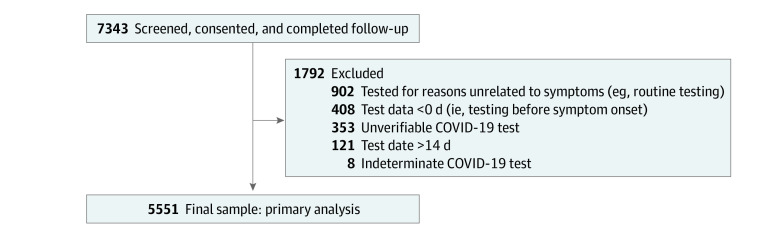
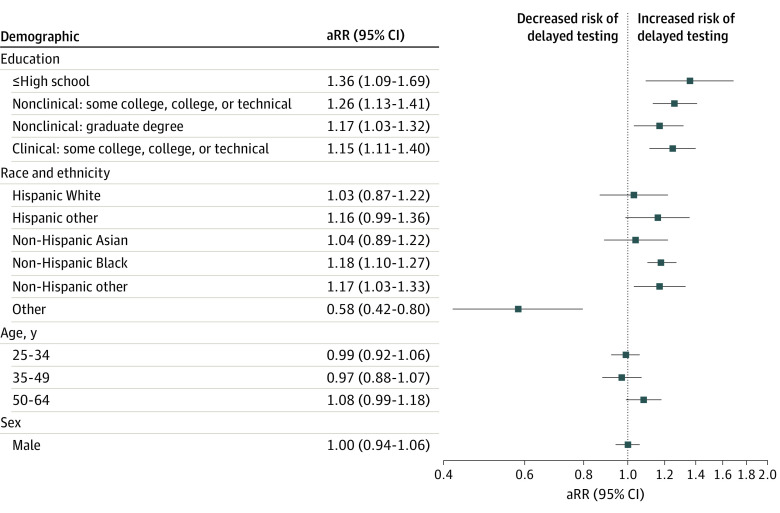
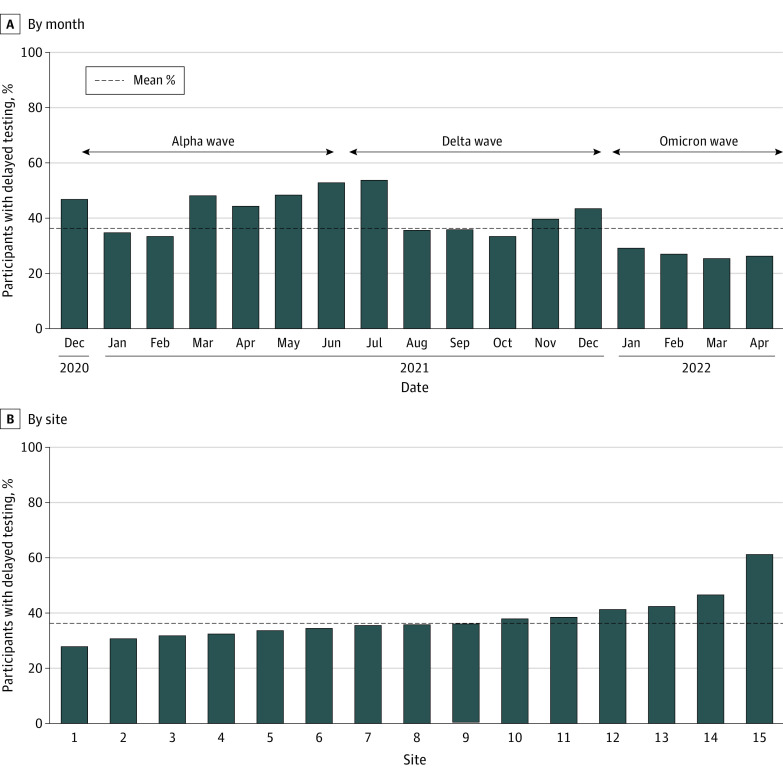
A total of 5551 HCP (4859 female [82.9%]; 1954 aged 25-34 years [35.2%]; 4233 non-Hispanic White [76.3%], 370 non-Hispanic Black [6.7%], and 324 non-Hispanic Asian [5.8%]) were included in the final analysis. Overall, 2060 participants (37.1%) reported delayed testing and 3491 (62.9%) reported early testing. Compared with non-Hispanic White HCP, delayed testing was higher among non-Hispanic Black HCP (adjusted risk ratio, 1.18; 95%CI, 1.10-1.27) and for non-Hispanic HCP of other races (adjusted risk ratio, 1.17; 95% CI, 1.03-1.33). Sex and age were not associated with delayed testing. Compared with clinical HCP with graduate degrees, all other professional and educational groups had significantly delayed testing.
In this cross-sectional study of HCP, compared with non-Hispanic White HCP and clinical HCP with graduate degrees, non-Hispanic Black HCP, non-Hispanic HCP of other races, and HCP all other professional and education backgrounds were more likely to have delayed COVID-19 testing. These findings suggest that time to testing may serve as a valuable metric in evaluating sociodemographic disparities in the response to COVID-19 and future health mitigation strategies.
获得 COVID-19 检测对于减少传播和支持早期治疗决策至关重要;当检测变得容易获得时,检测的及时性也可能是减轻感染在社区传播的一个重要指标。虽然 COVID-19 的传播和结果存在明显的差异,但检测的及时性程度及其与人口统计学因素的关联尚不清楚。
评估 COVID-19 大流行期间医护人员(HCP)COVID-19 检测延迟的相关人口统计学因素。
设计、地点和参与者:这项横断面研究使用了预防新发传染病疫苗有效性测试研究的数据,这是一项多中心、检测阴性、病例对照疫苗有效性研究,招募了在 2020 年 12 月至 2022 年 4 月期间出现 COVID-19 症状并接受检测的 HCP。数据分析于 2022 年 3 月至 2023 年 6 月进行。
表现出 COVID-19 样症状和聚合酶链反应检测,从症状出现的第一天到症状出现后 14 天进行。
感兴趣的变量包括患者的人口统计学特征(性别、年龄和临床合并症)和 COVID-19 特征(疫苗接种状况和 COVID-19 波)。主要结局是从症状出现到 COVID-19 检测的时间,定义为早期检测(≤2 天)或延迟检测(≥3 天)。使用多变量模型,在调整临床合并症、COVID-19 特征和检测地点的情况下,测量人口统计学特征与延迟检测的关联,以估计相对风险和 95%置信区间。
共有 5551 名 HCP(4859 名女性[82.9%];1954 名年龄在 25-34 岁之间[35.2%];4233 名非西班牙裔白人[76.3%],370 名非西班牙裔黑人[6.7%],324 名非西班牙裔亚裔[5.8%])被纳入最终分析。总体而言,2060 名参与者(37.1%)报告了延迟检测,3491 名(62.9%)报告了早期检测。与非西班牙裔白人 HCP 相比,非西班牙裔黑人 HCP 的延迟检测率更高(调整风险比,1.18;95%CI,1.10-1.27),非西班牙裔其他种族的 HCP(调整风险比,1.17;95%CI,1.03-1.33)也是如此。性别和年龄与延迟检测无关。与拥有研究生学历的临床 HCP 相比,所有其他专业和教育群体的检测延迟明显更长。
在这项针对 HCP 的横断面研究中,与非西班牙裔白人 HCP 和拥有研究生学历的临床 HCP 相比,非西班牙裔黑人 HCP、非西班牙裔其他种族的 HCP 和其他专业和教育背景的 HCP 更有可能延迟 COVID-19 检测。这些发现表明,检测时间可能是评估 COVID-19 应对措施中社会人口统计学差异和未来健康缓解策略的一个有价值的指标。