
农村大学生就业压力的潜在类别及其与就业心理的关系。
Potential categories of employment stress among rural college students and their relationship to employment psychology.
作者信息
Wu Xinyue, Kim Kyung Yee, Jian Ziting
机构信息
Student Affairs Department, Qingdao University of Technology, Qingdao, China.
Department of Education, General Graduate School, The Catholic University of Korea, Bucheon-si, Republic of Korea.
出版信息
Front Psychol. 2024 Mar 28;15:1363065. doi: 10.3389/fpsyg.2024.1363065. eCollection 2024.
BACKGROUND
Psychological problems related to employment are among the most common psychological problems faced by rural college students. Employment stress is an important factor affecting the development of psychological health in employees; thus, reducing employment stress can improve the psychological state of employment.
OBJECTIVE
This study aimed to understand the potential profiles of employment stress among rural college students to determine the relationship between different profiles and employment psychology.
METHODS
This study was conducted in a higher education institution in Qingdao, Shandong Province, China between June and December 2023, and 249 rural college students participated. The Employment Stress Scale and Employment Psychology Scale were used to collect the data. Data were analyzed using latent profile analysis, independent sample -tests, and binary logistic regression analysis.
RESULTS
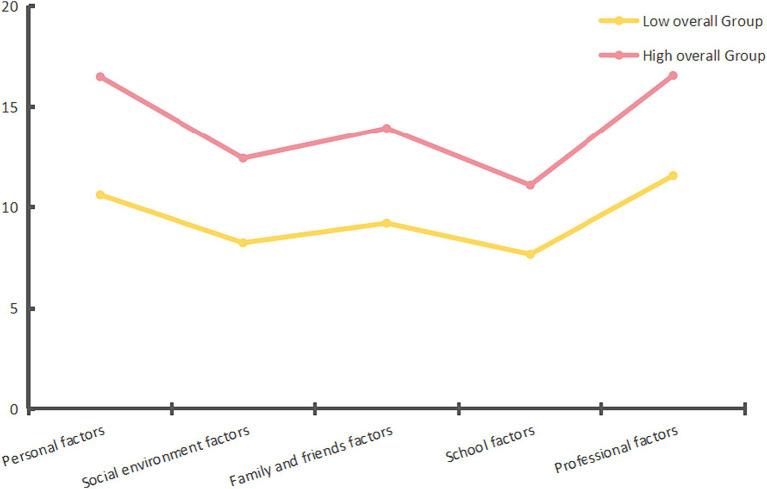
The results showed that rural university students were categorized into low-level (49.80%) and high-level (50.21%) employment stress groups. There was a statistically significant difference between the employment psychology of rural college students in the low- and high-level groups ( < 0.001). Juniors/seniors were more likely to be classified in the high-level group (OR = 0.477, = 0.011).
CONCLUSION
Intervention programs should be developed and implemented to address the characteristics of employment stress among rural college students with different profiles to promote the healthy development of their attitudes toward employment.
背景
与就业相关的心理问题是农村大学生面临的最常见心理问题之一。就业压力是影响员工心理健康发展的重要因素;因此,减轻就业压力可以改善就业心理状态。
目的
本研究旨在了解农村大学生就业压力的潜在类型,以确定不同类型与就业心理之间的关系。
方法
本研究于2023年6月至12月在中国山东省青岛市的一所高等院校进行,共有249名农村大学生参与。使用就业压力量表和就业心理量表收集数据。采用潜在剖面分析、独立样本t检验和二元逻辑回归分析对数据进行分析。
结果
结果显示,农村大学生被分为低就业压力组(49.80%)和高就业压力组(50.21%)。低水平组和高水平组农村大学生的就业心理存在统计学显著差异(P<0.001)。大三/大四学生更有可能被归类为高水平组(OR=0.477,P=0.011)。
结论
应制定并实施干预方案,以应对不同类型农村大学生就业压力的特点,促进其就业态度的健康发展。
 Zotero 插件