Dua Ruchi, Malik Saloni, Bhadoria Ajeet S, Neyaz Osama, Krishnan Ajay S, Pandya Chinmay
Pulmonary Medicine, All India Institute of Medical Sciences, Rishikesh, Rishikesh, IND.
Himalayan School of Yoga Sciences, Swami Rama Himalayan University, Dehradun, IND.
Cureus. 2024 Mar 12;16(3):e56060. doi: 10.7759/cureus.56060. eCollection 2024 Mar.
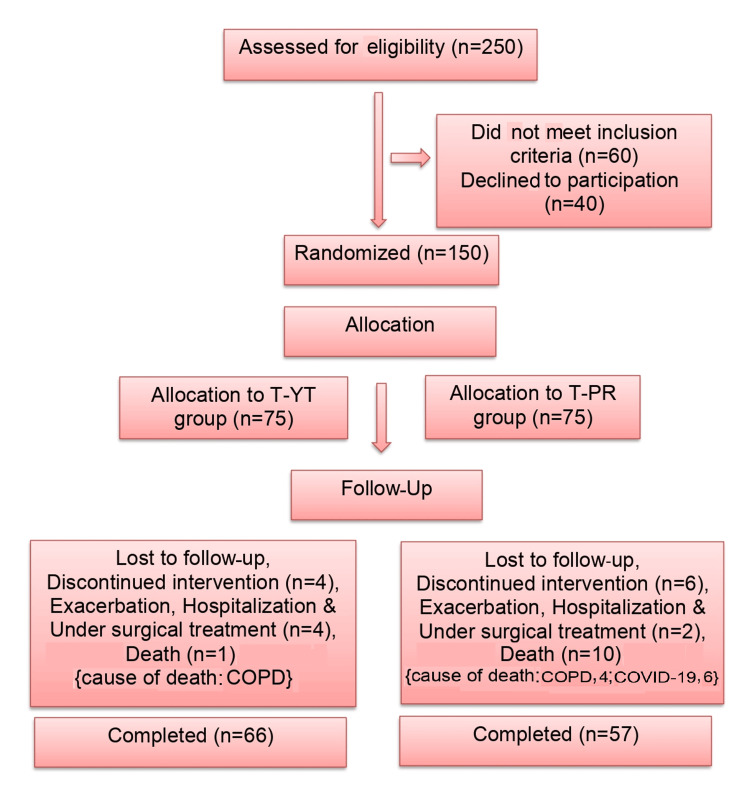
Background Pulmonary rehabilitation (PR) is an integral part of non-pharmacological therapy in chronic obstructive pulmonary disease (COPD). Yoga therapy (YT) has been shown to be beneficial in COPD, but the lack of large well-designed trials and standardized modules restricts its acceptability. This randomized control trial compares these two modalities in COPD patients via supervised tele-intervention. Objectives The primary objective of the study is to compare a 45-minute, five-days-per-week series of tele-YT (T-YT) with tele-PR (T-PR) for three months in terms of exercise capacity (6-Minute Walk Distance (6MWD)) in COPD patients. Methods COPD patients were randomly assigned (1:1) to T-YT or T-PR groups in a parallel-arm single-blinded controlled trial. The primary outcome is 6MWD recorded at baseline and after three months and secondary outcomes were symptom scores, Forced expiratory volume in the first second (FEV1), health-related quality of life (HrQoL), and depression and anxiety scores. Assessments were conducted at baseline and at the end of the three-month study period with a sample size of 75 in each group. Results A total of 150 consecutive patients with COPD were randomly assigned to either the T-YT (n = 75) or T-PR (n = 75) group. Their mean ± SD ages was 62.5 ± 7.0 years. The T-YT group had 55.5% males and 34.47% females, whereas the T-PR group had 44.5% males and 61.53% females. The trial was completed by 123 patients; 88% in the T-YT group and 76% in the T-PR group. Pre-intervention, the median (range) of 6MWD in T-YT and T-PR groups was 240 (120-600) m and 240 (120-660) m, respectively. There was statistically significant improvement in both groups respectively (p<0.001) post intervention from baseline but no significant intergroup difference (p = 0.486). A similar trend was seen in secondary outcomes with significant intragroup improvements and non-significant inter-group differences except FEV1%, which showed neither intragroup nor intergroup significant improvement. Conclusion Using a validated module, a three-month T-YT improves exercise capacity, symptom scores, HrQoL, and depression and anxiety scores similar to T-PR. T-YT is an acceptable alternative to T-PR in the management of COPD.
背景 肺康复(PR)是慢性阻塞性肺疾病(COPD)非药物治疗的重要组成部分。瑜伽疗法(YT)已被证明对COPD有益,但缺乏大型精心设计的试验和标准化模块限制了其可接受性。这项随机对照试验通过监督远程干预比较了这两种治疗方式在COPD患者中的效果。
目的 本研究的主要目的是比较为期三个月、每周五天、每次45分钟的远程瑜伽疗法(T-YT)与远程肺康复(T-PR)对COPD患者运动能力(6分钟步行距离(6MWD))的影响。
方法 在一项平行臂单盲对照试验中,COPD患者被随机(1:1)分配到T-YT组或T-PR组。主要结局指标是在基线和三个月后记录的6MWD,次要结局指标是症状评分、第一秒用力呼气量(FEV1)、健康相关生活质量(HrQoL)以及抑郁和焦虑评分。在基线和三个月研究期结束时进行评估,每组样本量为75例。
结果 共有150例连续的COPD患者被随机分配到T-YT组(n = 75)或T-PR组(n = 75)。他们的平均年龄±标准差为62.5±7.0岁。T-YT组男性占55.5%,女性占34.47%,而T-PR组男性占44.5%,女性占61.53%。123例患者完成了试验;T-YT组为88%,T-PR组为76%。干预前,T-YT组和T-PR组6MWD的中位数(范围)分别为240(120 - 600)米和240(120 - 660)米。两组干预后与基线相比均有统计学显著改善(p<0.001),但组间差异无统计学意义(p = 0.486)。次要结局指标也呈现类似趋势,组内有显著改善,组间差异无统计学意义,但FEV1%除外,其在组内和组间均无显著改善。
结论 使用经过验证的模块,为期三个月的T-YT在改善运动能力、症状评分、HrQoL以及抑郁和焦虑评分方面与T-PR相似。在COPD的管理中,T-YT是T-PR的可接受替代方案。