Roche Pharma Research and Early Development (pRED), Neuroscience and Rare Diseases Discovery and Translational Area, Roche Innovation Center Basel, Basel, Switzerland.
University of Exeter Medical School, London, UK.
Nat Med. 2024 Apr;30(4):1096-1103. doi: 10.1038/s41591-024-02886-y. Epub 2024 Apr 15.
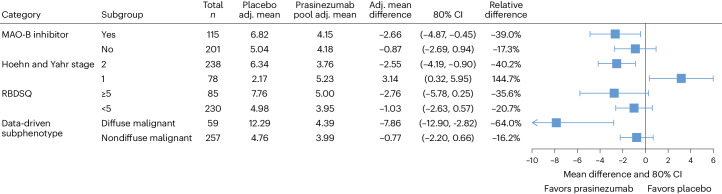
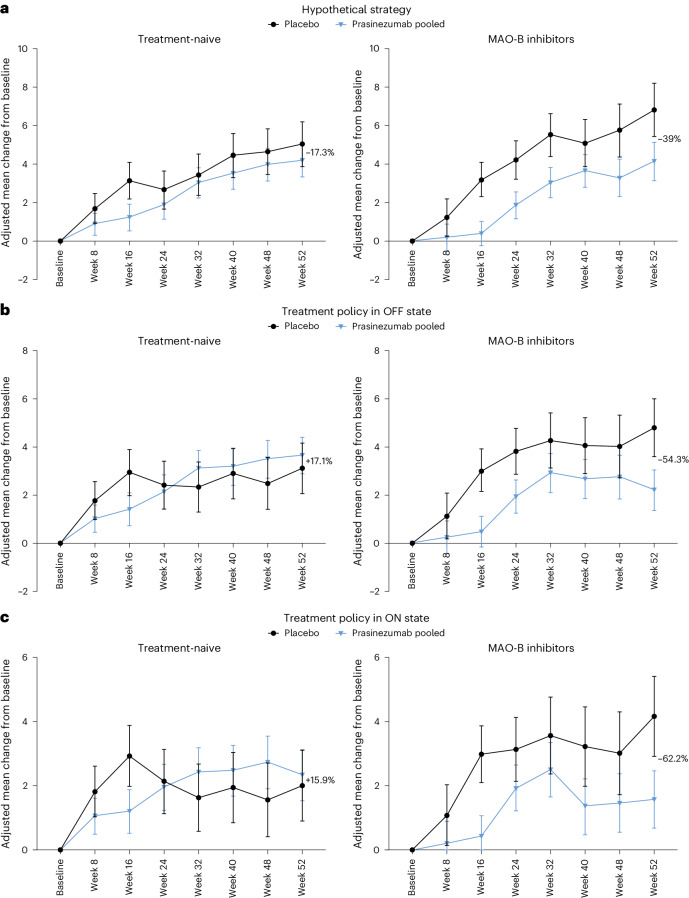
Prasinezumab, a monoclonal antibody that binds aggregated α-synuclein, is being investigated as a potential disease-modifying therapy in early-stage Parkinson's disease. Although in the PASADENA phase 2 study, the primary endpoint (Movement Disorder Society Unified Parkinson's Disease Rating Scale (MDS-UPDRS) sum of Parts I + II + III) was not met, prasinezumab-treated individuals exhibited slower progression of motor signs than placebo-treated participants (MDS-UPDRS Part III). We report here an exploratory analysis assessing whether prasinezumab showed greater benefits on motor signs progression in prespecified subgroups with faster motor progression. Prasinezumab's potential effects on disease progression were assessed in four prespecified and six exploratory subpopulations of PASADENA: use of monoamine oxidase B inhibitors at baseline (yes versus no); Hoehn and Yahr stage (2 versus 1); rapid eye movement sleep behavior disorder (yes versus no); data-driven subphenotypes (diffuse malignant versus nondiffuse malignant); age at baseline (≥60 years versus <60 years); sex (male versus female); disease duration (>12 months versus <12 months); age at diagnosis (≥60 years versus <60 years); motor subphenotypes (akinetic-rigid versus tremor-dominant); and motor subphenotypes (postural instability gait dysfunction versus tremor-dominant). In these subpopulations, the effect of prasinezumab on slowing motor signs progression (MDS-UPDRS Part III) was greater in the rapidly progressing subpopulations (for example, participants who were diffuse malignant or taking monoamine oxidase B inhibitors at baseline). This exploratory analysis suggests that, in a trial of 1-year duration, prasinezumab might reduce motor progression to a greater extent in individuals with more rapidly progressing Parkinson's disease. However, because this was a post hoc analysis, additional randomized clinical trials are needed to validate these findings.
普瑞西单抗是一种针对聚集的α-突触核蛋白的单克隆抗体,目前正在进行研究,作为早期帕金森病潜在的疾病修饰治疗方法。尽管在 PASADENA 2 期研究中,主要终点(运动障碍协会统一帕金森病评定量表(MDS-UPDRS)的第 I+II+III 部分总和)未达到,但普瑞西单抗治疗组的运动症状进展速度比安慰剂治疗组慢(MDS-UPDRS 第 III 部分)。我们在此报告一项探索性分析,评估普瑞西单抗是否在进展较快的特定亚组中对运动症状进展显示出更大的益处。在 PASADENA 的四个预设和六个探索性亚组中评估了普瑞西单抗对疾病进展的潜在影响:基线时是否使用单胺氧化酶 B 抑制剂(是与否);Hoehn 和 Yahr 分期(2 期与 1 期);快速眼动睡眠行为障碍(是与否);数据驱动的亚表型(弥漫恶性与非弥漫恶性);基线时的年龄(≥60 岁与<60 岁);性别(男与女);疾病持续时间(>12 个月与<12 个月);诊断时的年龄(≥60 岁与<60 岁);运动亚表型(运动不能-僵硬与震颤占主导);运动亚表型(姿势不稳-步态障碍与震颤占主导)。在这些亚组中,普瑞西单抗对运动症状进展(MDS-UPDRS 第 III 部分)的减缓作用在进展较快的亚组中更大(例如,弥漫恶性或基线时使用单胺氧化酶 B 抑制剂的患者)。这项探索性分析表明,在为期 1 年的试验中,普瑞西单抗可能会在帕金森病进展较快的患者中更大程度地减缓运动进展。然而,由于这是一项事后分析,需要进行更多的随机临床试验来验证这些发现。