U.K. Centre for Ecology and Hydrology (UKCEH), Wallingford, United Kingdom.
College of Engineering, Mathematics and Physical Sciences, University of Exeter, Exeter, United Kingdom.
PLoS One. 2024 Apr 16;19(4):e0297744. doi: 10.1371/journal.pone.0297744. eCollection 2024.
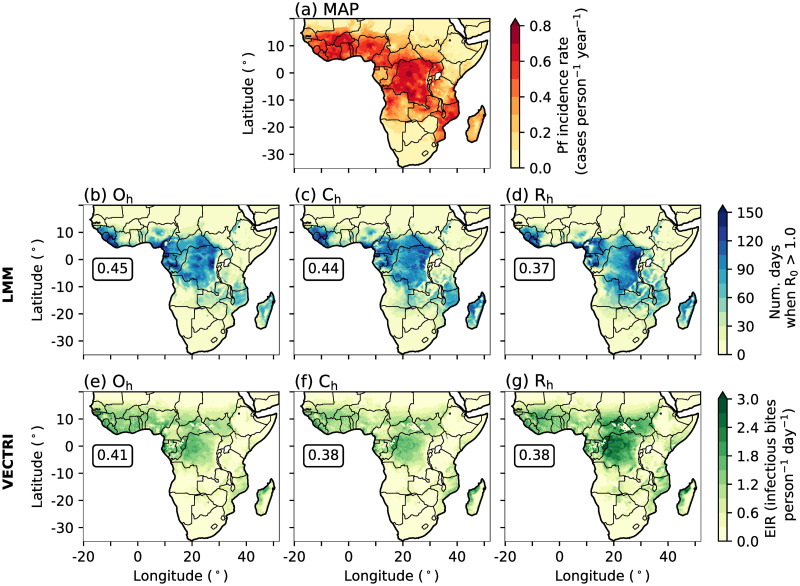
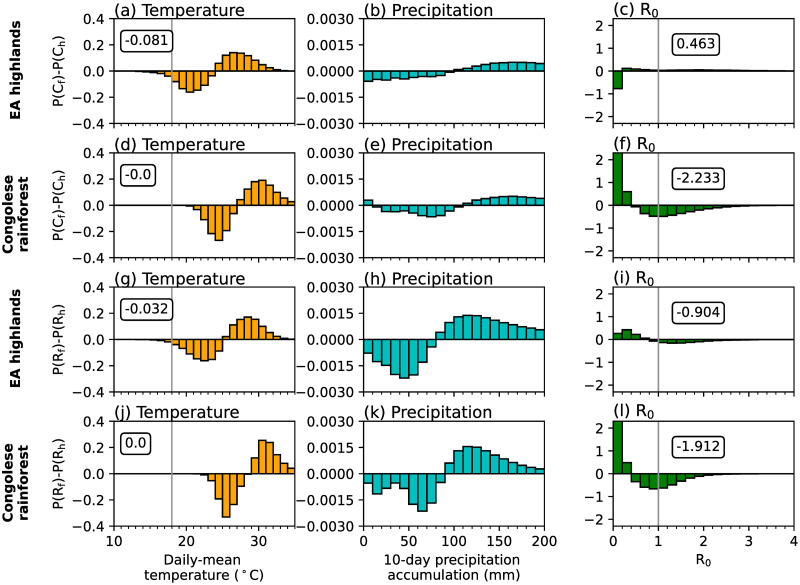
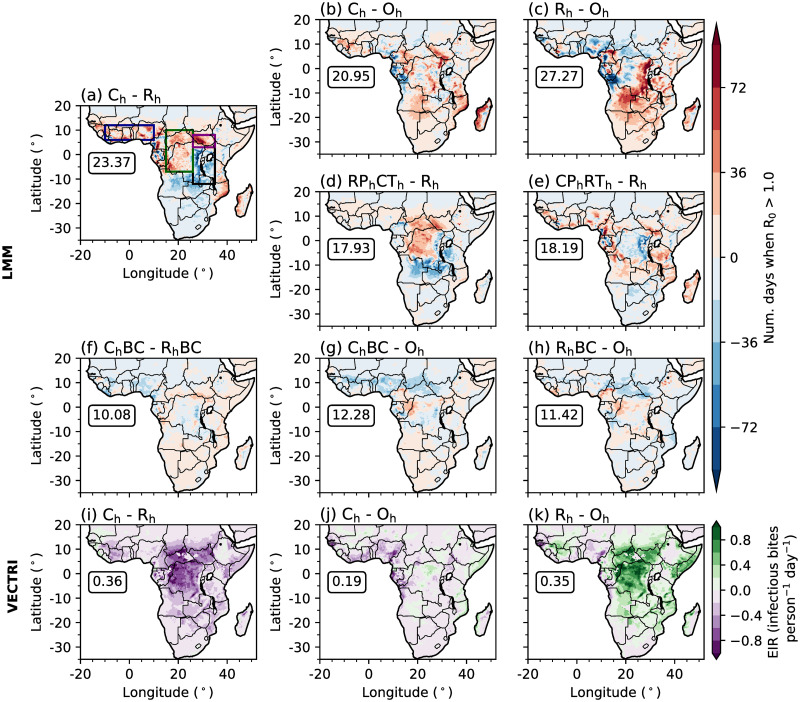
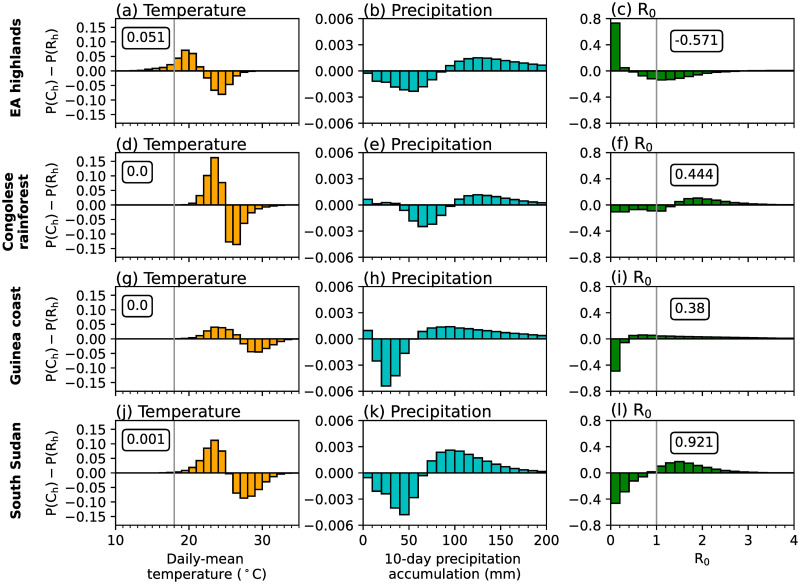
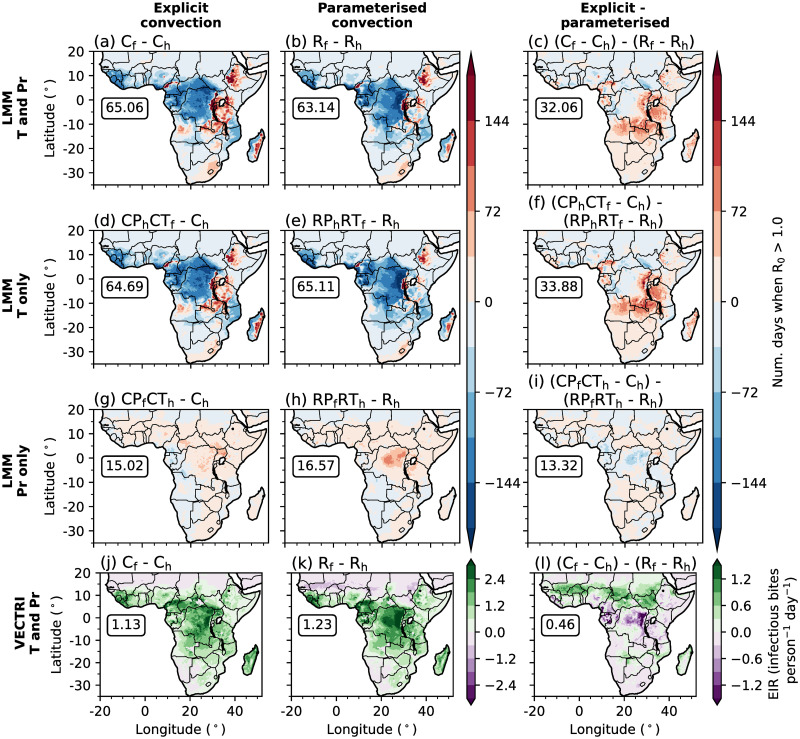
Malaria transmission across sub-Saharan Africa is sensitive to rainfall and temperature. Whilst different malaria modelling techniques and climate simulations have been used to predict malaria transmission risk, most of these studies use coarse-resolution climate models. In these models convection, atmospheric vertical motion driven by instability gradients and responsible for heavy rainfall, is parameterised. Over the past decade enhanced computational capabilities have enabled the simulation of high-resolution continental-scale climates with an explicit representation of convection. In this study we use two malaria models, the Liverpool Malaria Model (LMM) and Vector-Borne Disease Community Model of the International Centre for Theoretical Physics (VECTRI), to investigate the effect of explicitly representing convection on simulated malaria transmission. The concluded impact of explicitly representing convection on simulated malaria transmission depends on the chosen malaria model and local climatic conditions. For instance, in the East African highlands, cooler temperatures when explicitly representing convection decreases LMM-predicted malaria transmission risk by approximately 55%, but has a negligible effect in VECTRI simulations. Even though explicitly representing convection improves rainfall characteristics, concluding that explicit convection improves simulated malaria transmission depends on the chosen metric and malaria model. For example, whilst we conclude improvements of 45% and 23% in root mean squared differences of the annual-mean reproduction number and entomological inoculation rate for VECTRI and the LMM respectively, bias-correcting mean climate conditions minimises these improvements. The projected impact of anthropogenic climate change on malaria incidence is also sensitive to the chosen malaria model and representation of convection. The LMM is relatively insensitive to future changes in precipitation intensity, whilst VECTRI predicts increased risk across the Sahel due to enhanced rainfall. We postulate that VECTRI's enhanced sensitivity to precipitation changes compared to the LMM is due to the inclusion of surface hydrology. Future research should continue assessing the effect of high-resolution climate modelling in impact-based forecasting.
撒哈拉以南非洲的疟疾传播对降雨量和温度敏感。虽然已经使用了不同的疟疾建模技术和气候模拟来预测疟疾传播风险,但这些研究大多使用粗分辨率气候模型。在这些模型中,对流,由不稳定梯度驱动的大气垂直运动,负责强降雨,是参数化的。在过去的十年中,增强的计算能力使得可以模拟具有对流显式表示的高分辨率大陆尺度气候。在这项研究中,我们使用两种疟疾模型,利物浦疟疾模型(LMM)和国际理论物理中心的虫媒疾病社区模型(VECTRI),来研究显式表示对流对模拟疟疾传播的影响。显式表示对流对模拟疟疾传播的影响取决于所选的疟疾模型和当地的气候条件。例如,在东非高原,当显式表示对流时,温度降低会使 LMM 预测的疟疾传播风险降低约 55%,但在 VECTRI 模拟中几乎没有影响。即使显式表示对流会改善降雨特征,但结论是显式对流会改善模拟疟疾传播,这取决于所选择的指标和疟疾模型。例如,虽然我们得出结论,VECTRI 和 LMM 的年度平均繁殖数和昆虫接种率的均方根差异的分别提高了 45%和 23%,但对气候条件进行偏置校正会最小化这些改进。人为气候变化对疟疾发病率的预计影响也取决于所选的疟疾模型和对流的表示。LMM 对降水强度的未来变化相对不敏感,而 VECTRI 则由于降雨增强而预测萨赫勒地区的风险增加。我们假设,与 LMM 相比,VECTRI 对降水变化的敏感性增强是由于包括了地表水文学。未来的研究应继续评估高分辨率气候模型在基于影响的预测中的效果。