Faculty of Medicine and Health Technology, Tampere University, Tampere, Finland.
Finnish Cardiovascular Research Center, Tampere, Finland.
Sci Rep. 2024 Apr 17;14(1):8882. doi: 10.1038/s41598-024-56595-0.
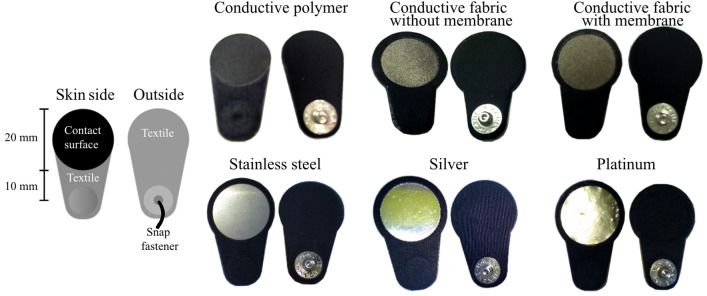
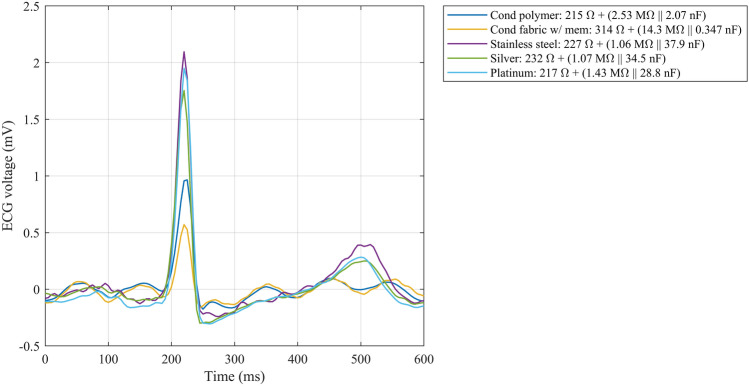
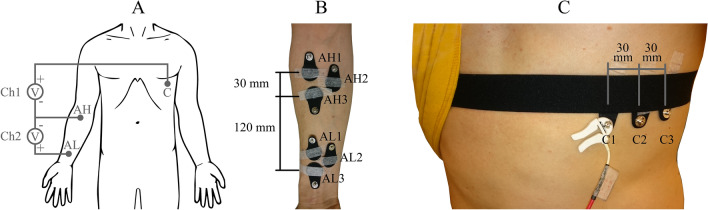
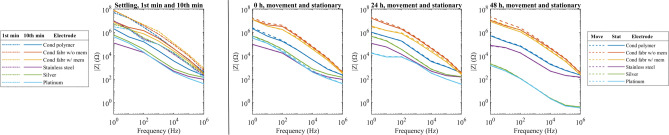
Wearable long-term monitoring applications are becoming more and more popular in both the consumer and the medical market. In wearable ECG monitoring, the data quality depends on the properties of the electrodes and on how they interface with the skin. Dry electrodes do not require any action from the user. They usually do not irritate the skin, and they provide sufficiently high-quality data for ECG monitoring purposes during low-intensity user activity. We investigated prospective motion artifact-resistant dry electrode materials for wearable ECG monitoring. The tested materials were (1) porous: conductive polymer, conductive silver fabric; and (2) solid: stainless steel, silver, and platinum. ECG was acquired from test subjects in a 10-min continuous settling test and in a 48-h intermittent long-term test. In the settling test, the electrodes were stationary, whereas both stationary and controlled motion artifact tests were included in the long-term test. The signal-to-noise ratio (SNR) was used as the figure of merit to quantify the results. Skin-electrode interface impedance was measured to quantify its effect on the ECG, as well as to leverage the dry electrode ECG amplifier design. The SNR of all electrode types increased during the settling test. In the long-term test, the SNR was generally elevated further. The introduction of electrode movement reduced the SNR markedly. Solid electrodes had a higher SNR and lower skin-electrode impedance than porous electrodes. In the stationary testing, stainless steel showed the highest SNR, followed by platinum, silver, conductive polymer, and conductive fabric. In the movement testing, the order was platinum, stainless steel, silver, conductive polymer, and conductive fabric.
可穿戴式长期监测应用在消费者和医疗市场中越来越受欢迎。在可穿戴式心电图监测中,数据质量取决于电极的特性及其与皮肤的接口方式。干电极不需要用户采取任何行动。它们通常不会刺激皮肤,并且在低强度用户活动期间,为心电图监测提供足够高质量的数据。我们研究了用于可穿戴式心电图监测的前瞻性抗运动伪影干电极材料。测试的材料有:(1)多孔:导电聚合物、导电银纤维;(2)固体:不锈钢、银和铂。从测试对象中采集 10 分钟连续稳定测试和 48 小时间歇性长期测试的心电图。在稳定测试中,电极是静止的,而在长期测试中包括静止和受控运动伪影测试。信噪比(SNR)被用作量化结果的指标。测量皮肤-电极界面阻抗,以量化其对心电图的影响,并利用干电极心电图放大器设计。所有电极类型的 SNR 在稳定测试中都增加。在长期测试中,SNR 通常进一步提高。电极运动的引入显著降低了 SNR。固体电极的 SNR 比多孔电极更高,皮肤-电极阻抗更低。在静止测试中,不锈钢的 SNR 最高,其次是铂、银、导电聚合物和导电织物。在运动测试中,顺序是铂、不锈钢、银、导电聚合物和导电织物。