Ge Tianxin, Hu Wenxu, Zhang Zilong, He Xuexue, Wang Liqiu, Han Xing, Dai Zong
Guangdong Provincial Key Laboratory of Sensing Technology and Biomedical Instrument, School of Biomedical Engineering, Shenzhen Campus of Sun Yat-sen University, Sun Yat-sen University, No.66, Gongchang Road, Guangming District, Shenzhen, Guangdong, 518107, PR China.
Department of Mechanical Engineering, The Hong Kong Polytechnic University, 999077, Hong Kong, PR China.
Mater Today Bio. 2024 Apr 4;26:101048. doi: 10.1016/j.mtbio.2024.101048. eCollection 2024 Jun.
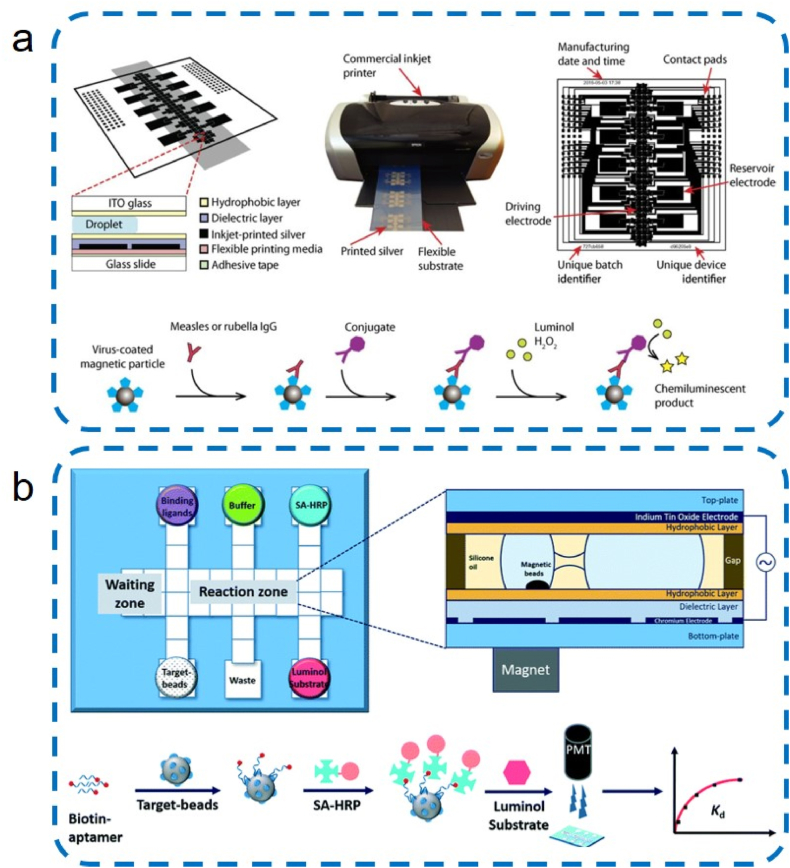
Biosensing is vital for many areas like disease diagnosis, infectious disease prevention, and point-of-care monitoring. Microfluidics has been evidenced to be a powerful tool for biosensing via integrating biological detection processes into a palm-size chip. Based on the chip structure, microfluidics has two subdivision types: open microfluidics and closed microfluidics, whose operation methods would be diverse. In this review, we summarize fundamentals, liquid control methods, and applications of open and closed microfluidics separately, point out the bottlenecks, and propose potential directions of microfluidics-based biosensing.
生物传感对于疾病诊断、传染病预防和即时护理监测等许多领域至关重要。通过将生物检测过程集成到手掌大小的芯片中,微流控技术已被证明是一种强大的生物传感工具。基于芯片结构,微流控技术有两种细分类型:开放式微流控和封闭式微流控,其操作方法各不相同。在本综述中,我们分别总结了开放式和封闭式微流控的基本原理、液体控制方法及应用,指出了瓶颈问题,并提出了基于微流控的生物传感的潜在发展方向。