Lu Lan, Zhao Yuting, Li Mingxing, Wang Xiaobo, Zhu Jie, Liao Li, Wang Jingya
Key Laboratory of Medicinal and Edible Plants Resources Development of Sichuan Education Department, Sichuan Industrial Institute of Antibiotics, School of Pharmacy, Chengdu University, Chengdu, 610000, China.
Meishan Pharmaceutical Vocational College, School of Pharmacy, Meishan, Sichuan, 620200, China.
J Pharm Anal. 2024 Apr;14(4):100906. doi: 10.1016/j.jpha.2023.11.013. Epub 2023 Nov 29.
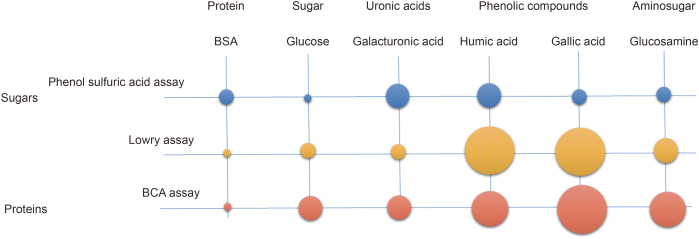
Extracellular polymeric substances (EPS) constitutes crucial elements within bacterial biofilms, facilitating accelerated antimicrobial resistance and conferring defense against the host's immune cells. Developing precise and effective antibiofilm approaches and strategies, tailored to the specific characteristics of EPS composition, can offer valuable insights for the creation of novel antimicrobial drugs. This, in turn, holds the potential to mitigate the alarming issue of bacterial drug resistance. Current analysis of EPS compositions relies heavily on colorimetric approaches with a significant bias, which is likely due to the selection of a standard compound and the cross-interference of various EPS compounds. Considering the pivotal role of EPS in biofilm functionality, it is imperative for EPS research to delve deeper into the analysis of intricate compositions, moving beyond the current focus on polymeric materials. This necessitates a shift from heavy reliance on colorimetric analytic methods to more comprehensive and nuanced analytical approaches. In this study, we have provided a comprehensive summary of existing analytical methods utilized in the characterization of EPS compositions. Additionally, novel strategies aimed at targeting EPS to enhance biofilm penetration were explored, with a specific focus on highlighting the limitations associated with colorimetric methods. Furthermore, we have outlined the challenges faced in identifying additional components of EPS and propose a prospective research plan to address these challenges. This review has the potential to guide future researchers in the search for novel compounds capable of suppressing EPS, thereby inhibiting biofilm formation. This insight opens up a new avenue for exploration within this research domain.
胞外聚合物(EPS)是细菌生物膜中的关键成分,它促进了抗菌耐药性的加速发展,并赋予细菌抵御宿主免疫细胞的能力。开发针对EPS组成特定特征的精确有效的抗生物膜方法和策略,可为新型抗菌药物的研发提供有价值的见解。这反过来又有可能缓解令人担忧的细菌耐药性问题。目前对EPS组成的分析严重依赖比色法,且存在显著偏差,这可能是由于标准化合物的选择以及各种EPS化合物的交叉干扰所致。考虑到EPS在生物膜功能中的关键作用,EPS研究有必要深入分析其复杂的组成,而不仅仅局限于目前对聚合材料的关注。这就需要从严重依赖比色分析方法转向更全面、更细致的分析方法。在本研究中,我们全面总结了用于表征EPS组成的现有分析方法。此外,还探索了旨在靶向EPS以增强生物膜穿透性的新策略,特别强调了比色法的局限性。此外,我们概述了在识别EPS其他成分时面临的挑战,并提出了应对这些挑战的前瞻性研究计划。这篇综述有可能指导未来的研究人员寻找能够抑制EPS从而抑制生物膜形成的新型化合物。这一见解为该研究领域开辟了一条新的探索途径。