Pathogen Genomics Laboratory, Biological and Environmental Sciences and Engineering, King Abdullah University of Science and Technology, 23955-6900, Jeddah, Makkah, Saudi Arabia.
King Saud Bin Abdulaziz University for Health Sciences, Riyadh, Saudi Arabia.
Genome Med. 2024 Apr 18;16(1):58. doi: 10.1186/s13073-024-01332-5.
Klebsiella pneumoniae is a major bacterial and opportunistic human pathogen, increasingly recognized as a healthcare burden globally. The convergence of resistance and virulence in K. pneumoniae strains has led to the formation of hypervirulent and multidrug-resistant strains with dual risk, limiting treatment options. K. pneumoniae clones are known to emerge locally and spread globally. Therefore, an understanding of the dynamics and evolution of the emerging strains in hospitals is warranted to prevent future outbreaks.
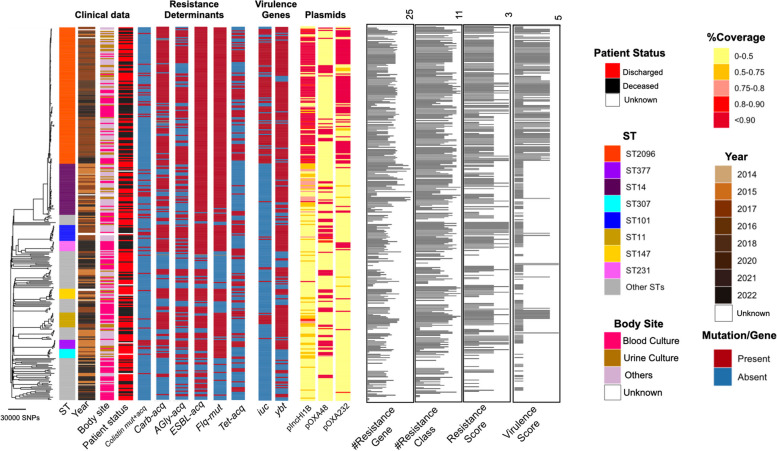
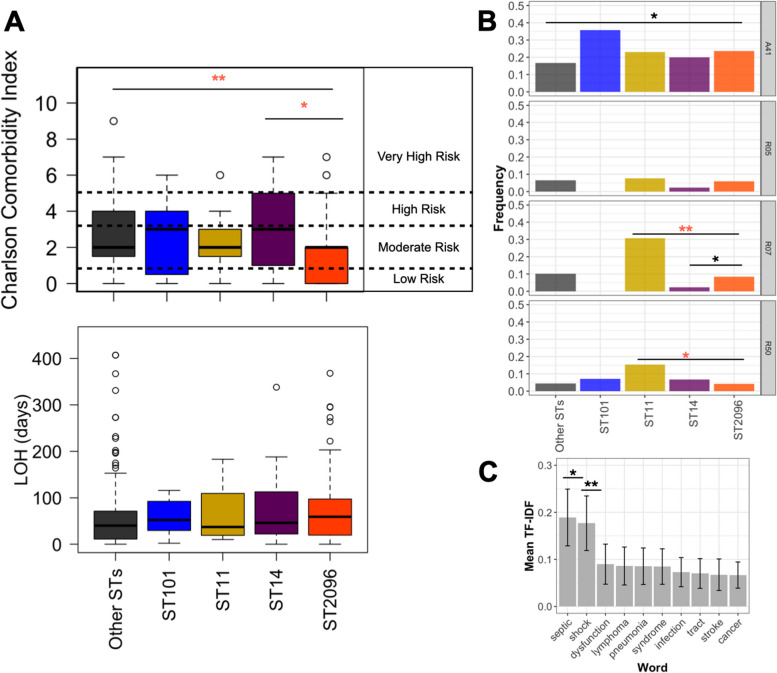
In this study, we conducted an in-depth genomic analysis on a large-scale collection of 328 multidrug-resistant (MDR) K. pneumoniae strains recovered from 239 patients from a single major hospital in the western coastal city of Jeddah in Saudi Arabia from 2014 through 2022. We employed a broad range of phylogenetic and phylodynamic methods to understand the evolution of the predominant clones on epidemiological time scales, virulence and resistance determinants, and their dynamics. We also integrated the genomic data with detailed electronic health record (EHR) data for the patients to understand the clinical implications of the resistance and virulence of different strains.
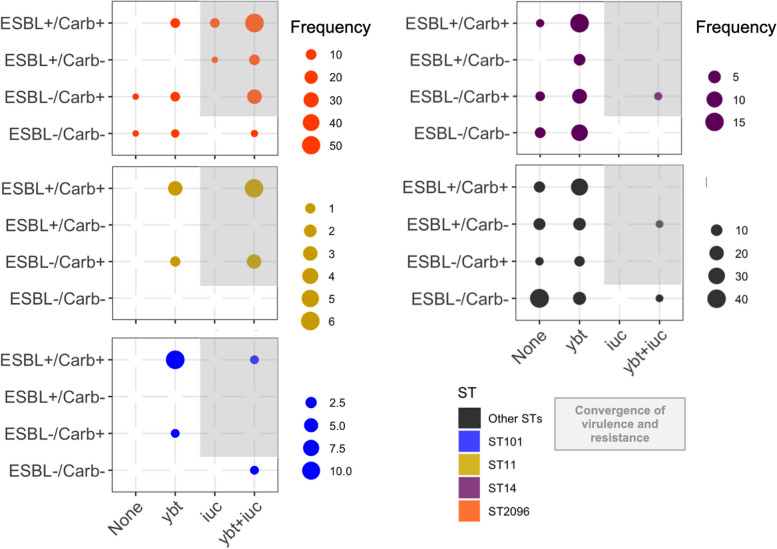
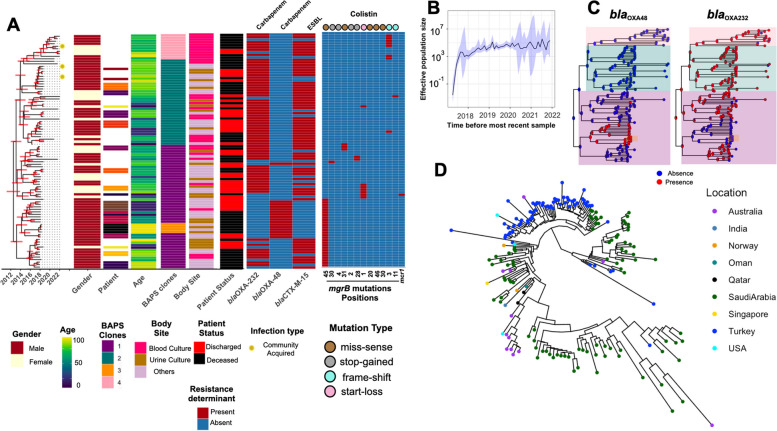
We discovered a diverse population underlying the infections, with most strains belonging to Clonal Complex 14 (CC14) exhibiting dominance. Specifically, we observed the emergence and continuous expansion of strains belonging to the dominant ST2096 in the CC14 clade across hospital wards in recent years. These strains acquired resistance mutations against colistin and extended spectrum β-lactamase (ESBL) and carbapenemase genes, namely bla and bla, located on three distinct plasmids, on epidemiological time scales. Strains of ST2096 exhibited a high virulence level with the presence of the siderophore aerobactin (iuc) locus situated on the same mosaic plasmid as the ESBL gene. Integration of ST2096 with EHR data confirmed the significant link between colonization by ST2096 and the diagnosis of sepsis and elevated in-hospital mortality (p-value < 0.05).
Overall, these results demonstrate the clinical significance of ST2096 clones and illustrate the rapid evolution of an emerging hypervirulent and MDR K. pneumoniae in a clinical setting.
肺炎克雷伯菌是一种主要的细菌性病原体和机会性病原体,在全球范围内日益被认为是医疗保健的负担。肺炎克雷伯菌菌株的耐药性和毒力的融合导致了具有双重风险的高毒力和多药耐药菌株的形成,限制了治疗选择。已知肺炎克雷伯菌克隆在当地出现并在全球传播。因此,了解医院中新兴菌株的动态和进化是有必要的,以防止未来的爆发。
在这项研究中,我们对 2014 年至 2022 年间从沙特阿拉伯吉达市西部沿海一家主要医院的 239 名患者中分离的 328 株多药耐药(MDR)肺炎克雷伯菌进行了大规模基因组分析。我们采用了广泛的系统发育和系统进化方法,以了解流行时间尺度上主要克隆的进化、毒力和耐药决定因素及其动态。我们还将基因组数据与患者的详细电子健康记录(EHR)数据整合,以了解不同菌株的耐药性和毒力的临床意义。
我们发现感染的基础是一个多样化的群体,大多数菌株属于克隆复合体 14(CC14),表现出优势。具体来说,我们观察到近年来,CC14 分支中的主导 ST2096 菌株的出现和持续扩张,这些菌株在医院病房中获得了对粘菌素和扩展谱β-内酰胺酶(ESBL)和碳青霉烯酶基因的耐药突变,即 bla 和 bla,位于三个不同的质粒上,在流行病学时间尺度上。ST2096 菌株表现出高毒力水平,铁载体aerobactin(iuc)基因位于与 ESBL 基因相同的镶嵌质粒上。将 ST2096 与 EHR 数据整合证实了 ST2096 定植与败血症和院内死亡率升高的显著关联(p 值<0.05)。
总的来说,这些结果表明 ST2096 克隆具有临床意义,并说明了一种新兴的高毒力和多药耐药肺炎克雷伯菌在临床环境中的快速进化。