Hopkins Jacob W, Sulka Katherine B, Sawden Machlan, Carroll Kimberly A, Brown Ronald D, Bunnell Stephen C, Poltorak Alexander, Tai Albert, Reed Eric R, Sharma Shruti
Department of Immunology, Tufts University, Boston, MA 02111.
Graduate School of Biomedical Sciences, Tufts University, Boston, MA 02111.
bioRxiv. 2024 Apr 8:2024.04.04.588107. doi: 10.1101/2024.04.04.588107.
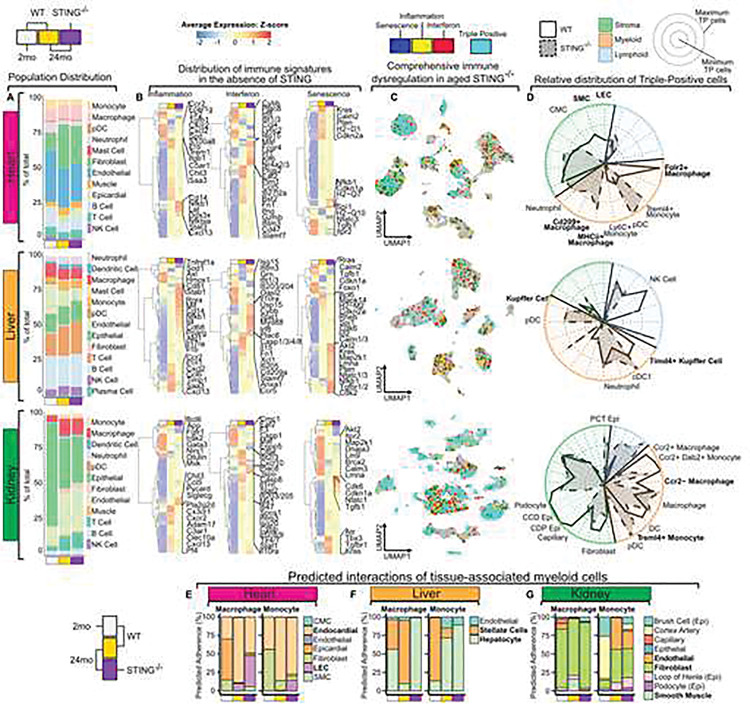
Local immune processes within aging tissues are a significant driver of aging associated dysfunction, but tissue-autonomous pathways and cell types that modulate these responses remain poorly characterized. The cytosolic DNA sensing pathway, acting through cyclic GMP-AMP synthase (cGAS) and Stimulator of Interferon Genes (STING), is broadly expressed in tissues, and is poised to regulate local type I interferon (IFN-I)-dependent and independent inflammatory processes within tissues. Recent studies suggest that the cGAS/STING pathway may drive pathology in various and models of accelerated aging. To date, however, the role of the cGAS/STING pathway in physiological aging processes, in the absence of genetic drivers, has remained unexplored. This remains a relevant gap, as STING is ubiquitously expressed, implicated in multitudinous disorders, and loss of function polymorphisms of STING are highly prevalent in the human population (>50%). Here we reveal that, during physiological aging, STING-deficiency leads to a significant shortening of murine lifespan, increased pro-inflammatory serum cytokines and tissue infiltrates, as well as salient changes in histological composition and organization. We note that aging hearts, livers, and kidneys express distinct subsets of inflammatory, interferon-stimulated gene (ISG), and senescence genes, collectively comprising an immune for each tissue. These distinctive patterns are largely imprinted by tissue-specific stromal and myeloid cells. Using cellular interaction network analyses, immunofluorescence, and histopathology data, we show that these immune fingerprints shape the tissue architecture and the landscape of cell-cell interactions in aging tissues. These age-associated immune fingerprints are grossly dysregulated with STING-deficiency, with key genes that define aging STING-sufficient tissues greatly diminished in the absence of STING. Changes in immune signatures are concomitant with a restructuring of the stromal and myeloid fractions, whereby cell:cell interactions are grossly altered and resulting in disorganization of tissue architecture in STING-deficient organs. This altered homeostasis in aging STING-deficient tissues is associated with a cross-tissue loss of homeostatic tissue-resident macrophage (TRM) populations in these tissues. analyses reveal that basal STING-signaling limits the susceptibility of TRMs to death-inducing stimuli and determines their localization in tissue niches, thereby promoting tissue homeostasis. Collectively, these data upend the paradigm that cGAS/STING signaling is primarily pathological in aging and instead indicate that basal STING signaling sustains tissue function and supports organismal longevity. Critically, our study urges caution in the indiscriminate targeting of these pathways, which may result in unpredictable and pathological consequences for health during aging.
衰老组织中的局部免疫过程是衰老相关功能障碍的重要驱动因素,但调节这些反应的组织自主途径和细胞类型仍未得到充分表征。通过环鸟苷酸-腺苷酸合成酶(cGAS)和干扰素基因刺激物(STING)起作用的胞质DNA传感途径在组织中广泛表达,并有望调节组织内局部I型干扰素(IFN-I)依赖性和非依赖性炎症过程。最近的研究表明,cGAS/STING途径可能在各种加速衰老的模型中引发病理变化。然而,迄今为止,在没有遗传驱动因素的情况下,cGAS/STING途径在生理衰老过程中的作用仍未得到探索。这仍然是一个相关的空白,因为STING在全身广泛表达,与多种疾病有关,并且STING的功能丧失多态性在人群中非常普遍(>50%)。在这里,我们揭示了在生理衰老过程中,STING缺陷会导致小鼠寿命显著缩短,促炎血清细胞因子和组织浸润增加,以及组织学组成和结构的显著变化。我们注意到,衰老的心脏、肝脏和肾脏表达炎症、干扰素刺激基因(ISG)和衰老基因的不同子集,共同构成每个组织的免疫特征。这些独特的模式在很大程度上由组织特异性基质细胞和髓样细胞印记。通过细胞相互作用网络分析、免疫荧光和组织病理学数据,我们表明这些免疫指纹塑造了衰老组织中的组织结构和细胞间相互作用的格局。这些与年龄相关的免疫指纹在STING缺陷时严重失调,在没有STING的情况下,定义衰老的STING充足组织的关键基因大大减少。免疫特征的变化与基质和髓样部分的重组同时发生,由此细胞间相互作用发生严重改变,导致STING缺陷器官的组织结构紊乱。衰老的STING缺陷组织中这种改变的内环境稳态与这些组织中稳态组织驻留巨噬细胞(TRM)群体的跨组织丧失有关。分析表明,基础STING信号限制了TRM对死亡诱导刺激的敏感性,并决定了它们在组织微环境中的定位,从而促进组织内环境稳态。总的来说,这些数据颠覆了cGAS/STING信号在衰老中主要是病理性的这一范式,相反表明基础STING信号维持组织功能并支持机体长寿。至关重要的是,我们的研究敦促在不加区分地靶向这些途径时要谨慎,因为这可能会在衰老过程中对健康产生不可预测的病理后果。