Morang'a Alexina K, Muloi Dishon M, Kamau Simon M, Onono Joshua O, Gathura Peter B, Moodley Arshnee
Animal and Human Health Program, International Livestock Research Institute, Nairobi, Kenya.
Department of Public Health, Pharmacology and Toxicology, Faculty of Veterinary Medicine, University of Nairobi, Nairobi, Kenya.
Front Vet Sci. 2024 Apr 5;11:1304318. doi: 10.3389/fvets.2024.1304318. eCollection 2024.
To effectively regulate and reduce antibiotic use, in the livestock sector, a thorough understanding of the flow of veterinary antibiotics will help to identify key nodes in the chain for targeted interventions. The aim of this study was to understand the flow of antibiotics from import to end-user, and identify relevant governance mechanisms.
A mixed methods approach was used to collect data in three Kenyan counties (Nairobi, Kiambu, and Kajiado). Focus group discussions ( = 23), individual interviews ( = 148), and key informant interviews ( = 10) were conducted.
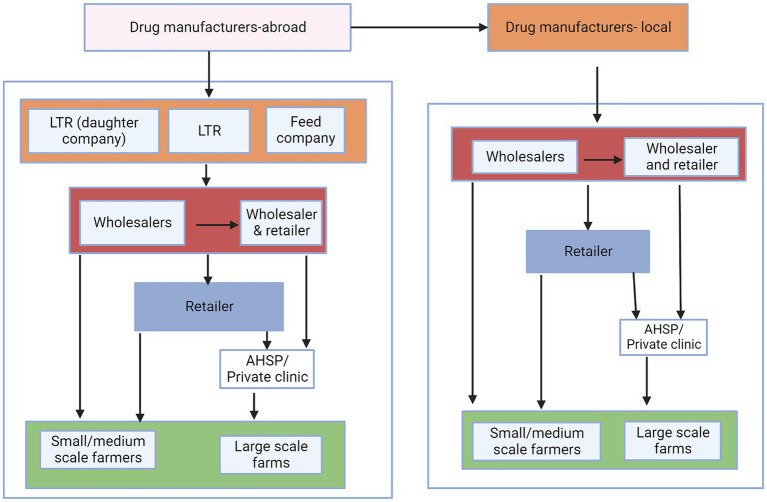
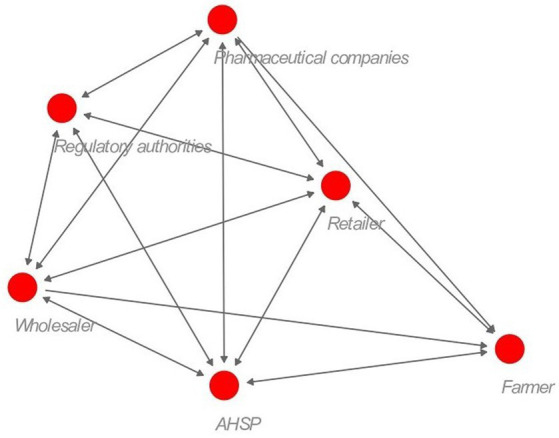
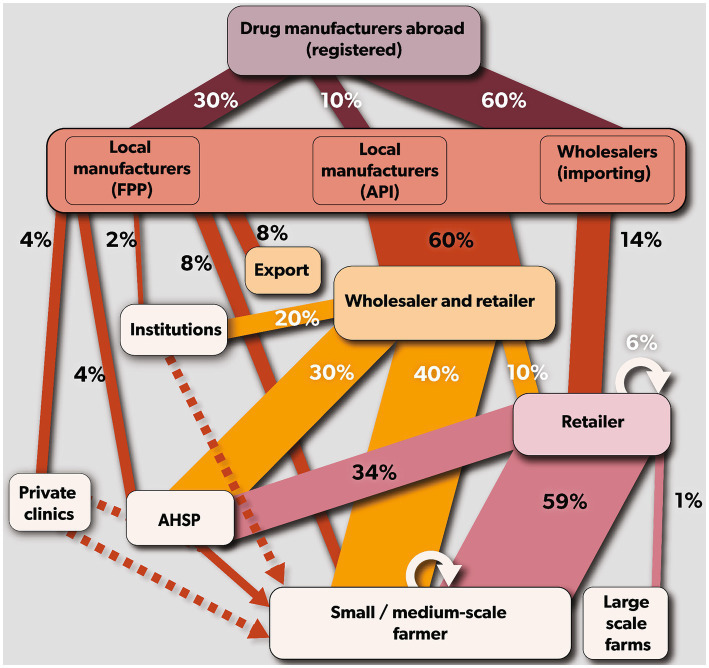
The key actors identified include primary wholesalers, secondary wholesalers, retailers, animal health service providers (AHSPs), and farmers. Kenya imports 100% of its veterinary antibiotics: primary wholesalers legally import antibiotics as finished pharmaceutical products (90%) or active pharmaceutical ingredients (10%) after approval by the Veterinary Medicines Directorate. Secondary wholesalers play a major role in the distribution of antibiotics (60% of antibiotics) from importers to farmers, AHSPs, and retailers. Some of the illegal sources of antibiotics include unlicenced/unauthorized middlemen and online platforms that sell directly to retailers, AHSPs, and farmers.
Despite the presence of various laws and regulations governing the antibiotic value chain, implementation has been a challenge due to financial and human resource constraints. This contributes to over-the-counter sale of antibiotics without prescription, unlicensed businesses selling antibiotics, illegal importation, and presence of poor-quality drugs. There is a need to review the applicability of existing policies and address policy gaps (e.g., product containing antibiotic combinations, and use of human critically important antibiotics) to ensure the prudent sale and use of antibiotics, pharmacovigilance, antimicrobial use surveillance, and developing a business model that aligns with antibiotic stewardship. Additional interventions include awareness raising and capacity building of the different stakeholders along the antibiotic distribution chain to reduce antibiotic mis- and overuse.
为有效规范和减少畜牧业中的抗生素使用,全面了解兽用抗生素的流通情况将有助于确定链条中的关键节点,以便进行有针对性的干预。本研究的目的是了解抗生素从进口到最终用户的流通情况,并确定相关治理机制。
采用混合方法在肯尼亚的三个县(内罗毕、基安布和卡贾多)收集数据。进行了焦点小组讨论(23次)、个人访谈(148次)和关键信息提供者访谈(10次)。
确定的关键行为者包括一级批发商、二级批发商、零售商、动物健康服务提供者(AHSP)和农民。肯尼亚100%的兽用抗生素依赖进口:一级批发商经兽药管理局批准后,以成品药品(90%)或活性药物成分(10%)的形式合法进口抗生素。二级批发商在将抗生素(占抗生素总量的60%)从进口商分销给农民、动物健康服务提供者和零售商方面发挥着主要作用。抗生素的一些非法来源包括未经许可/授权的中间商以及直接向零售商、动物健康服务提供者和农民销售的在线平台。
尽管存在各种管理抗生素价值链的法律法规,但由于财政和人力资源限制,实施一直是一项挑战。这导致了无处方的抗生素非处方销售、无许可证企业销售抗生素、非法进口以及劣质药品的存在。有必要审查现有政策的适用性并填补政策空白(例如,含有抗生素组合的产品以及人类极为重要的抗生素的使用),以确保抗生素的谨慎销售和使用、药物警戒、抗菌药物使用监测,并制定符合抗生素管理的商业模式。其他干预措施包括提高抗生素分销链上不同利益相关者的认识并开展能力建设,以减少抗生素的误用和滥用。