Dione Michel Mainack, Amia Winfred Christine, Ejobi Francis, Ouma Emily Awuor, Wieland Barbara
Animal and Human Health Program, International Livestock Research Institute, Dakar, Senegal.
Animal and Human Health Program, International Livestock Research Institute, Kampala, Uganda.
Front Vet Sci. 2021 Sep 8;8:611076. doi: 10.3389/fvets.2021.611076. eCollection 2021.
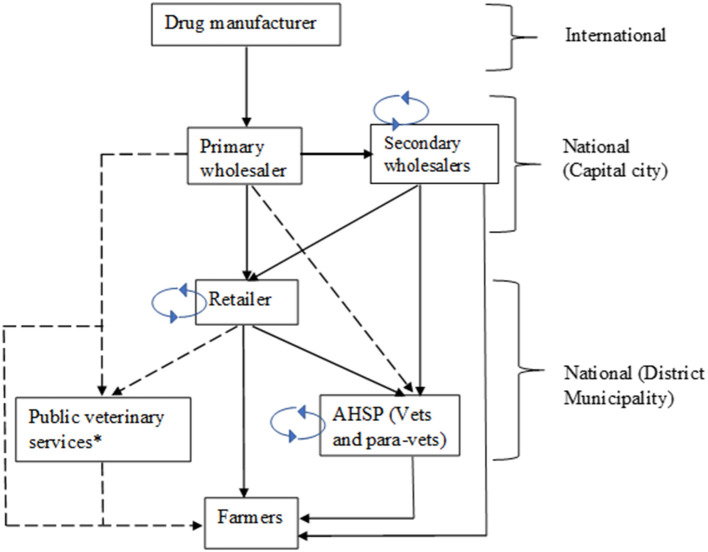
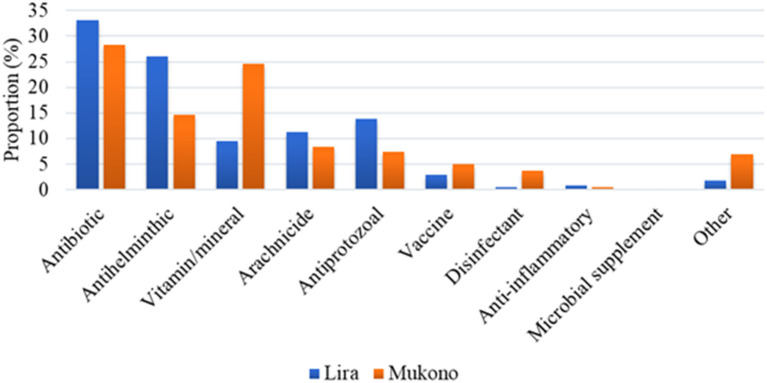
This study assessed the veterinary drug supply chain in Uganda, the constraints faced by the actors, and how the challenges influence the use of antimicrobial (AMs) by livestock farmers. We carried out stakeholder consultation workshops, key informant interviews and a knowledge, practices, and awareness survey with actors of the veterinary drug supply chain. We also profiled drugs stored in 23 urban and peri-urban drug shops in Lira and Mukono districts to record the commonly sold drugs. The veterinary drug supply chain is made of several actors including wholesalers, retailers, Animal Health Service Providers (AHSP) and farmers. Nearly ninety per cent of drug retailers and veterinary practitioners did not receive specialized training in veterinary medicine, and most of veterinary practitioners have been in the drug business market for more than 10 years. Antibiotics and anti-helminthics were the most stocked drugs by retailers, with antibiotics ranking highest in terms of contribution to annual financial profits, accounting for 33%. The choice of a drug by veterinary practitioners was mainly informed by past success with efficacy of the drug, and financial capacity of the client (the farmer) to meet the treatment cost. Many veterinary practitioners were not conversant with veterinary drug policies of the country, with Mukono having a higher number (72%) compared to Lira (37%). Veterinary practitioners from Lira district compared to Mukono and those mainly serving small scale farmers relative to large scale smallholders were more knowledgeable about antibiotics and AMR. Several supply chain constraints were identified as potential drivers of misuse of antibiotics that could contribute to AMR. These included low level of education of supply chain actors, particularly drug retailers, poor handling of drugs at purchase and administration practices, low enforcement of policies and regulations, and lack of awareness of stakeholders about policies that regulate drug use. Thus, future interventions to reduce misuse of AM drugs in livestock production systems in Uganda such as capacity building, should also target veterinary input suppliers, and deliberately involve a strong policy advocacy component.
本研究评估了乌干达的兽药供应链、各行为主体面临的制约因素,以及这些挑战如何影响家畜养殖户对抗菌素的使用。我们举办了利益相关者协商研讨会、关键信息人访谈,并对兽药供应链中的行为主体进行了知识、实践和认知调查。我们还对利拉和穆科诺区23家城市及城郊药店储存的药品进行了分析,以记录常见销售药品。兽药供应链由多个行为主体组成,包括批发商、零售商、动物卫生服务提供者(AHSP)和养殖户。近90%的药品零售商和兽医从业者未接受过兽医学专业培训,且大多数兽医从业者从事药品商业市场已超过10年。抗生素和抗蠕虫药是零售商库存最多的药品,其中抗生素对年度财务利润的贡献最高,占33%。兽医从业者选择药品的主要依据是该药过去的疗效以及客户(养殖户)支付治疗费用的经济能力。许多兽医从业者不熟悉该国的兽药政策,穆科诺区不熟悉政策的从业者比例(72%)高于利拉区(37%)。与穆科诺区相比,利拉区的兽医从业者以及主要服务小规模养殖户而非大规模小农户的从业者对抗生素和抗菌素耐药性的了解更多。已确定若干供应链制约因素是抗生素滥用的潜在驱动因素,可能导致抗菌素耐药性。这些因素包括供应链行为主体,尤其是药品零售商的教育水平低、药品采购和使用操作不当、政策法规执行不力,以及利益相关者对药品使用监管政策缺乏认识。因此,乌干达未来为减少家畜生产系统中抗菌药物滥用而采取的干预措施,如能力建设,也应针对兽医投入品供应商,并特意纳入强有力的政策宣传内容。