Dinh Mai Thi Ngoc, Nguyen Van Thi, Nguyen Ly Thi Huong
Faculty of Biotechnology, Chemistry and Environmental Engineering, Phenikaa University, A9 Building, Nguyen Van Trac Street, Ha Dong District, Hanoi, Vietnam.
Bioresource Research Center, Phenikaa University, Hanoi, Vietnam.
Bioresour Bioprocess. 2023 Aug 30;10(1):56. doi: 10.1186/s40643-023-00680-1.
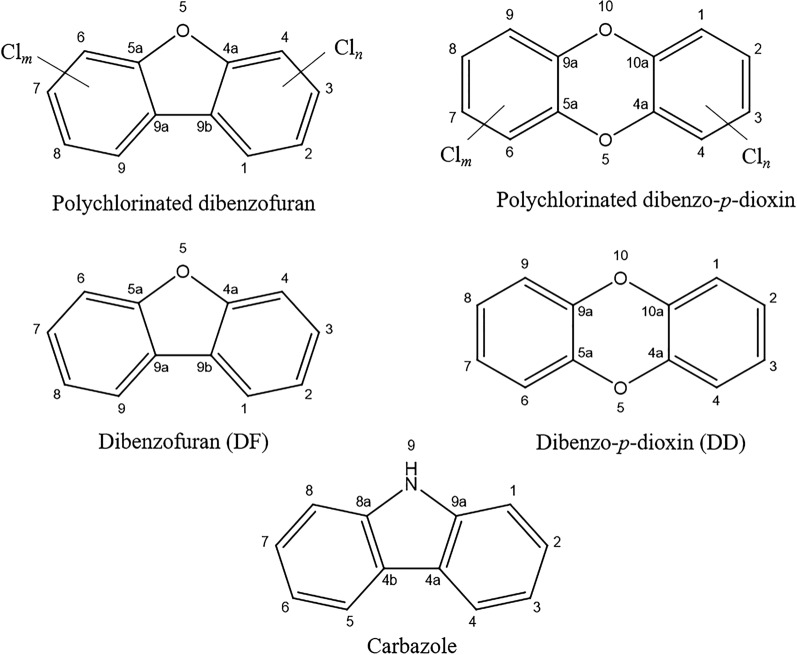
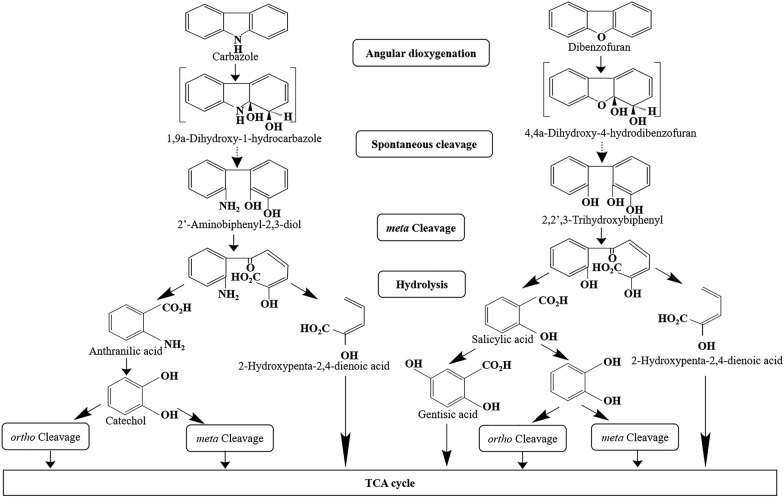
Extensive research has been conducted over the years on the bacterial degradation of dioxins and their related compounds including carbazole, because these chemicals are highly toxic and has been widely distributed in the environment. There is a pressing need to explore and develop more bacterial strains with unique catabolic features to effectively remediate dioxin-polluted sites. Carbazole has a chemical structure similar to dioxins, and the degradation pathways of these two chemicals are highly homologous. Some carbazole-degrading bacterial strains have been demonstrated to have the ability to degrade dioxins, such as Pseudomonas sp. strain CA10 và Sphingomonas sp. KA1. The introduction of strain KA1 into dioxin-contaminated model soil resulted in the degradation of 96% and 70% of 2-chlorodibenzo-p-dioxin (2-CDD) and 2,3-dichlorodibenzo-p-dioxin (2,3-DCDD), respectively, after 7-day incubation period. These degradation rates were similar to those achieved with strain CA10, which removed 96% of 2-CDD and 80% of 2,3-DCDD from the same model soil. Therefore, carbazole-degrading bacteria hold significant promise as potential candidates for dioxin bioremediation. This paper overviews the connection between the bacterial degradation of dioxins and carbazole, highlighting the potential for dioxin biodegradation by carbazole-degrading bacterial strains.
多年来,人们对二噁英及其相关化合物(包括咔唑)的细菌降解进行了广泛研究,因为这些化学物质毒性极高且已在环境中广泛分布。迫切需要探索和开发更多具有独特分解代谢特性的细菌菌株,以有效修复受二噁英污染的场地。咔唑的化学结构与二噁英相似,这两种化学物质的降解途径高度同源。一些咔唑降解细菌菌株已被证明具有降解二噁英的能力,如假单胞菌属菌株CA10和鞘氨醇单胞菌属菌株KA1。将菌株KA1引入受二噁英污染的模型土壤中,经过7天的培养期后,2-氯二苯并对二噁英(2-CDD)和2,3-二氯二苯并对二噁英(2,3-DCDD)的降解率分别达到了96%和70%。这些降解率与菌株CA10的降解率相似,菌株CA10从同一模型土壤中去除了96%的2-CDD和80%的2,3-DCDD。因此,咔唑降解细菌作为二噁英生物修复的潜在候选者具有巨大潜力。本文概述了二噁英和咔唑细菌降解之间的联系,强调了咔唑降解细菌菌株对二噁英生物降解的潜力。