Department of Surgery, University of New Mexico, Albuquerque, NM.
Department of Applied AI and Data Science, City of Hope National Medical Center, Duarte, CA.
JCO Clin Cancer Inform. 2024 Apr;8:e2300247. doi: 10.1200/CCI.23.00247.
Preoperative prediction of postoperative complications (PCs) in inpatients with cancer is challenging. We developed an explainable machine learning (ML) model to predict PCs in a heterogenous population of inpatients with cancer undergoing same-hospitalization major operations.
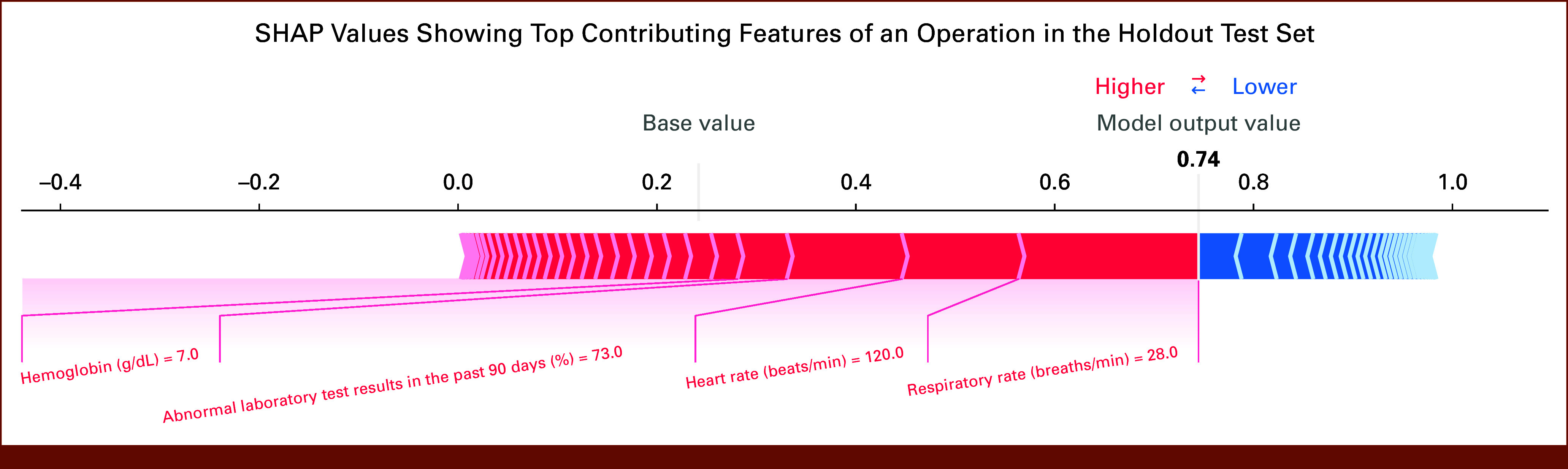
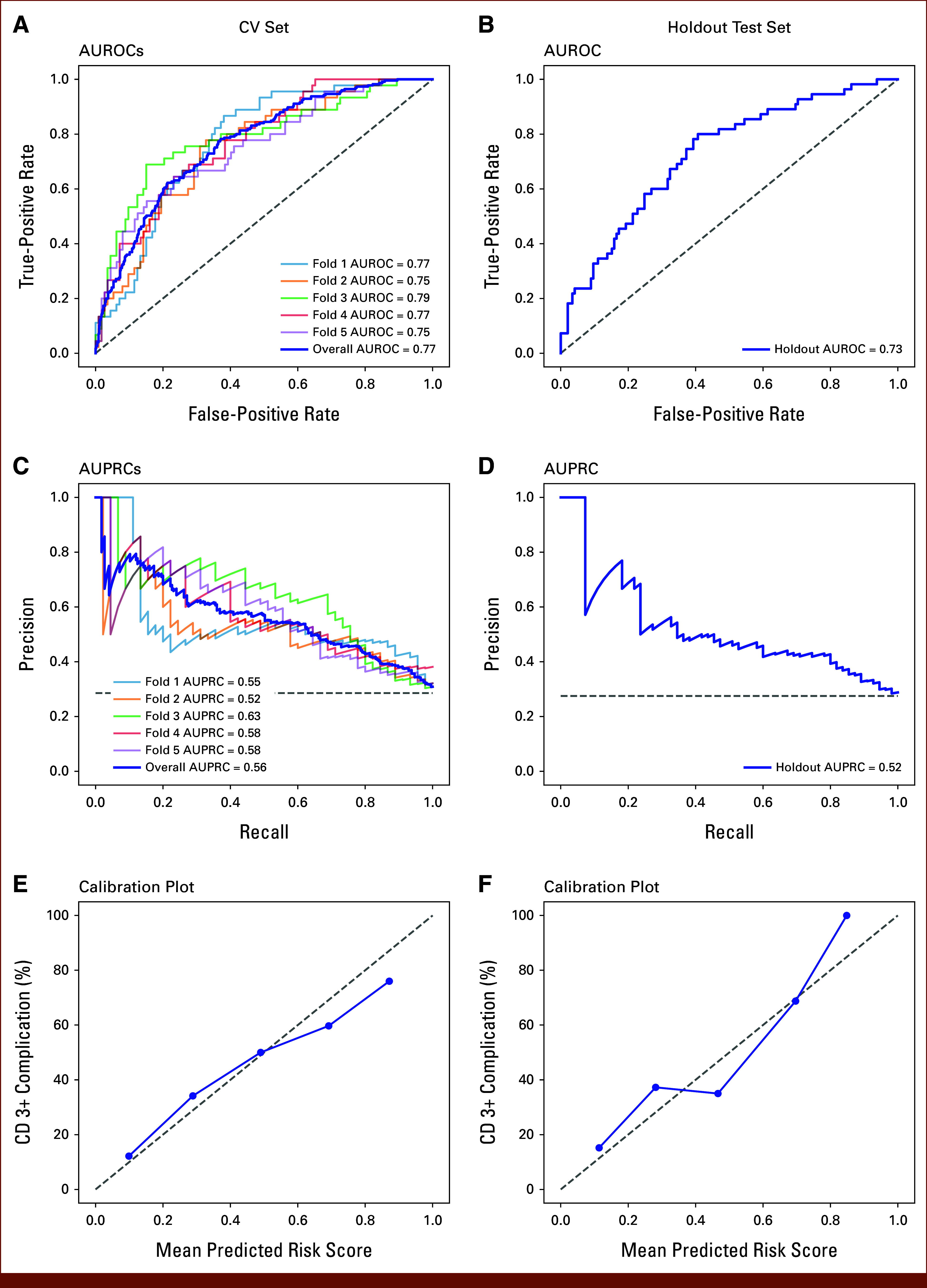
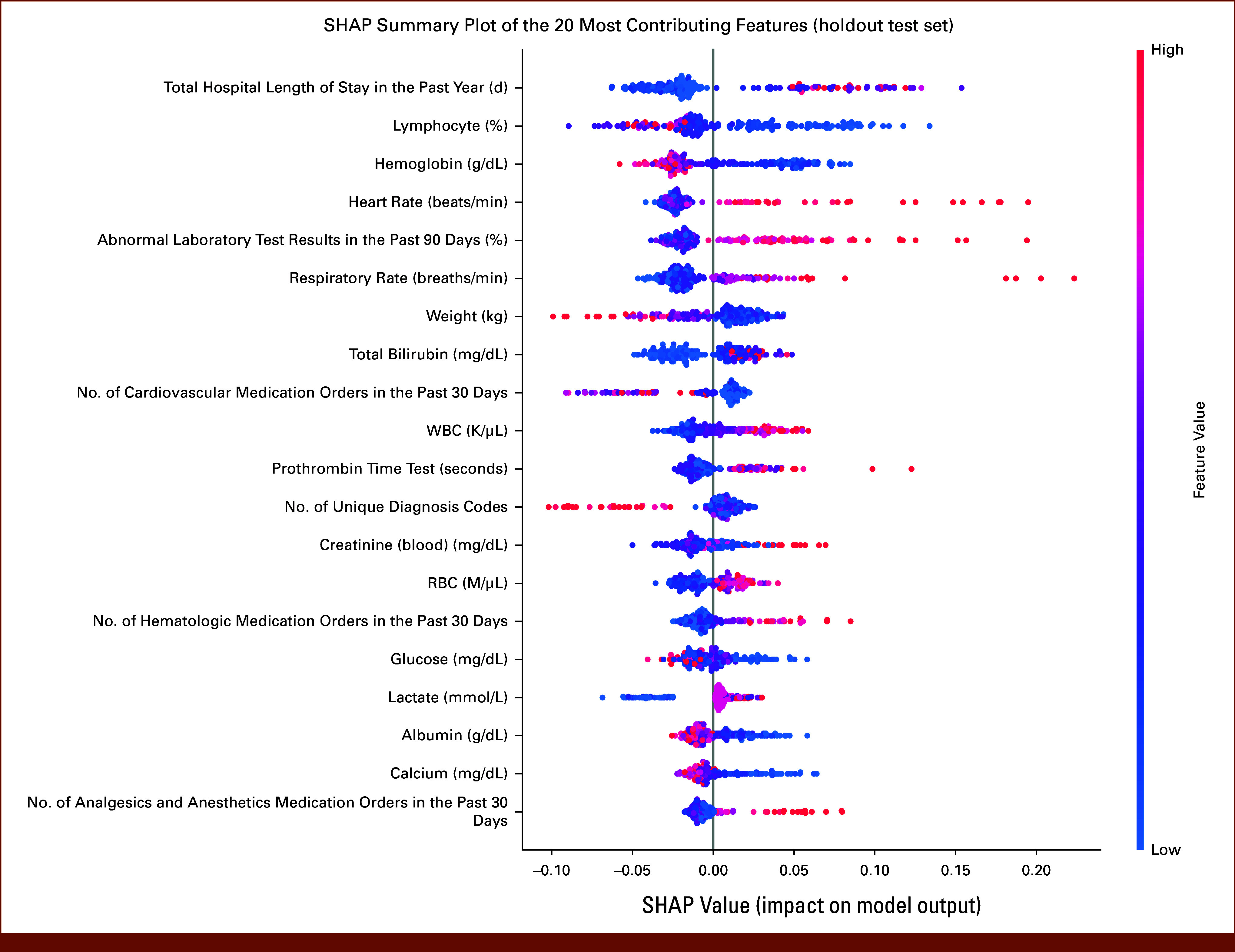
Consecutive inpatients who underwent same-hospitalization operations from December 2017 to June 2021 at a single institution were retrospectively reviewed. The ML model was developed and tested using electronic health record (EHR) data to predict 30-day PCs for patients with Clavien-Dindo grade 3 or higher (CD 3+) per the CD classification system. Model performance was assessed using area under the receiver operating characteristic curve (AUROC), area under the precision recall curve (AUPRC), and calibration plots. Model explanation was performed using the Shapley additive explanations (SHAP) method at cohort and individual operation levels.
A total of 988 operations in 827 inpatients were included. The ML model was trained using 788 operations and tested using a holdout set of 200 operations. The CD 3+ complication rates were 28.6% and 27.5% in the training and holdout test sets, respectively. Training and holdout test sets' model performance in predicting CD 3+ complications yielded an AUROC of 0.77 and 0.73 and an AUPRC of 0.56 and 0.52, respectively. Calibration plots demonstrated good reliability. The SHAP method identified features and the contributions of the features to the risk of PCs.
We trained and tested an explainable ML model to predict the risk of developing PCs in patients with cancer. Using patient-specific EHR data, the ML model accurately discriminated the risk of developing CD 3+ complications and displayed top features at the individual operation and cohort level.
预测癌症住院患者术后并发症(PCs)具有挑战性。我们开发了一种可解释的机器学习(ML)模型,以预测在同一家医院接受同种住院大手术的癌症住院患者的异质人群中的 PCs。
回顾性分析了 2017 年 12 月至 2021 年 6 月期间在一家单机构接受同种住院手术的连续住院患者。使用电子健康记录(EHR)数据开发和测试 ML 模型,以根据 Clavien-Dindo 分级系统(CD 分类系统)预测 CD3+患者(CD 分级 3 或更高)的 30 天 PCs。使用接受者操作特征曲线下面积(AUROC)、精度召回曲线下面积(AUPRC)和校准图评估模型性能。在队列和个体手术水平使用 Shapley 加性解释(SHAP)方法进行模型解释。
共纳入 827 名患者的 988 次手术。该 ML 模型使用 788 次手术进行训练,并使用 200 次手术的保留数据集进行测试。训练和保留测试集的 CD3+并发症发生率分别为 28.6%和 27.5%。训练和保留测试集在预测 CD3+并发症方面的模型性能分别产生了 0.77 和 0.73 的 AUROC 和 0.56 和 0.52 的 AUPRC。校准图表明可靠性良好。SHAP 方法确定了特征以及特征对 PCs 风险的贡献。
我们训练和测试了一种可解释的 ML 模型,以预测癌症患者发生 PCs 的风险。使用患者特定的 EHR 数据,ML 模型准确区分了发生 CD3+并发症的风险,并显示了个体手术和队列水平的顶级特征。