Rostami Sepideh, Alavi Seyed Mohammad, Daghagheleh Robab, Maraghi Elham, Hosseini Seyed Ahmad
Department of Nutrition, School of Allied Medical Sciences, Ahvaz Jundishapur University of Medical Sciences, Ahvaz, Iran.
Jundishapur Infectious and Tropical Diseases Research Center, Ahvaz Jundishapur University of Medical Sciences, Ahvaz, Iran.
Virol J. 2024 Apr 23;21(1):91. doi: 10.1186/s12985-024-02362-6.
This study sought to examine the impact of magnesium supplementation on clinical outcomes and biochemical factors among hospitalized patients with COVID-19.
This double-blind, randomized clinical trial was conducted at Razi Hospital, Ahvaz, Iran, between September 2021 and March 2022. Participants aged 18-70 years with moderate disease severity were enrolled. Magnesium supplementation (300 mg daily) was administered to the intervention group, while the control group received a placebo. Clinical outcomes, including the need for oxygen therapy, oxygen saturation, respiratory rate, fever, hs-CRP and TNF-α levels, as well as quality of life and mental health, were assessed. Blood samples were collected to measure biochemical variables.
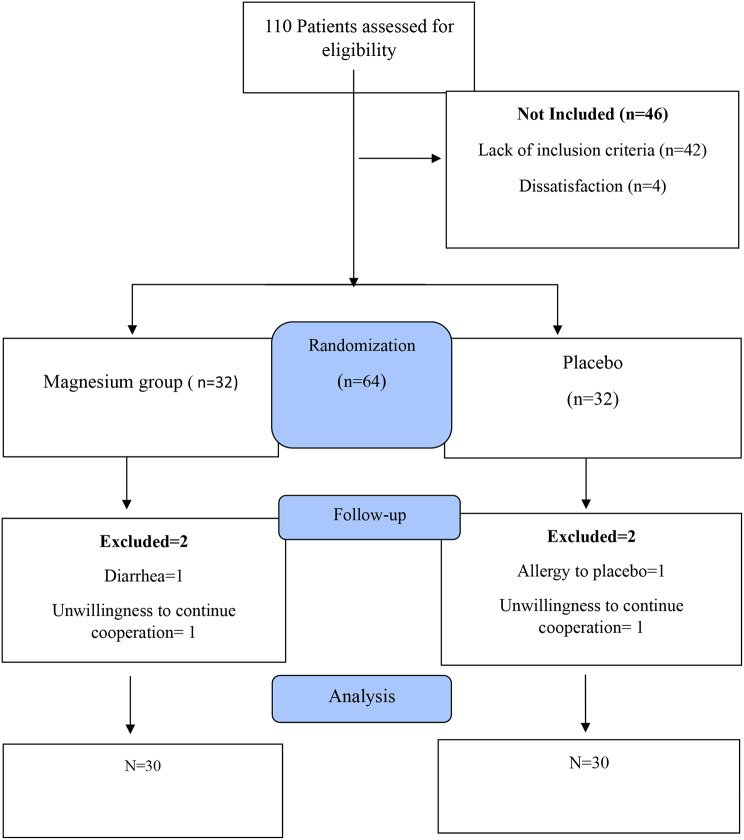
The main result was the count of individuals requiring oxygen therapy. Additional outcomes comprised of oxygen saturation, respiratory rate, fever, hs-CRP and TNF-α levels, as well as quality of life and mental health. Out of 64 participants, 60 completed the study. The results showed that magnesium supplementation significantly reduced the number of patients requiring oxygen therapy (9 vs. 14; P < 0.001). Moreover, the magnesium group demonstrated improved oxygen saturation compared to the control group (4.55 ± 2.35 vs. 1.8 ± 1.67; P < 0.001). Furthermore, we observed a noteworthy enhancement in the quality of life and depression score in the magnesium group. No significant differences were observed in respiratory rate, fever, hs-CRP, and TNF-α levels (P > 0.05).
The findings suggest that magnesium supplementation may have beneficial effects on clinical outcomes and arterial oxygen saturation in COVID-19 patients. More investigation is necessary to delve into its potential mechanisms and long-term effects on patient outcomes.
This study is registered on Iranian Registry of Clinical Trials (IRCT) under identifier IRCT20210413050957N1. (The registration date: May 1, 2021).
本研究旨在探讨补充镁对新冠肺炎住院患者临床结局和生化因素的影响。
本双盲随机临床试验于2021年9月至2022年3月在伊朗阿瓦士的拉齐医院进行。纳入年龄在18 - 70岁、疾病严重程度为中度的参与者。干预组给予补充镁(每日300毫克),而对照组接受安慰剂。评估临床结局,包括氧疗需求、血氧饱和度、呼吸频率、发热、hs-CRP和TNF-α水平,以及生活质量和心理健康。采集血样以测量生化变量。
主要结果是需要氧疗的个体数量。其他结局包括血氧饱和度、呼吸频率、发热、hs-CRP和TNF-α水平,以及生活质量和心理健康。64名参与者中,60名完成了研究。结果显示,补充镁显著减少了需要氧疗的患者数量(9例对14例;P < 0.001)。此外,与对照组相比,镁组的血氧饱和度有所改善(4.55±2.35对1.8±1.67;P < 0.001)。此外,我们观察到镁组的生活质量和抑郁评分有显著提高。呼吸频率、发热、hs-CRP和TNF-α水平未观察到显著差异(P > 0.05)。
研究结果表明,补充镁可能对新冠肺炎患者的临床结局和动脉血氧饱和度有有益影响。有必要进行更多研究以深入探讨其潜在机制以及对患者结局的长期影响。
本研究已在伊朗临床试验注册中心(IRCT)注册,标识符为IRCT20210413050957N1。(注册日期:2021年5月1日)