Preventive Medicine and Interdisciplinarity Department, Grigore T. Popa University of Medicine and Pharmacy Iasi, 700115 Iasi, Romania.
2nd Internal Medicine Department, Sf. Spiridon Clinical Emergency Hospital, 700111 Iasi, Romania.
Medicina (Kaunas). 2023 Jan 31;59(2):279. doi: 10.3390/medicina59020279.
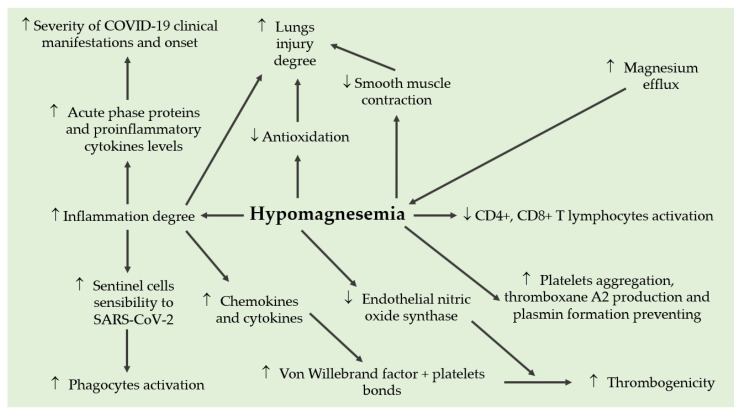
Magnesium is the fourth most common mineral in the human body and the second richest intracellular cation. This element is necessary for many physiological reactions, especially in the cardiovascular and respiratory systems. COVID-19 is an infectious disease caused by SARS-CoV-2. The majority of people who become ill as a result of COVID-19 have mild-to-moderate symptoms and recover without specific treatment. Moreover, there are people who develop severe forms of COVID-19, which require highly specialized medical assistance. Magnesium deficiency may play a role in the pathophysiology of infection with SARS-CoV-2. The primary manifestation of COVID-19 remains respiratory, but the virus can spread to other organs and tissues, complicating the clinical picture and culminating in multiorgan failure. The key mechanisms involved in the disease include direct viral cytotoxicity, endothelial dysfunction, and exaggerated release of inflammatory cytokines. The aim of this review was to summarize the available data regarding the role of magnesium in COVID-19 patients and its particularities in different clinical settings.
镁是人体内第四大常见矿物质,也是第二丰富的细胞内阳离子。这种元素对许多生理反应是必要的,特别是在心血管和呼吸系统中。COVID-19 是由 SARS-CoV-2 引起的传染病。大多数因 COVID-19 而患病的人症状从轻度到中度,无需特定治疗即可康复。此外,有些人会发展出严重的 COVID-19,这需要高度专业化的医疗援助。镁缺乏可能在 SARS-CoV-2 感染的病理生理学中起作用。COVID-19 的主要表现仍然是呼吸道症状,但该病毒可以传播到其他器官和组织,使临床情况复杂化,并最终导致多器官衰竭。涉及该疾病的关键机制包括直接的病毒细胞毒性、内皮功能障碍和炎症细胞因子的过度释放。本综述的目的是总结有关镁在 COVID-19 患者中的作用及其在不同临床环境中的特殊性的现有数据。