Rodríguez Quiroga Andrea, Peña Loray Juan Segundo, Moreno Poyato Antonio, Roldán Merino Juan, Botero Camila, Bongiardino Laura, Aufenacker Saskia Ivana, Stanley Samantha K, Costa Tiago, Luís Sílvia, O'Brien Léan V, Hogg Teaghan L, Teixeira-Santos Luísa, Guedes de Pinho Lara, Sequeira Carlos, Sampaio Francisco
Foundation Turning Point for Health and Sustainability, Calle Augusta 64 AT 1, Barcelona, 08006, Spain.
Public Health, Mental Health and Maternal-Infant Nursing Department, Nursing College, Universitat de Barcelona, Health Sciences Campus Bellvitge, Gran Via de les Corts Catalanes 585, Barcelona, 08007, Spain.
BMC Psychol. 2024 Apr 24;12(1):227. doi: 10.1186/s40359-024-01737-2.
Eco-anxiety is increasingly recognized as a shared experience by many people internationally, encompassing fear of environmental catastrophe and anxiety about ecological crises. Despite its importance in the context of the changing climate, measures for this construct are still being developed in languages other than English.
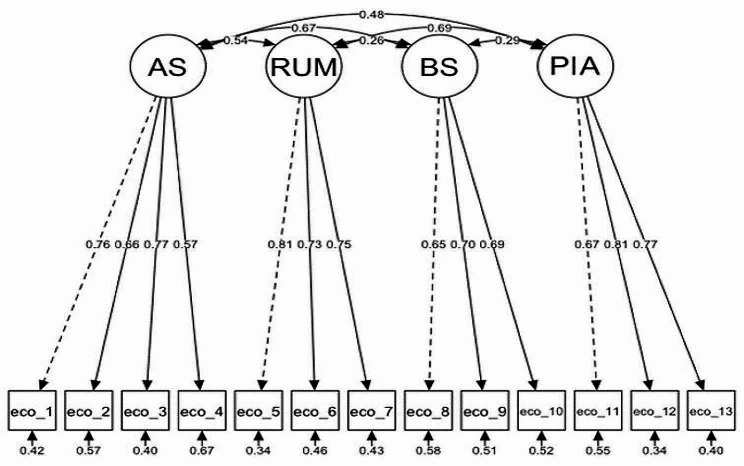
To contribute to global eco-anxiety research, we translated the Hogg Eco-Anxiety Scale (HEAS) into Spanish, creating the HEAS-SP. We validated this measure in samples from both Argentina (n = 990) and Spain (n = 548), performing measurement invariance and confirmatory factor analyses. Internal consistency of the scale and score stability over time were investigated through reliability analyses. Differences in eco-anxiety across sociodemographic variables were explored through Student's t-tests and Pearson's r tests.
The four-factor model of the HEAS-SP comprising affective and behavioural symptoms, rumination, and anxiety about personal impact demonstrated excellent model fit. We found good internal consistency for each subscale, and established measurement invariance between Spanish and Argentine samples, as well as across genders and participants' age. Spanish participants reported higher scores on the affective symptoms and personal impact anxiety factors compared to the Argentinian sample. Also, men reported lower levels than women on the subscales of affective symptoms, rumination, and personal impact anxiety. It was found that the relationship between both age and personal impact anxiety and age and affective symptoms varies significantly depending on the gender of the individuals. Younger participants tended to report higher scores on most dimensions of eco-anxiety.
These findings enhance the global initiative to investigate, explore and therefore comprehend eco-anxiety by introducing the first valid and reliable Spanish-language version of this psychometric instrument for its use within Spanish and Argentinian populations. This study augments the body of evidence supporting the robust psychometric properties of the HEAS, as demonstrated in prior validations for Australian, Turkish, Portuguese, German, French, and Italian populations.
生态焦虑日益被国际上许多人视为一种共同体验,包括对环境灾难的恐惧和对生态危机的焦虑。尽管在气候变化背景下它很重要,但针对这一概念的测量工具仍主要以英语开发,其他语言的相关工具仍在不断发展。
为推动全球生态焦虑研究,我们将霍格生态焦虑量表(HEAS)翻译成西班牙语,形成了HEAS-SP。我们在阿根廷(n = 990)和西班牙(n = 548)的样本中对该量表进行了验证,进行了测量不变性和验证性因素分析。通过可靠性分析研究了量表的内部一致性和随时间的分数稳定性。通过学生t检验和皮尔逊r检验探索了社会人口统计学变量间生态焦虑的差异。
HEAS-SP的四因素模型,包括情感和行为症状、沉思以及对个人影响的焦虑,显示出极佳的模型拟合度。我们发现每个子量表都有良好的内部一致性,并在西班牙和阿根廷样本之间以及不同性别和参与者年龄之间建立了测量不变性。与阿根廷样本相比,西班牙参与者在情感症状和个人影响焦虑因素上得分更高。此外,在情感症状、沉思和个人影响焦虑子量表上,男性得分低于女性。研究发现,年龄与个人影响焦虑以及年龄与情感症状之间的关系因个体性别而异。年轻参与者在生态焦虑的大多数维度上往往得分更高。
这些发现通过引入首个有效且可靠的西班牙语版本的心理测量工具,用于西班牙和阿根廷人群,加强了全球对生态焦虑进行调查、探索并进而理解的倡议。本研究增加了支持HEAS强大心理测量特性的证据,这在之前对澳大利亚、土耳其、葡萄牙、德国、法国和意大利人群的验证中已得到证明。