Carneiro Dos Santos Lucas Alves, Carvalho Rodrigo Dias de Oliveira, Cruz Neto José Patrocínio Ribeiro, de Albuquerque Lemos Deborah Emanuelle, de Oliveira Kataryne Árabe Rimá, Sampaio Karoliny Brito, de Luna Freire Micaelle Oliveira, Aburjaile Flavia Figueira, Azevedo Vasco Ariston de Carvalho, de Souza Evandro Leite, de Brito Alves José Luiz
Department of Nutrition, Health Sciences Center, Federal University of Paraíba, João Pessoa 58051-900, Brazil.
Department of Genetics, Ecology and Evolution, Federal University of Minas Gerais, Belo Horizonte 31270-901, Brazil.
Microorganisms. 2024 Mar 26;12(4):659. doi: 10.3390/microorganisms12040659.
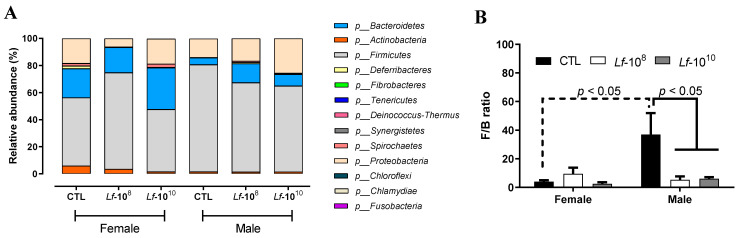
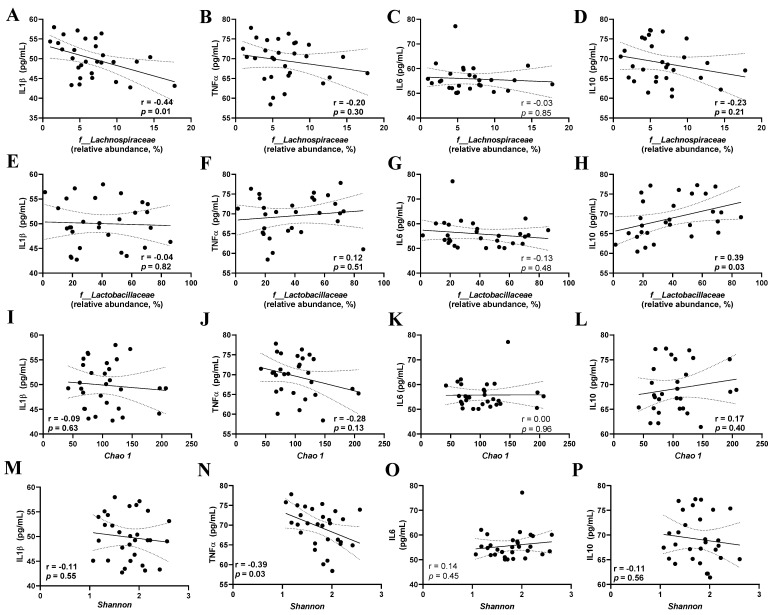
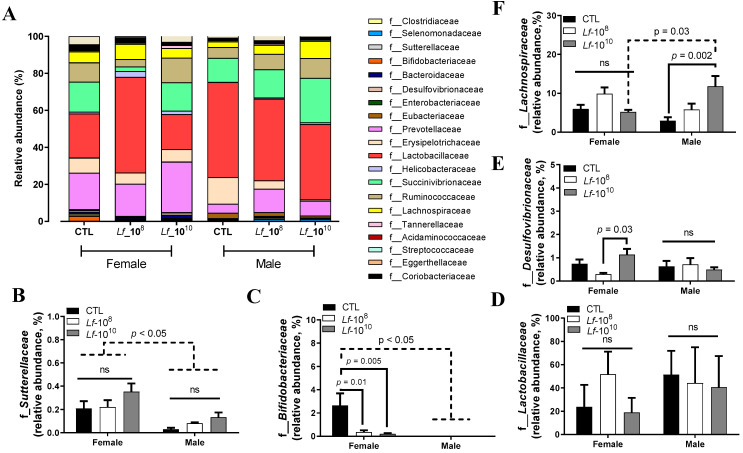
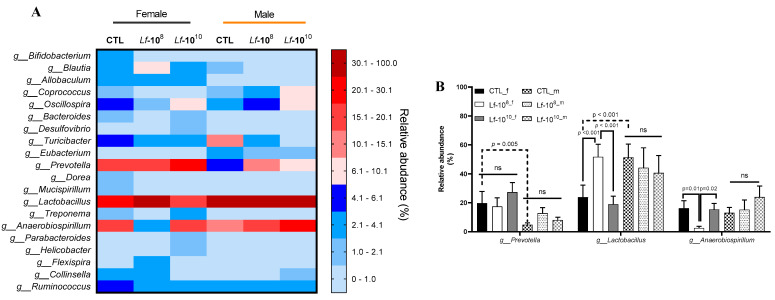
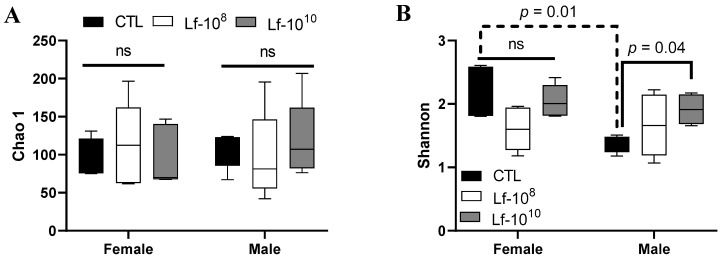
Multi-strain (L.) is a potential probiotic with reported immunomodulatory properties. This study aimed to evaluate the composition, richness, and diversity of the gut microbiota in male and female rats after treatment with a multi-strain of at different doses. Thirty rats (fifteen male and fifteen female) were allocated into a control group (CTL), a group receiving at a dose of 10 CFU (Lf-10), and a group receiving at a dose of 10 CFU (Lf-10) for 13 weeks. Gut microbiota and serum cytokine levels were evaluated after treatment. Male CTL rats had a lower relative abundance of and and a lower alpha diversity than their female CTL counterparts ( < 0.05). In addition, male CTL rats had a higher (F/B) ratio than female CTL rats ( < 0.05). In female rats, the administration of at 10 CFU decreased the relative abundance of and and increased ( < 0.05). In male rats, the administration of at 10 CFU decreased the F/B ratio and increased and the diversity of the gut microbiota ( < 0.05). The relative abundance of and the alpha-diversity of gut microbiota were negatively correlated with serum levels of IL1β (r = -0.44) and TNFα (r = -0.39), respectively. This study identified important changes in gut microbiota between male and female rats and showed that a lower dose of may have more beneficial effects on gut microbiota in females, while a higher dose may result in more beneficial effects on gut microbiota in male rats.
多菌株(L.)是一种据报道具有免疫调节特性的潜在益生菌。本研究旨在评估不同剂量多菌株处理后雄性和雌性大鼠肠道微生物群的组成、丰富度和多样性。将30只大鼠(15只雄性和15只雌性)分为对照组(CTL)、接受10⁸CFU剂量的一组(Lf-10)和接受10¹⁰CFU剂量的一组(Lf-10),处理13周。处理后评估肠道微生物群和血清细胞因子水平。雄性CTL大鼠的[具体菌属1]和[具体菌属2]相对丰度低于雌性CTL大鼠,且α多样性较低(P<0.05)。此外,雄性CTL大鼠的[某比值](F/B)高于雌性CTL大鼠(P<0.05)。在雌性大鼠中,给予10⁸CFU的[多菌株名称]降低了[具体菌属3]和[具体菌属4]的相对丰度,并增加了[某比值](P<0.05)。在雄性大鼠中,给予10¹⁰CFU的[多菌株名称]降低了F/B比值,并增加了[具体菌属5]和肠道微生物群的多样性(P<0.05)。肠道微生物群的[具体菌属6]相对丰度和α多样性分别与血清IL1β水平(r=-0.44)和TNFα水平(r=-0.39)呈负相关。本研究确定了雄性和雌性大鼠肠道微生物群的重要变化,并表明较低剂量的[多菌株名称]可能对雌性肠道微生物群有更有益的影响,而较高剂量可能对雄性大鼠肠道微生物群产生更有益的影响。