Velho Tiago R, Pereira Rafael Maniés, Guerra Nuno Carvalho, Ferreira Ricardo, Pedroso Dora, Neves-Costa Ana, Nobre Ângelo, Moita Luís Ferreira
Innate Immunity and Inflammation Laboratory, Instituto Gulbenkian de Ciência, Oeiras, Portugal.
Department of Cardiothoracic Surgery, Hospital de Santa Maria, Centro Hospitalar Lisboa Norte, Lisbon, Portugal.
Interdiscip Cardiovasc Thorac Surg. 2024 May 2;38(5). doi: 10.1093/icvts/ivae082.
Postoperative organ dysfunction is common after cardiac surgery, particularly when cardiopulmonary bypass (CPB) is used. The Sequential Organ Failure Assessment (SOFA) score is validated to predict morbidity and mortality in cardiac surgery. However, the impact of CPB duration on postoperative SOFA remains unclear.
This is a retrospective study. Categorical values are presented as percentages. The comparison of SOFA groups utilized the Kruskal-Wallis chi-squared test, complemented by ad hoc Dunn's test with Bonferroni correction. Multinomial logistics regressions were employed to evaluate the relationship between CPB time and SOFA.
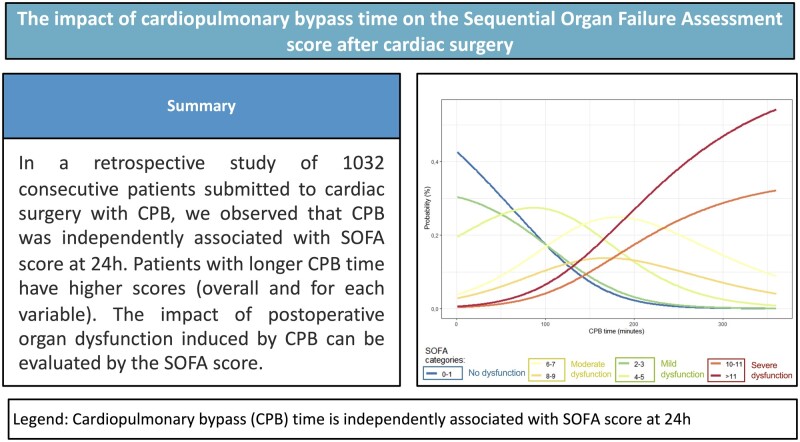
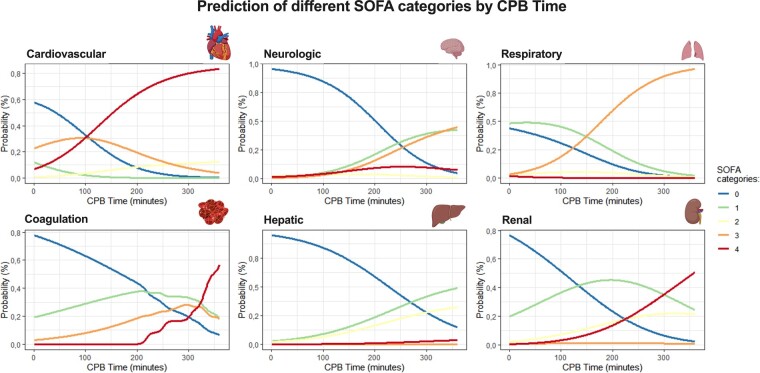
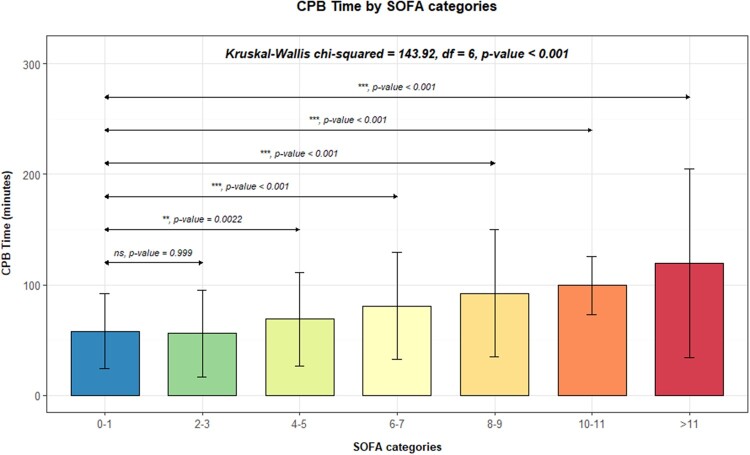
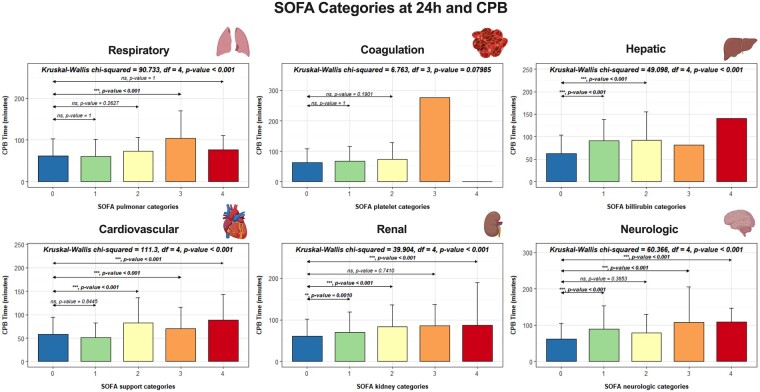
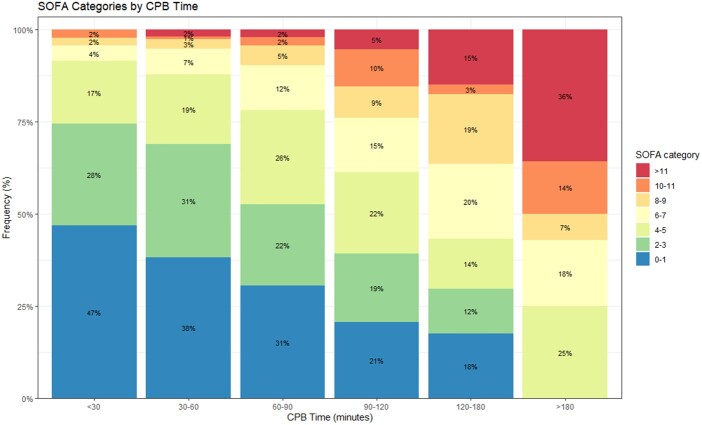
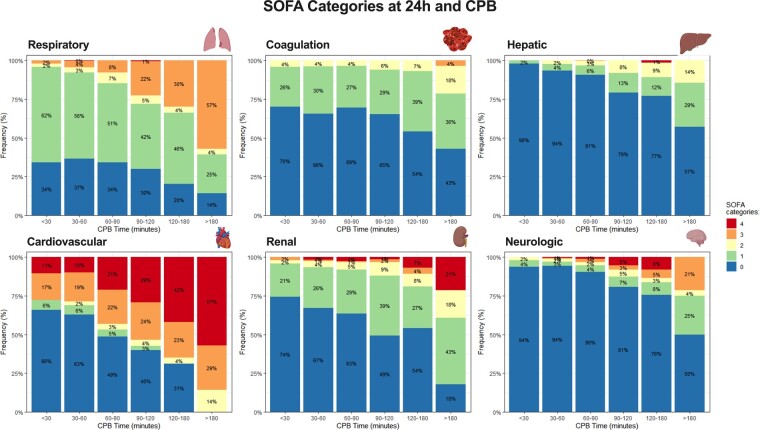
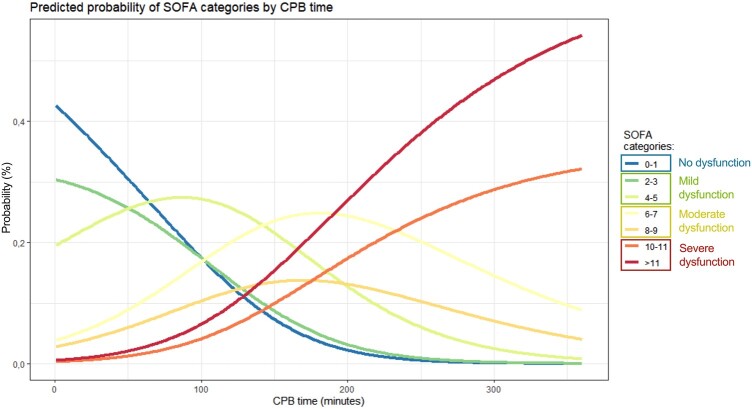
A total of 1032 patients were included. CPB time was independently associated with higher postoperative SOFA scores at 24 h. CPB time was significantly higher in patients with SOFA 4-5 (**P = 0.0022) or higher (***P < 0.001) when compared to SOFA 0-1. The percentage of patients with no/mild dysfunction decreased with longer periods of CPB, down to 0% for CPB time >180min (50% of the patients with >180m in of CPB presented SOFA ≥ 10). The same trend is observed for each of the SOFA variables, with higher impact in the cardiovascular and renal systems. Severe dysfunction occurs especially >200 min of CPB (cardiovascular system >100 min; other systems mainly >200 min).
CPB time may predict the probability of postoperative SOFA categories. Patients with extended CPB durations exhibited higher SOFA scores (overall and for each variable) at 24 h, with higher proportion of moderate and severe dysfunction with increasing times of CPB.
心脏手术后器官功能障碍很常见,尤其是在使用体外循环(CPB)时。序贯器官衰竭评估(SOFA)评分已被证实可预测心脏手术的发病率和死亡率。然而,CPB持续时间对术后SOFA的影响仍不清楚。
这是一项回顾性研究。分类变量以百分比表示。SOFA组间比较采用Kruskal-Wallis卡方检验,并辅以经Bonferroni校正的Dunn事后检验。采用多项逻辑回归评估CPB时间与SOFA之间的关系。
共纳入1032例患者。CPB时间与术后24小时较高的SOFA评分独立相关。与SOFA 0-1组相比,SOFA 4-5(**P = 0.0022)或更高(***P < 0.001)的患者CPB时间显著更长。CPB时间越长,无/轻度功能障碍患者的比例越低,CPB时间>180分钟时降至0%(CPB时间>180分钟的患者中有50%的SOFA≥10)。每个SOFA变量都观察到相同的趋势,对心血管和肾脏系统的影响更大。严重功能障碍尤其发生在CPB>200分钟时(心血管系统>100分钟;其他系统主要>200分钟)。
CPB时间可能预测术后SOFA分类的概率。CPB持续时间延长的患者在24小时时表现出更高的SOFA评分(总体及各变量),随着CPB时间增加,中度和重度功能障碍的比例更高。