Division of Reproductive Endocrinology and Infertility, Department of Obstetrics and Gynecology, Baylor College of Medicine, Houston, Texas, USA.
Division of Reproductive Endocrinology and Infertility, Division of Reproductive Sciences, Department of Obstetrics, Gynecology, and Reproductive Sciences, Yale School of Medicine, New Haven, Connecticut, USA.
Biol Reprod. 2024 Jun 12;110(6):1115-1124. doi: 10.1093/biolre/ioae056.
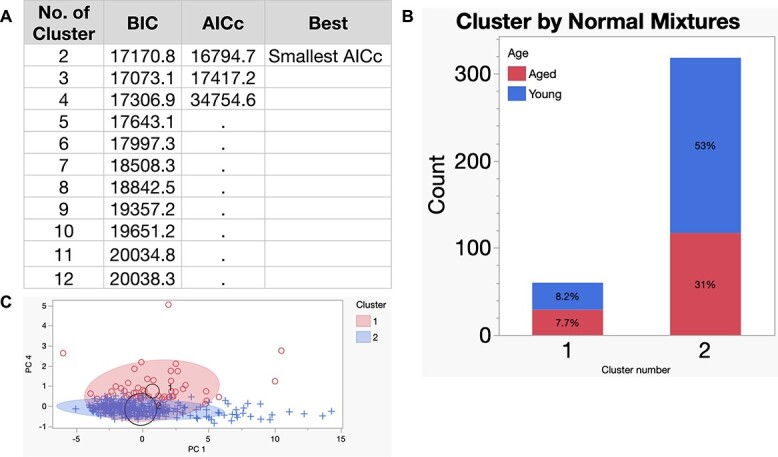
Time-lapse microscopy for embryos is a non-invasive technology used to characterize early embryo development. This study employs time-lapse microscopy and machine learning to elucidate changes in embryonic growth kinetics with maternal aging. We analyzed morphokinetic parameters of embryos from young and aged C57BL6/NJ mice via continuous imaging. Our findings show that aged embryos accelerated through cleavage stages (from 5-cells) to morula compared to younger counterparts, with no significant differences observed in later stages of blastulation. Unsupervised machine learning identified two distinct clusters comprising of embryos from aged or young donors. Moreover, in supervised learning, the extreme gradient boosting algorithm successfully predicted the age-related phenotype with 0.78 accuracy, 0.81 precision, and 0.83 recall following hyperparameter tuning. These results highlight two main scientific insights: maternal aging affects embryonic development pace, and artificial intelligence can differentiate between embryos from aged and young maternal mice by a non-invasive approach. Thus, machine learning can be used to identify morphokinetics phenotypes for further studies. This study has potential for future applications in selecting human embryos for embryo transfer, without or in complement with preimplantation genetic testing.
延时显微镜技术是一种非侵入性技术,用于描述早期胚胎的发育情况。本研究采用延时显微镜和机器学习来阐明母体衰老对胚胎生长动力学的影响。我们通过连续成像分析了年轻和衰老 C57BL6/NJ 小鼠胚胎的形态动力学参数。我们的研究结果表明,与年轻胚胎相比,衰老胚胎在卵裂阶段(从 5 细胞期)到桑椹胚的发育速度加快,而囊胚形成的后期阶段没有明显差异。无监督机器学习确定了由年轻或年老供体组成的两个不同的簇。此外,在有监督学习中,极端梯度增强算法在经过超参数调整后,成功地以 0.78 的准确率、0.81 的精确率和 0.83 的召回率预测了与年龄相关的表型。这些结果突出了两个主要的科学见解:母体衰老会影响胚胎的发育速度,而人工智能可以通过非侵入性方法区分来自年老和年轻母体的胚胎。因此,机器学习可以用于鉴定形态动力学表型,以进一步研究。本研究在选择人类胚胎进行胚胎移植方面具有潜在的应用前景,既可以单独使用,也可以与植入前遗传学检测结合使用。