Wang Bin, Zhao Yanbin, Li Yangyang, Yao Junyan, Wu Shunjie, Miu Guoping, Chu Chenglin
Department of Orthopedics, Rudong People's Hospital Nantong 226400 Jiangsu China
Affiliated Rudong Hospital of Xinglin College, Nantong University 226007 Jiangsu China.
RSC Adv. 2024 Apr 29;14(20):13958-13971. doi: 10.1039/d4ra01079e. eCollection 2024 Apr 25.
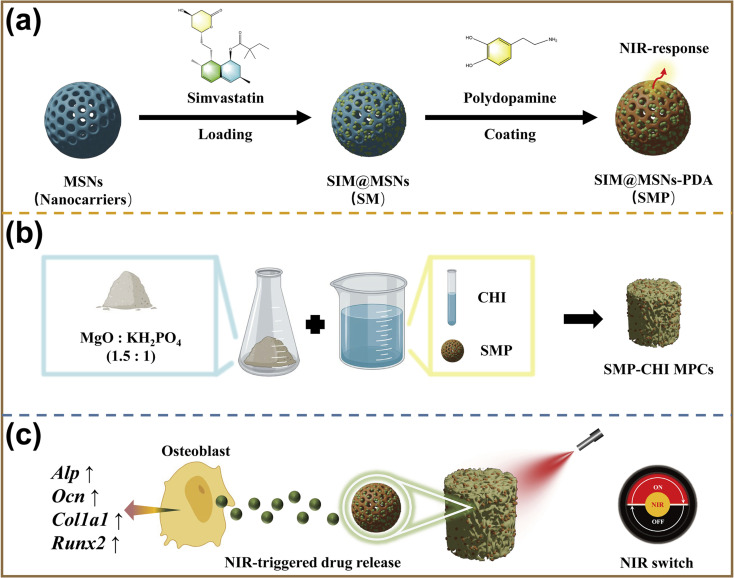
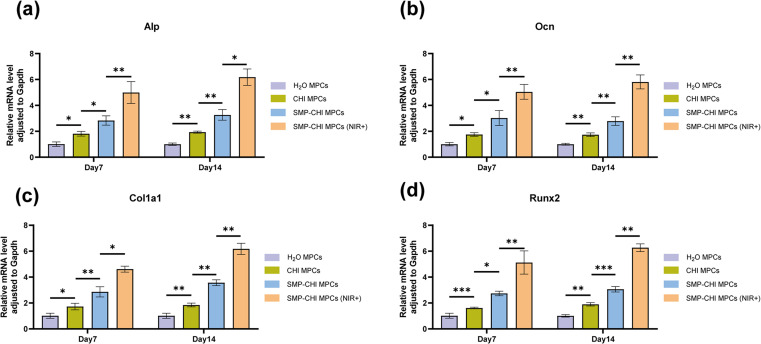
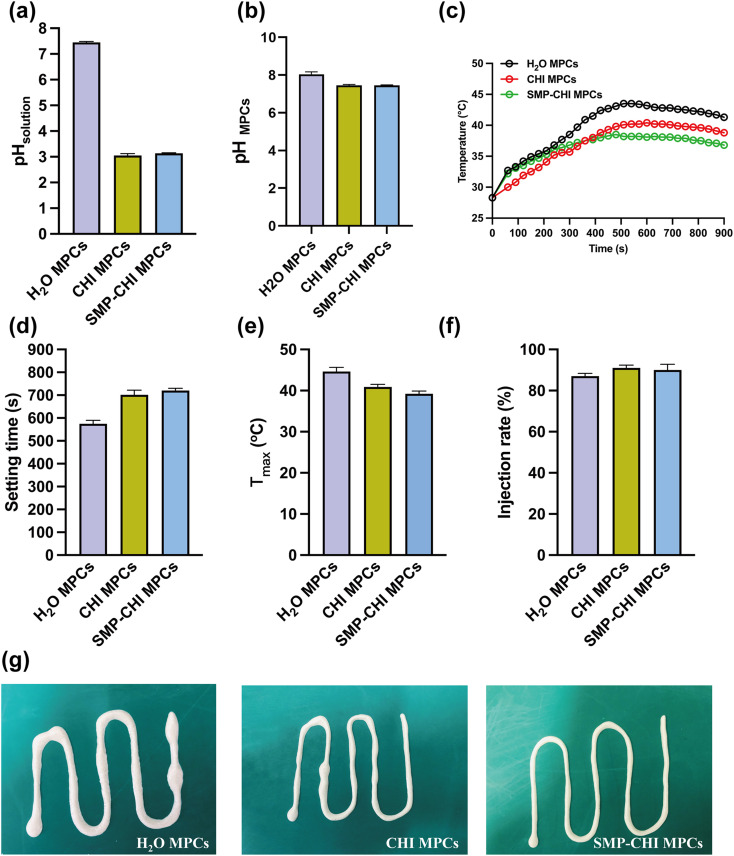
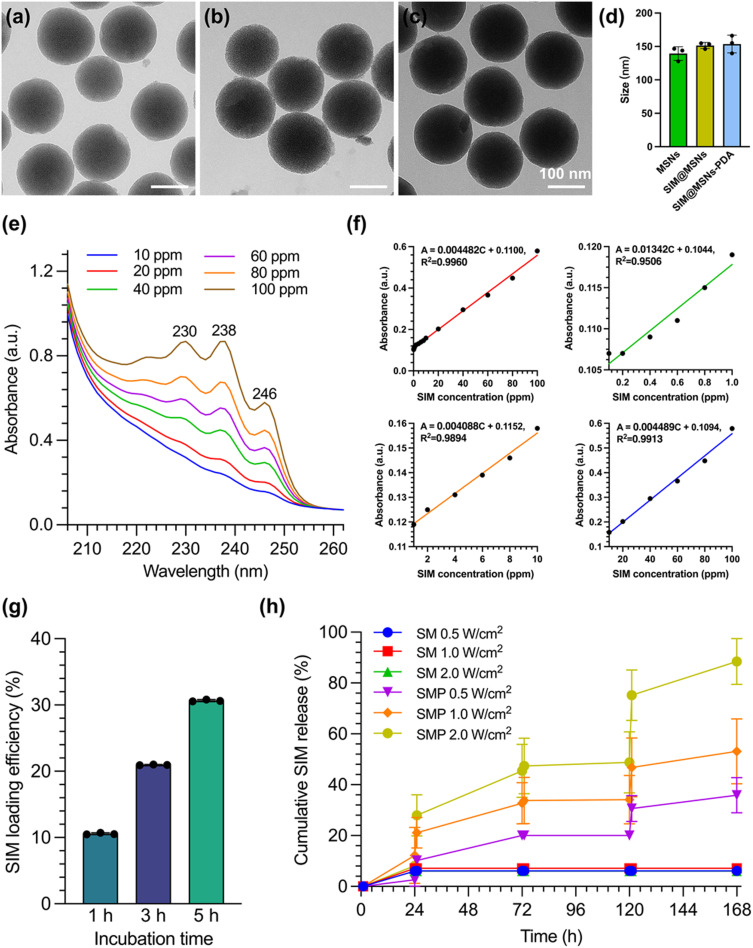
The insufficient osteogenesis of magnesium phosphate cement (MPC) limits its biomedical application. It is of great significance to develop a bioactive MPC with osteogenic performance. In this study, an injectable MPC was reinforced by the incorporation of a near infrared (NIR)-responsive nanocontainer, which was based on simvastatin (SIM)-loaded mesoporous silica nanoparticles (MSNs) modified with a polydopamine (PDA) bilayer, named SMP. In addition, chitosan (CHI) was introduced into MPC (K-struvite) to enhance its mechanical properties and cytocompatibility. The results showed that nanocontainer-incorporated MPC possessed a prolonged setting time, almost neutral pH, excellent injectability, and enhanced compressive strength. Immersion tests indicated that SMP-CHI MPC could suppress rapid degradation. Based on its physicochemical features, the SMP-CHI MPC had good biocompatibility and osteogenesis properties, as shown and experiments. These findings can provide a simple way to produce a multifunctional MPC with improved osteogenesis for further orthopedic applications.
磷酸镁骨水泥(MPC)的成骨不足限制了其生物医学应用。开发具有成骨性能的生物活性MPC具有重要意义。在本研究中,通过掺入基于载有辛伐他汀(SIM)的介孔二氧化硅纳米颗粒(MSN)并用聚多巴胺(PDA)双层修饰的近红外(NIR)响应纳米容器来增强可注射MPC,命名为SMP。此外,将壳聚糖(CHI)引入MPC(K-鸟粪石)中以增强其力学性能和细胞相容性。结果表明,掺入纳米容器的MPC具有延长的凝固时间、几乎中性的pH值、优异的可注射性和增强的抗压强度。浸泡试验表明,SMP-CHI MPC可以抑制快速降解。基于其物理化学特性,SMP-CHI MPC具有良好的生物相容性和成骨性能,如 和 实验所示。这些发现可以提供一种简单的方法来制备具有改善成骨性能的多功能MPC,用于进一步的骨科应用。