Centro de Modelamiento Matemático, Universidad de Chile and CNRS IRL2807, Santiago, Chile.
Mathematical Modelling of Infectious Diseases Unit, Institut Pasteur, Université Paris Cité, CNRS UMR 2000, Paris, F-75015, France.
BMC Infect Dis. 2024 May 3;24(1):467. doi: 10.1186/s12879-024-09304-1.
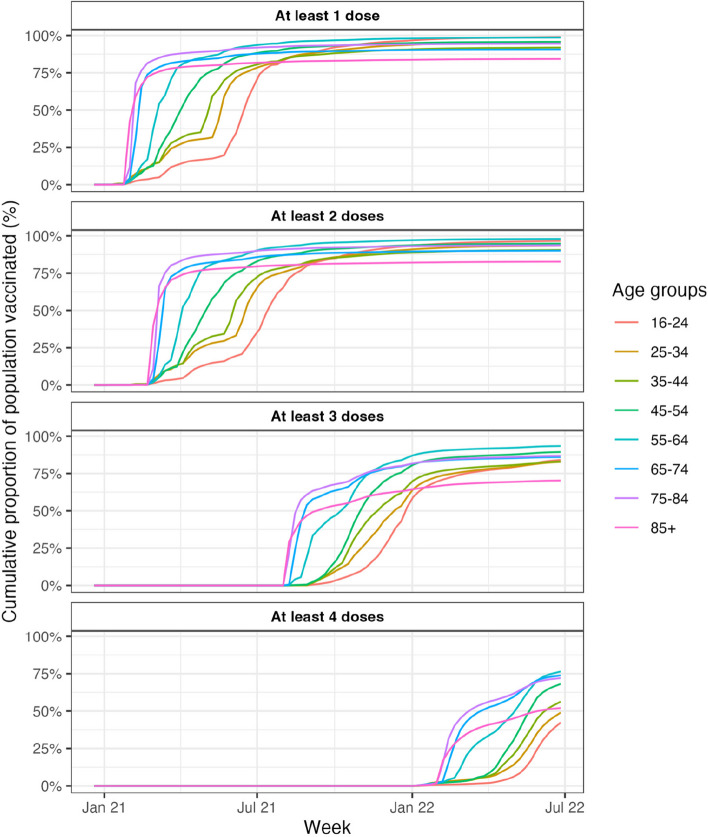
Chile rapidly implemented an extensive COVID-19 vaccination campaign, deploying a diversity of vaccines with a strategy that prioritized the elderly and individuals with comorbidities. This study aims to assess the direct impact of vaccination on the number of COVID-19 related cases, hospital admissions, ICU admissions and deaths averted during the first year and a half of the campaign.
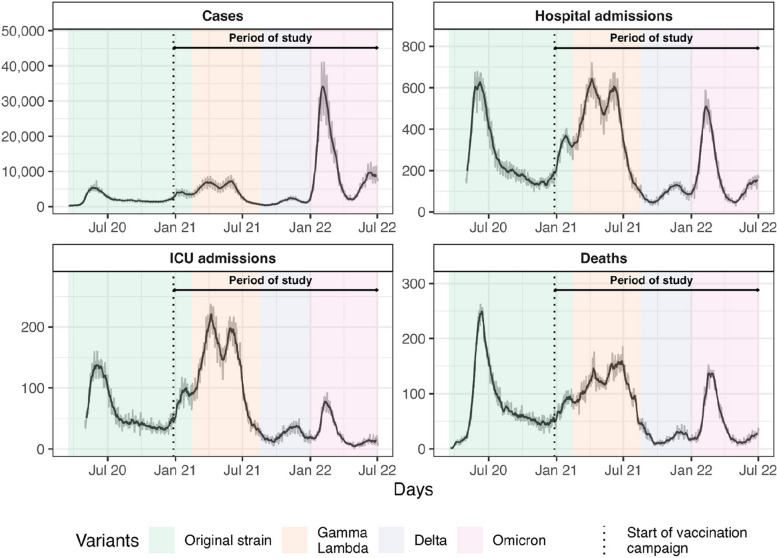
Via Chile's transparency law, we obtained access to weekly event counts categorized by vaccination status and age. Integrating this data with publicly available census and vaccination coverage information, we conducted a comparative analysis of weekly incidence rates between vaccinated and unvaccinated groups from December 20, 2020 to July 2, 2022 to estimate the direct impact of vaccination in terms of the number of cases, hospitalizations, ICU admissions and deaths averted, using an approach that avoids the need to explicitly specify the effectiveness of each vaccine deployed.
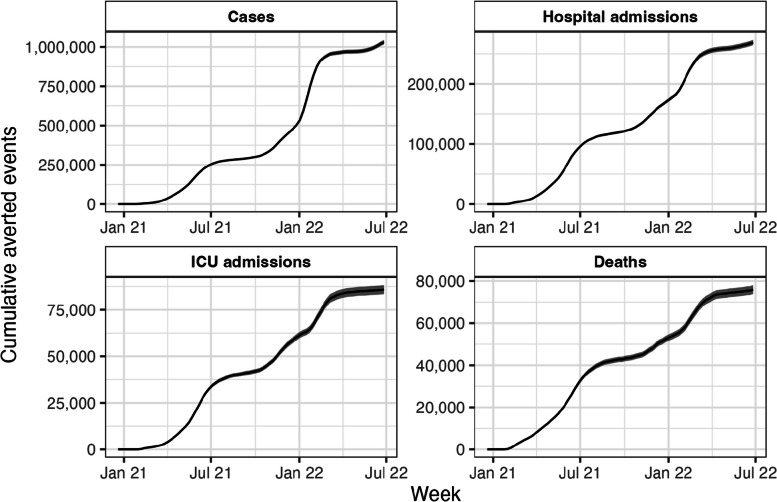
We estimated that, from December 20, 2020 to July 2, 2022 the vaccination campaign directly prevented 1,030,648 (95% Confidence Interval: 1,016,975-1,044,321) cases, 268,784 (95% CI: 264,524-273,045) hospitalizations, 85,830 (95% CI: 83,466-88,194) ICU admissions and 75,968 (95% CI: 73,909-78,028) deaths related to COVID-19 among individuals aged 16 years and older. This corresponds to a reduction of 26% of cases, 66% of hospital admissions, 70% of ICU admissions and 67% of deaths compared to a scenario without vaccination. Individuals 55 years old or older represented 67% of hospitalizations, 73% of ICU admissions and 89% of deaths related to COVID-19 prevented.
This study highlights the role of Chile's vaccination campaign in reducing COVID-19 disease burden, with the most substantial reductions observed in severe outcomes.
智利迅速开展了广泛的 COVID-19 疫苗接种运动,使用多种疫苗,并制定了优先考虑老年人和合并症患者的策略。本研究旨在评估在该运动开展的头一年半中,疫苗接种对 COVID-19 相关病例、住院、重症监护病房 (ICU) 入院和死亡人数的直接影响。
根据智利透明度法,我们获得了按疫苗接种状况和年龄分类的每周事件计数。通过将这些数据与公开的人口普查和疫苗接种覆盖率信息相结合,我们对 2020 年 12 月 20 日至 2022 年 7 月 2 日期间接种组和未接种组的每周发病率进行了比较分析,以估计疫苗接种在病例数、住院、ICU 入院和死亡人数方面的直接影响,该方法避免了明确规定所使用的每种疫苗的有效性的需要。
我们估计,从 2020 年 12 月 20 日至 2022 年 7 月 2 日,疫苗接种运动直接预防了 1030648 例(95%置信区间:1016975-1044321)、268784 例(95%置信区间:264524-273045)、85830 例(95%置信区间:83466-88194)和 75968 例(95%置信区间:73909-78028)COVID-19 相关病例、住院、ICU 入院和死亡,这与不接种疫苗的情况下相比,分别减少了 26%、66%、70%和 67%。55 岁及以上人群占 COVID-19 相关住院、ICU 入院和死亡人数的 67%、73%和 89%。
本研究强调了智利疫苗接种运动在降低 COVID-19 疾病负担方面的作用,最显著的减少发生在严重后果中。