Fan Ming-Hui, Pi Jin-Kui, Zou Chen-Yu, Jiang Yan-Lin, Li Qian-Jin, Zhang Xiu-Zhen, Xing Fei, Nie Rong, Han Chen, Xie Hui-Qi
Department of Orthopedic Surgery and Orthopedic Research Institute, Laboratory of Stem Cell and Tissue Engineering, State Key Laboratory of Biotherapy, West China Hospital, Sichuan University, Chengdu, Sichuan, 610041, PR China.
Core Facilities, West China Hospital, Sichuan University, Chengdu, Sichuan, 610041, PR China.
Bioact Mater. 2024 Apr 23;38:1-30. doi: 10.1016/j.bioactmat.2024.04.007. eCollection 2024 Aug.
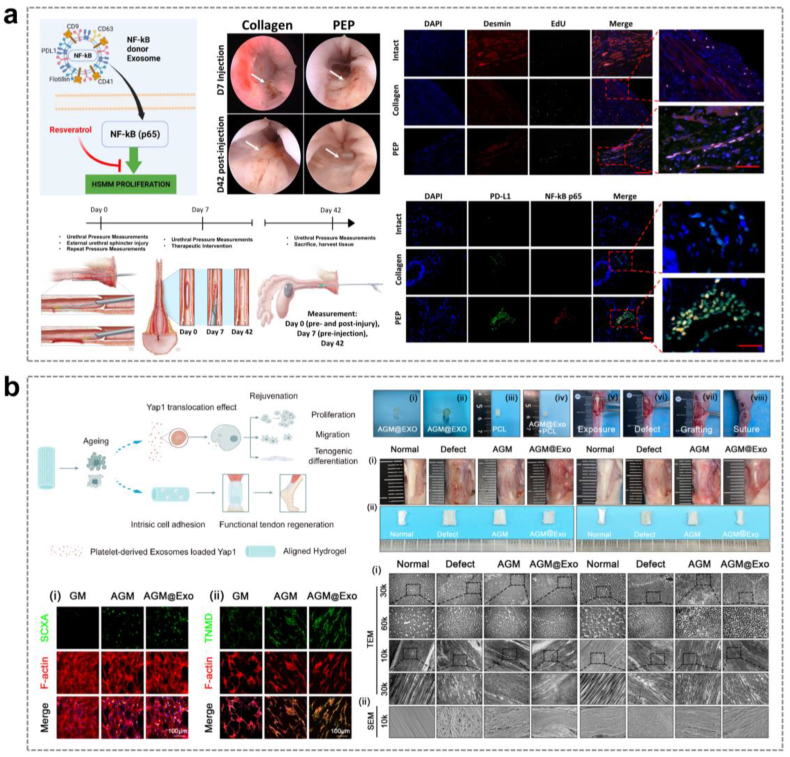
Characterized by their pivotal roles in cell-to-cell communication, cell proliferation, and immune regulation during tissue repair, exosomes have emerged as a promising avenue for "cell-free therapy" in clinical applications. Hydrogels, possessing commendable biocompatibility, degradability, adjustability, and physical properties akin to biological tissues, have also found extensive utility in tissue engineering and regenerative repair. The synergistic combination of exosomes and hydrogels holds the potential not only to enhance the efficiency of exosomes but also to collaboratively advance the tissue repair process. This review has summarized the advancements made over the past decade in the research of hydrogel-exosome systems for regenerating various tissues including skin, bone, cartilage, nerves and tendons, with a focus on the methods for encapsulating and releasing exosomes within the hydrogels. It has also critically examined the gaps and limitations in current research, whilst proposed future directions and potential applications of this innovative approach.
外泌体在组织修复过程中的细胞间通讯、细胞增殖和免疫调节中发挥着关键作用,已成为临床应用中“无细胞疗法”的一个有前景的途径。水凝胶具有良好的生物相容性、可降解性、可调节性以及与生物组织相似的物理性质,在组织工程和再生修复中也有广泛应用。外泌体与水凝胶的协同组合不仅有可能提高外泌体的效率,还能协同推进组织修复过程。本文综述了过去十年中用于再生包括皮肤、骨骼、软骨、神经和肌腱在内的各种组织的水凝胶-外泌体系统的研究进展,重点介绍了在外泌体在水凝胶中的包封和释放方法。同时,本文也批判性地审视了当前研究中的差距和局限性,并提出了这种创新方法的未来方向和潜在应用。