Lingaratnam Senthil, Shah Mahek, Nicolazzo Joseph, Michael Michael, Seymour John F, James Paul, Lazarakis Smaro, Loi Sherene, Kirkpatrick Carl M J
Pharmacy Department, Peter MacCallum Cancer Centre, Melbourne, Victoria, Australia.
Sir Peter MacCallum Department of Oncology, University of Melbourne, Melbourne, Victoria, Australia.
Clin Transl Sci. 2024 May;17(5):e13781. doi: 10.1111/cts.13781.
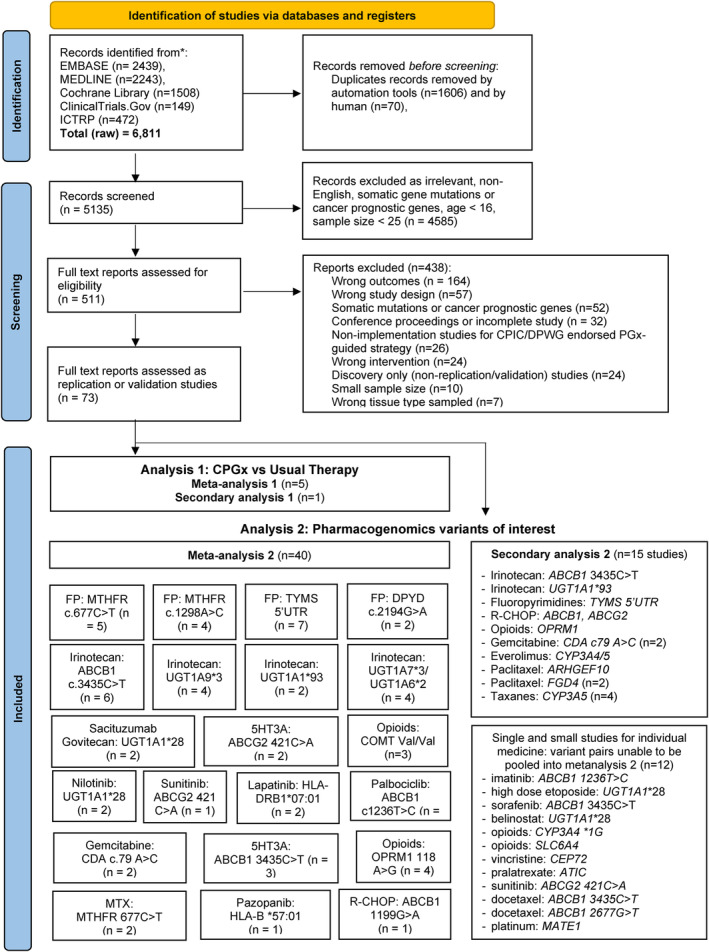
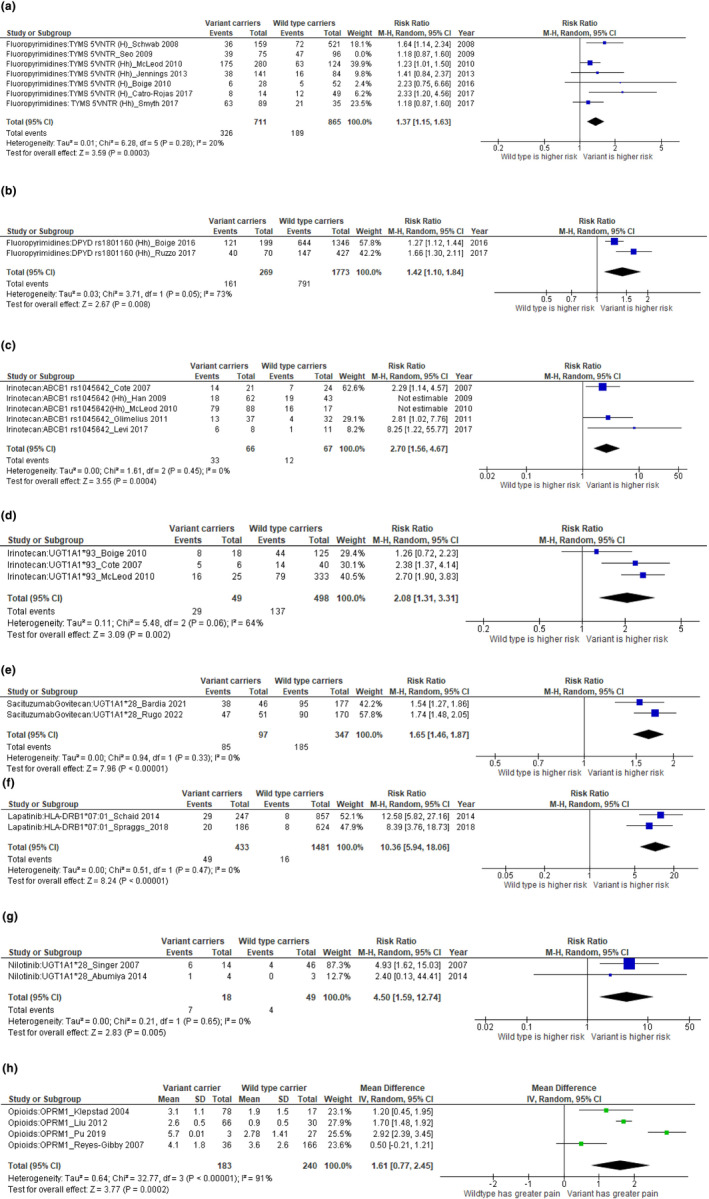
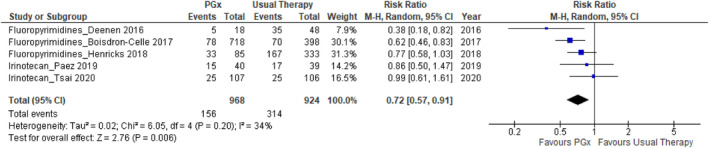
The clinical application of Pharmacogenomics (PGx) has improved patient safety. However, comprehensive PGx testing has not been widely adopted in clinical practice, and significant opportunities exist to further optimize PGx in cancer care. This systematic review and meta-analysis aim to evaluate the safety outcomes of reported PGx-guided strategies (Analysis 1) and identify well-studied emerging pharmacogenomic variants that predict severe toxicity and symptom burden (Analysis 2) in patients with cancer. We searched MEDLINE, EMBASE, CENTRAL, clinicaltrials.gov, and International Clinical Trials Registry Platform from inception to January 2023 for clinical trials or comparative studies evaluating PGx strategies or unconfirmed pharmacogenomic variants. The primary outcomes were severe adverse events (SAE; ≥ grade 3) or symptom burden with pain and vomiting as defined by trial protocols and assessed by trial investigators. We calculated pooled overall relative risk (RR) and 95% confidence interval (95%CI) using random effects models. PROSPERO, registration number CRD42023421277. Of 6811 records screened, six studies were included for Analysis 1, 55 studies for Analysis 2. Meta-analysis 1 (five trials, 1892 participants) showed a lower absolute incidence of SAEs with PGx-guided strategies compared to usual therapy, 16.1% versus 34.0% (RR = 0.72, 95%CI 0.57-0.91, p = 0.006, I = 34%). Meta-analyses 2 identified nine medicine(class)-variant pairs of interest across the TYMS, ABCB1, UGT1A1, HLA-DRB1, and OPRM1 genes. Application of PGx significantly reduced rates of SAEs in patients with cancer. Emergent medicine-variant pairs herald further research into the expansion and optimization of PGx to improve systemic anti-cancer and supportive care medicine safety and efficacy.
药物基因组学(PGx)的临床应用提高了患者安全性。然而,全面的PGx检测在临床实践中尚未得到广泛应用,在癌症护理中进一步优化PGx仍有很大机会。本系统评价和荟萃分析旨在评估已报道的PGx指导策略的安全性结果(分析1),并识别在癌症患者中预测严重毒性和症状负担的经过充分研究的新兴药物基因组变异(分析2)。我们检索了MEDLINE、EMBASE、CENTRAL、clinicaltrials.gov和国际临床试验注册平台,从创建到2023年1月,以查找评估PGx策略或未经证实的药物基因组变异的临床试验或比较研究。主要结局为严重不良事件(SAE;≥3级)或根据试验方案定义并由试验研究者评估的伴有疼痛和呕吐的症状负担。我们使用随机效应模型计算合并的总体相对风险(RR)和95%置信区间(95%CI)。PROSPERO注册号:CRD42023421277。在筛选的6811条记录中,6项研究纳入分析1,55项研究纳入分析2。荟萃分析1(5项试验,1892名参与者)显示,与常规治疗相比,PGx指导策略的SAE绝对发生率更低,分别为16.1%和34.0%(RR = 0.72,95%CI 0.57 - 0.91,p = 0.006,I² = 34%)。荟萃分析2在胸苷酸合成酶(TYMS)、ATP结合盒转运蛋白B1(ABCB1)、尿苷二磷酸葡萄糖醛酸基转移酶1家族多肽A1(UGT1A1)、人白细胞抗原DRB1(HLA - DRB1)和μ-阿片受体(OPRM1)基因中确定了9对感兴趣的药物-变异对。PGx的应用显著降低了癌症患者的SAE发生率。新出现的药物-变异对预示着对PGx扩展和优化的进一步研究,以提高全身抗癌和支持性护理药物的安全性和疗效。