Department of Medicine A, University Medicine Greifswald, Ferdinand-Sauerbruch Str, 17475, Greifswald, Germany.
Department of Internal Medicine, Hue University, Hue, Vietnam.
Cell Mol Life Sci. 2024 May 6;81(1):207. doi: 10.1007/s00018-024-05247-7.
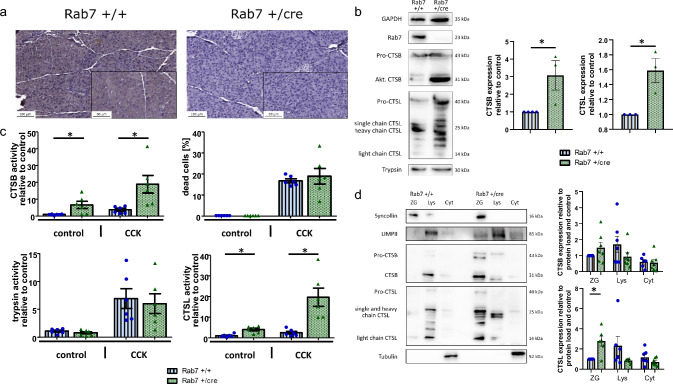
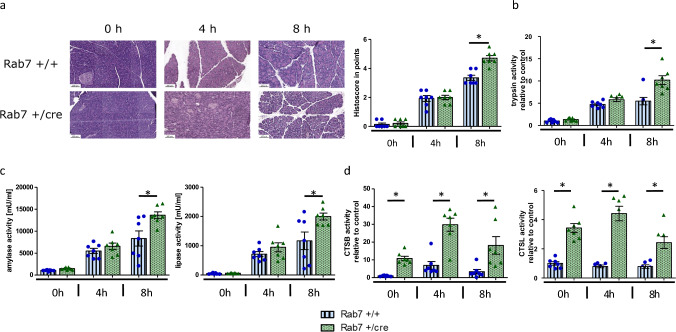
The co-localization of the lysosomal protease cathepsin B (CTSB) and the digestive zymogen trypsinogen is a prerequisite for the initiation of acute pancreatitis. However, the exact molecular mechanisms of co-localization are not fully understood. In this study, we investigated the role of lysosomes in the onset of acute pancreatitis by using two different experimental approaches. Using an acinar cell-specific genetic deletion of the ras-related protein Rab7, important for intracellular vesicle trafficking and fusion, we analyzed the subcellular distribution of lysosomal enzymes and the severity of pancreatitis in vivo and ex vivo. Lysosomal permeabilization was performed by the lysosomotropic agent Glycyl-L-phenylalanine 2-naphthylamide (GPN). Acinar cell-specific deletion of Rab7 increased endogenous CTSB activity and despite the lack of re-distribution of CTSB from lysosomes to the secretory vesicles, the activation of CTSB localized in the zymogen compartment still took place leading to trypsinogen activation and pancreatic injury. Disease severity was comparable to controls during the early phase but more severe at later time points. Similarly, GPN did not prevent CTSB activation inside the secretory compartment upon caerulein stimulation, while lysosomal CTSB shifted to the cytosol. Intracellular trypsinogen activation was maintained leading to acute pancreatitis similar to controls. Our results indicate that initiation of acute pancreatitis seems to be independent of the presence of lysosomes and that fusion of lysosomes and zymogen granules is dispensable for the disease onset. Intact lysosomes rather appear to have protective effects at later disease stages.
溶酶体蛋白酶组织蛋白酶 B(CTSB)和消化酶原胰蛋白酶原的共定位是急性胰腺炎发生的前提。然而,共定位的确切分子机制尚不完全清楚。在这项研究中,我们通过两种不同的实验方法研究了溶酶体在急性胰腺炎发病中的作用。使用一种特异地在腺泡细胞中缺失 Ras 相关蛋白 Rab7 的方法,Rab7 对细胞内囊泡运输和融合很重要,我们分析了溶酶体酶的亚细胞分布以及体内和体外的胰腺炎严重程度。通过溶酶体亲脂性试剂 Glycyl-L-phenylalanine 2-naphthylamide(GPN)进行溶酶体通透性。Rab7 的腺泡细胞特异性缺失增加了内源性 CTSB 活性,尽管 CTSB 没有从溶酶体重新分布到分泌小泡,但仍发生了定位于酶原区室的 CTSB 激活,导致胰蛋白酶原激活和胰腺损伤。疾病严重程度在早期与对照组相当,但在后期更为严重。同样,GPN 不能防止在 caerulein 刺激时 CTSB 在分泌小泡内的激活,而溶酶体 CTSB 转移到细胞质。细胞内胰蛋白酶原的激活得到维持,导致与对照组相似的急性胰腺炎。我们的结果表明,急性胰腺炎的发生似乎不依赖于溶酶体的存在,并且溶酶体与酶原颗粒的融合对于疾病的发生是可有可无的。完整的溶酶体在疾病后期似乎具有保护作用。