Xie Jinzhao, Lin Xiao, Fan Xiaoyan, Wang Xu, Pan Deng, Li Jinghua, Hao Yuantao, Jie Yusheng, Zhang Lei, Gu Jing
Department of Medical Statistics, School of Public Health, Sun Yat-sen University, Guangzhou, China.
School of Public Health, LKS Faculty of Medicine, The University of Hong Kong, Pokfulam, Hong Kong SAR, China.
J Epidemiol Glob Health. 2024 Jun;14(2):398-410. doi: 10.1007/s44197-024-00237-1. Epub 2024 May 7.
Type 2 diabetes mellitus (T2DM) increases the risk of liver cancer among people living with hepatitis B virus (HBV). Our study aimed to estimate the global burden and trends of liver cancer attributable to comorbid T2DM among people living with HBV from 1990 to 2019.
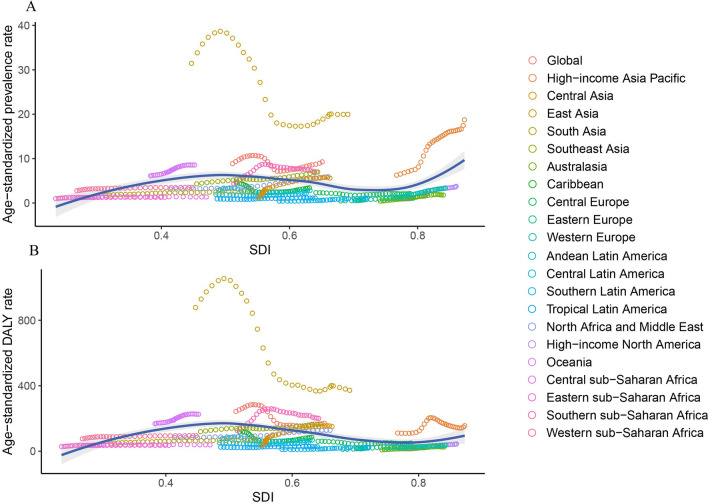
We calculated the population attributable fractions (PAFs) of liver cancer attributable to comorbid T2DM among the burden of HBV-related liver cancer. We applied the PAFs to the burden of HBV-related liver cancer derived from the Global Burden of Disease (GBD) 2019 database to obtain the burden of liver cancer attributable to HBV-T2DM comorbidity. The prevalence, disability-adjusted life year (DALY), and deaths of liver cancer attributable to the comorbidity were assessed at the global, regional, and country levels and then stratified by the sociodemographic index (SDI), sex, and age group. Estimated annual percentage changes (EAPCs) were calculated to quantify the temporal trends.
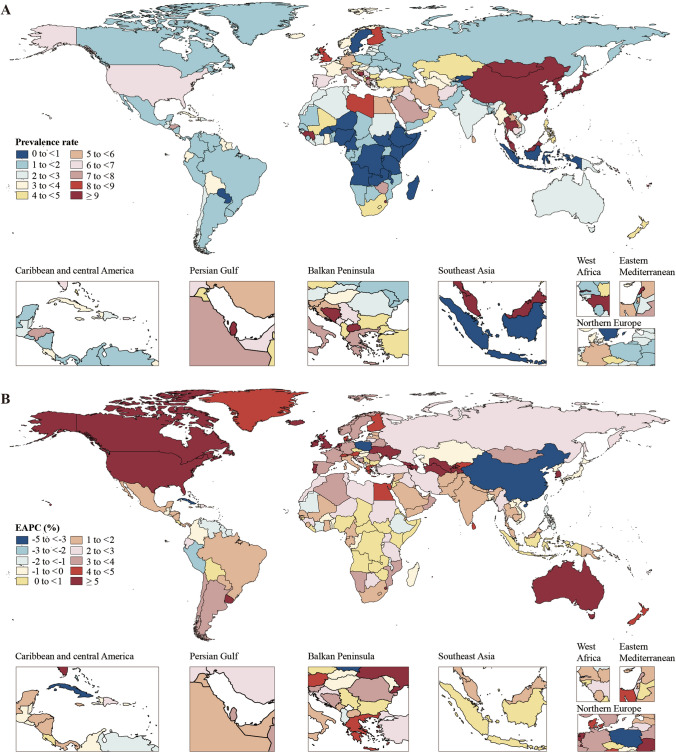
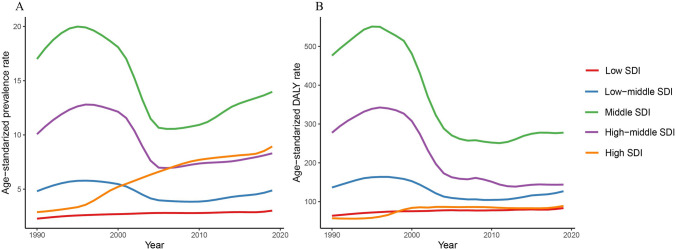
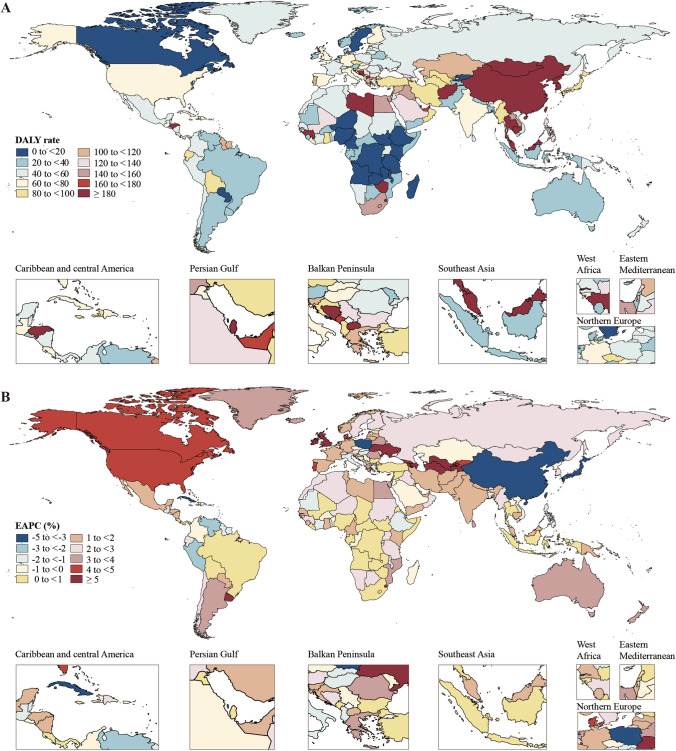
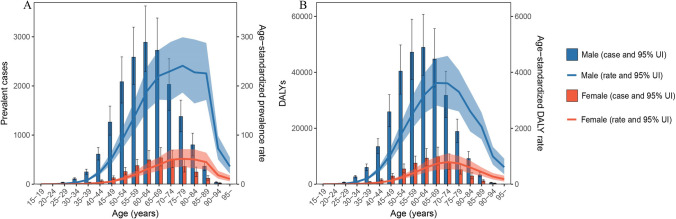
In 2019, the global age-standardized prevalence and DALY rates of liver cancer attributable to HBV-T2DM comorbidity were 9.9 (8.4-11.5) and 182.4 (154.9-212.7) per 10,000,000 individuals, respectively. High-income Asia Pacific and East Asia had the highest age-standardized prevalence and DALY rates of liver cancer attributable to HBV-T2DM comorbidity, respectively. From 1990 to 2019, age-standardized prevalence and DALY rates increased in 16 out of 21 GBD regions. High-income North America had the largest annual increases in both age-standardized prevalence rates (EAPC = 6.07; 95% UI, 5.59 to 6.56) and DALY rates (EAPC = 4.77; 95% UI, 4.35 to 5.20), followed by Australasia and Central Asia. Across all SDI regions, the high SDI region exhibited the most rapid increase in age-standardized prevalence and DALY rates from 1990 to 2019. Additionally, men had consistently higher disease burdens than women across all age groups. The patterns of mortality burden and trends are similar to those of DALYs.
The burden of liver cancer attributable to comorbid T2DM among people living with HBV has exhibited an increasing trend across most regions over the last three decades. Tailored prevention strategies targeting T2DM should be implemented among individuals living with HBV.
2型糖尿病(T2DM)增加了乙型肝炎病毒(HBV)感染者患肝癌的风险。我们的研究旨在估计1990年至2019年期间,HBV感染者中合并T2DM所致肝癌的全球负担及趋势。
我们计算了在HBV相关肝癌负担中,合并T2DM所致肝癌的人群归因分数(PAF)。我们将PAF应用于从《2019年全球疾病负担(GBD)》数据库得出的HBV相关肝癌负担,以获得HBV-T2DM合并症所致肝癌的负担。在全球、区域和国家层面评估了合并症所致肝癌的患病率、伤残调整生命年(DALY)和死亡情况,然后按社会人口学指数(SDI)、性别和年龄组进行分层。计算估计年度百分比变化(EAPC)以量化时间趋势。
2019年,HBV-T2DM合并症所致肝癌的全球年龄标准化患病率和DALY率分别为每1000万人9.9(8.4-11.5)和182.4(154.9-212.7)。高收入亚太地区和东亚地区HBV-T2DM合并症所致肝癌的年龄标准化患病率和DALY率分别最高。1990年至2019年期间,21个GBD区域中有16个区域的年龄标准化患病率和DALY率有所上升。高收入北美地区的年龄标准化患病率(EAPC = 6.07;95% UI,5.59至6.56)和DALY率(EAPC = 4.77;95% UI,4.35至5.20)的年增幅最大,其次是澳大拉西亚和中亚地区。在所有SDI区域中,高SDI区域在1990年至2019年期间年龄标准化患病率和DALY率的增长最为迅速。此外,在所有年龄组中,男性的疾病负担一直高于女性。死亡负担和趋势模式与DALY相似。
在过去三十年中,HBV感染者中合并T2DM所致肝癌的负担在大多数地区呈上升趋势。应针对HBV感染者实施针对T2DM的定制化预防策略。