Department of Public Health Sciences, University of Chicago, 5815 S. Maryland Ave, Rm TC-620A, MC2000, Chicago, IL, 60637, USA.
Institute for Population and Precision Health, University of Chicago, Chicago, IL, USA.
Environ Health. 2024 May 7;23(1):47. doi: 10.1186/s12940-024-01077-z.
To examine whether long-term air pollution exposure is associated with central hemodynamic and brachial artery stiffness parameters.
We assessed central hemodynamic parameters including central blood pressure, cardiac parameters, systemic vascular compliance and resistance, and brachial artery stiffness measures [including brachial artery distensibility (BAD), compliance (BAC), and resistance (BAR)] using waveform analysis of the arterial pressure signals obtained from a standard cuff sphygmomanometer (DynaPulse2000A, San Diego, CA). The long-term exposures to particles with an aerodynamic diameter < 2.5 μm (PM2.5) and nitrogen dioxide (NO2) for the 3-year periods prior to enrollment were estimated at residential addresses using fine-scale intra-urban spatiotemporal models. Linear mixed models adjusted for potential confounders were used to examine associations between air pollution exposures and health outcomes.
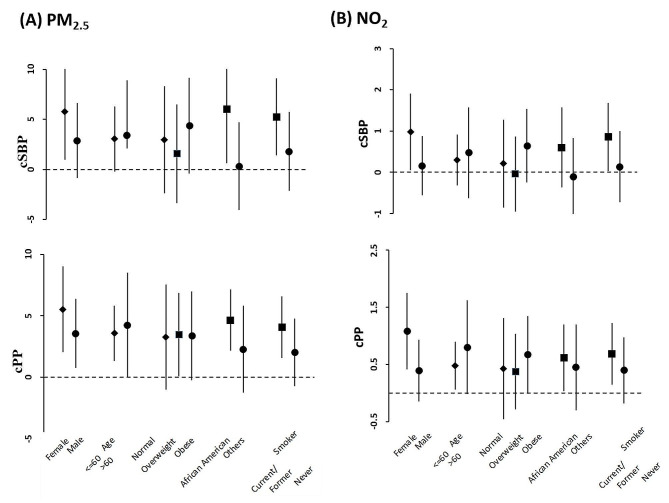
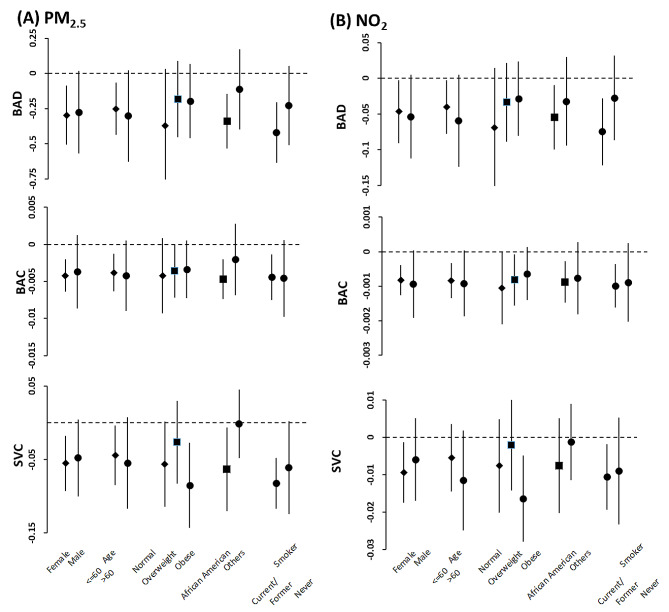
The cross-sectional study included 2,387 Chicago residents (76% African Americans) enrolled in the ChicagO Multiethnic Prevention And Surveillance Study (COMPASS) during 2013-2018 with validated address information, PM2.5 or NO2, key covariates, and hemodynamics measurements. We observed long-term concentrations of PM2.5 and NO2 to be positively associated with central systolic, pulse pressure and BAR, and negatively associated with BAD, and BAC after adjusting for relevant covariates. A 1-µg/m increment in preceding 3-year exposures to PM2.5 was associated with 1.8 mmHg higher central systolic (95% CI: 0.98, 4.16), 1.0 mmHg higher central pulse pressure (95% CI: 0.42, 2.87), a 0.56%mmHg lower BAD (95% CI: -0.81, -0.30), and a 0.009 mL/mmHg lower BAC (95% CI: -0.01, -0.01).
This population-based study provides evidence that long-term exposures to PM2.5 and NO2 is related to central BP and arterial stiffness parameters, especially among African Americans.
探讨长期空气污染暴露与中心血液动力学和肱动脉僵硬度参数之间的关系。
我们使用标准袖带血压计(DynaPulse2000A,圣地亚哥,CA)获得的动脉压力信号的波形分析来评估中心血液动力学参数,包括中心血压、心脏参数、全身血管顺应性和阻力以及肱动脉僵硬度指标[包括肱动脉扩张性(BAD)、顺应性(BAC)和阻力(BAR)]。在纳入研究前的 3 年期间,使用城市内时空精细尺度模型,在居住地址评估了空气动力学直径<2.5 μm 的颗粒物(PM2.5)和二氧化氮(NO2)的长期暴露情况。使用线性混合模型,根据潜在的混杂因素进行调整,以检验空气污染暴露与健康结果之间的关系。
这项横断面研究纳入了 2013 年至 2018 年期间在芝加哥多民族预防和监测研究(COMPASS)中登记的 2387 名芝加哥居民(76%为非裔美国人),他们的地址信息、PM2.5 或 NO2、关键混杂因素以及血液动力学测量结果均经过验证。在调整了相关混杂因素后,我们观察到 PM2.5 和 NO2 的长期浓度与中心收缩压、脉压和 BAR 呈正相关,与 BAD 和 BAC 呈负相关。在 3 年的 PM2.5 暴露前增加 1µg/m,中心收缩压升高 1.8mmHg(95%置信区间:0.98,4.16),中心脉压升高 1.0mmHg(95%置信区间:0.42,2.87),BAD 降低 0.56%mmHg(95%置信区间:-0.81,-0.30),BAC 降低 0.009mL/mmHg(95%置信区间:-0.01,-0.01)。
这项基于人群的研究提供了证据表明,长期暴露于 PM2.5 和 NO2 与中心血压和动脉僵硬度参数有关,尤其是在非裔美国人中。