Université de Franche-Comté, CHU Besançon, UMR 1322 LINC, INSERM CIC 1431, 25000 Besançon, France.
Centre des Sciences du Goût et de l'Alimentation, CNRS, INRAE, Institut Agro, Université de Bourgogne, 21000 Dijon, France.
Int J Mol Sci. 2024 May 6;25(9):5041. doi: 10.3390/ijms25095041.
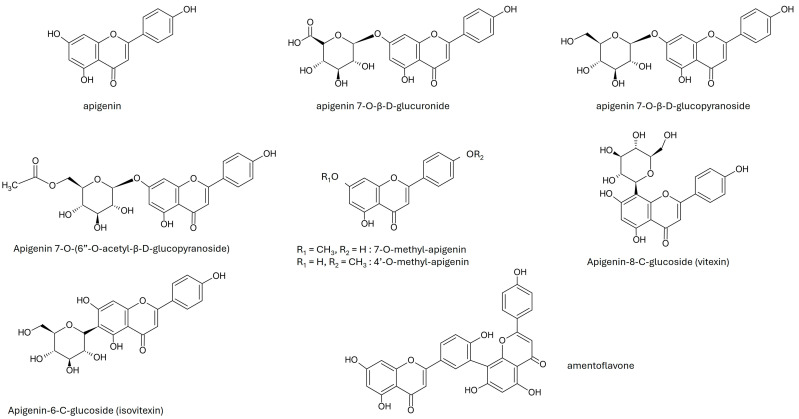
Neuroinflammation, a hallmark of various central nervous system disorders, is often associated with oxidative stress and neuronal or oligodendrocyte cell death. It is therefore very interesting to target neuroinflammation pharmacologically. One therapeutic option is the use of nutraceuticals, particularly apigenin. Apigenin is present in plants: vegetables (parsley, celery, onions), fruits (oranges), herbs (chamomile, thyme, oregano, basil), and some beverages (tea, beer, and wine). This review explores the potential of apigenin as an anti-inflammatory agent across diverse neurological conditions (multiple sclerosis, Parkinson's disease, Alzheimer's disease), cancer, cardiovascular diseases, cognitive and memory disorders, and toxicity related to trace metals and other chemicals. Drawing upon major studies, we summarize apigenin's multifaceted effects and underlying mechanisms in neuroinflammation. Our review underscores apigenin's therapeutic promise and calls for further investigation into its clinical applications.
神经炎症是各种中枢神经系统疾病的一个标志,通常与氧化应激以及神经元或少突胶质细胞死亡有关。因此,通过药理学方法靶向神经炎症是非常有趣的。一种治疗选择是使用营养保健品,特别是芹菜素。芹菜素存在于植物中:蔬菜(欧芹、芹菜、洋葱)、水果(橙子)、草药(洋甘菊、百里香、牛至、罗勒)和一些饮料(茶、啤酒和葡萄酒)。这篇综述探讨了芹菜素作为一种抗炎剂在多种神经疾病(多发性硬化症、帕金森病、阿尔茨海默病)、癌症、心血管疾病、认知和记忆障碍以及与痕量金属和其他化学物质相关的毒性方面的潜在应用。通过主要研究,我们总结了芹菜素在神经炎症中的多方面作用及其潜在机制。我们的综述强调了芹菜素的治疗潜力,并呼吁进一步研究其临床应用。