University Surgery Unit, Faculty of Medicine, University of Southampton, Tremona Road, Southampton, UK.
Birmingham Children's Hospital, Steelhouse Lane, Birmingham, UK.
Sci Rep. 2024 May 11;14(1):10783. doi: 10.1038/s41598-024-61482-9.
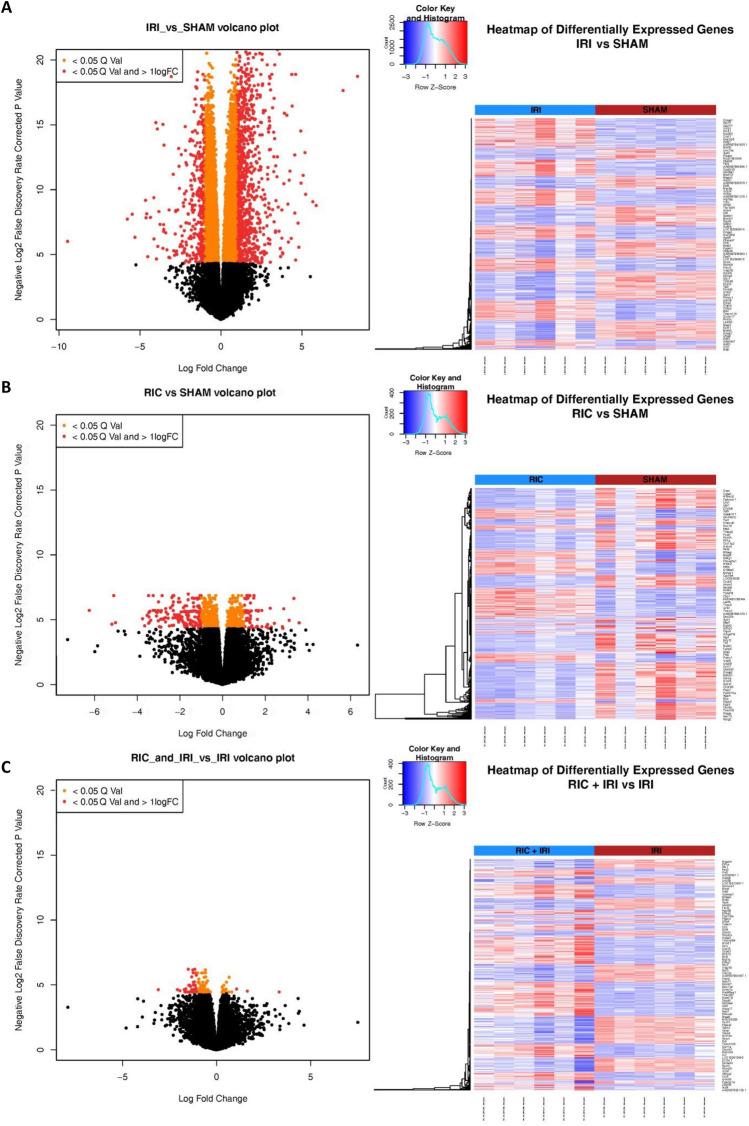
Necrotising enterocolitis (NEC) has a complex pathophysiology but the common end-point is ischaemia reperfusion injury (IRI) and intestinal necrosis. We have previously reported that RIC significantly reduces the intestinal injury in a rat model of NEC. Here we describe the changes in intestinal mRNA occurring in the intestine of animals exposed to IRI, both with and without RIC. Related rat-pups were randomly assigned to four groups: SHAM, IRI only, RIC only and RIC + IRI. IRI animals, underwent 40 min of intestinal ischaemia, and 90 min of reperfusion. Animals that underwent RIC had three cycles of 5 min of alternating ischaemia/reperfusion by means of a ligature applied to the hind limb. Samples from the terminal ileum were immediately stored in RNA-preserving media for later next generation sequencing and transciptome analysis using R v 3.6.1. Differential expression testing showed that 868 genes differentially expressed in animals exposed to RIC alone compared to SHAM and 135 in the IRI and RIC group compared to IRI alone. Comparison between these two sets showed that 25 genes were differentially expressed in both groups. Pro-inflammatory molecules: NF-ĸβ2, Cxcl1, SOD2 and Map3k8 all show reduced expression in response to RIC. Targeted gene analysis revealed increased expression in PI3K which is part of the so-called RISK-pathway which is a key part of the protective mechanisms of RIC in the heart. Overall, this transcriptomic analysis shows that RIC provides a protective effect to the intestine via anti-inflammatory pathways. This could be particularly relevant to treating and preventing NEC.
坏死性小肠结肠炎(NEC)的发病机制复杂,但共同的终点是缺血再灌注损伤(IRI)和肠坏死。我们之前的研究表明,重复缺血后处理(RIC)可显著减轻 NEC 大鼠模型的肠道损伤。本研究描述了在 IRI 作用下以及 RIC 作用下的肠道损伤动物模型中肠道 mRNA 的变化。相关大鼠幼崽被随机分为四组:SHAM、仅 IRI、仅 RIC 和 RIC+IRI。IRI 动物经历 40 分钟的肠道缺血和 90 分钟的再灌注。进行 RIC 的动物通过结扎后肢进行三次 5 分钟的交替缺血/再灌注循环。末端回肠样本立即用 RNA 保存液保存,用于以后的下一代测序和使用 R v 3.6.1 进行转录组分析。差异表达检测显示,单独接受 RIC 的动物与 SHAM 相比有 868 个基因差异表达,与仅 IRI 相比有 135 个基因差异表达。两组之间的比较显示,有 25 个基因在两组中差异表达。促炎分子:NF-κβ2、Cxcl1、SOD2 和 Map3k8 的表达均因 RIC 而降低。靶向基因分析显示,PI3K 的表达增加,PI3K 是所谓的 RISK 通路的一部分,该通路是 RIC 在心脏保护机制中的关键部分。总的来说,这项转录组分析表明,RIC 通过抗炎途径为肠道提供保护作用。这对于治疗和预防 NEC 可能特别相关。