Mantovani Mauro, Grossi Romano, Di Fede Giuseppe, Bellavite Paolo
Laboratory, Istituto di Medicina Biologica, Milan, ITA.
Nephrology and Dialysis, S.M. Goretti Hospital, Latina, ITA.
Cureus. 2024 May 10;16(5):e60019. doi: 10.7759/cureus.60019. eCollection 2024 May.
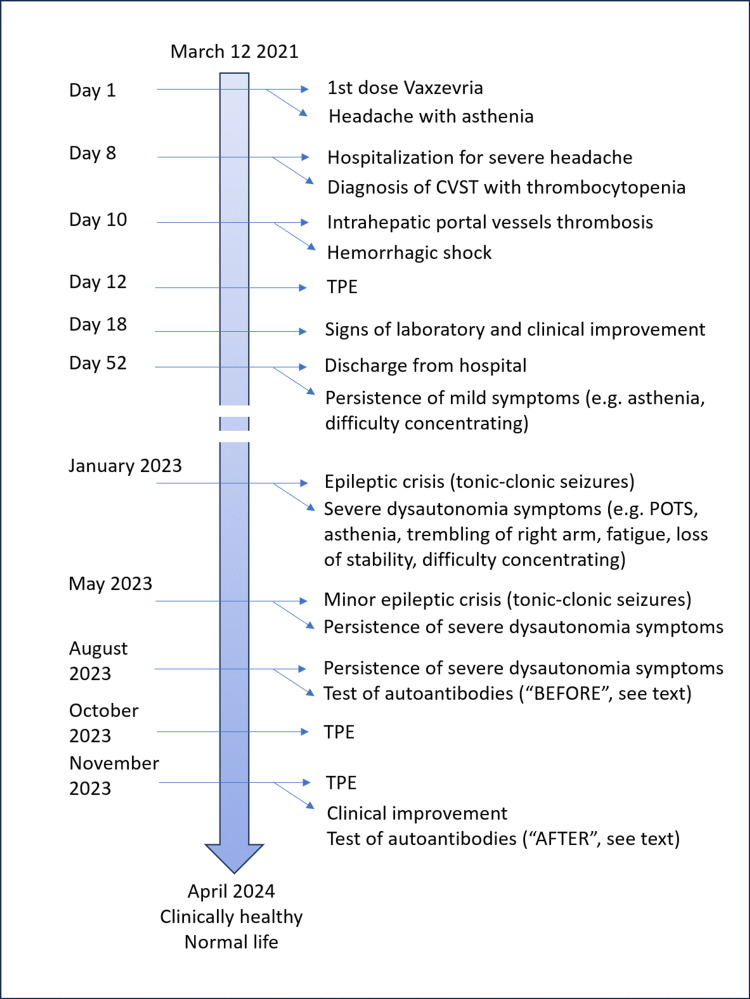
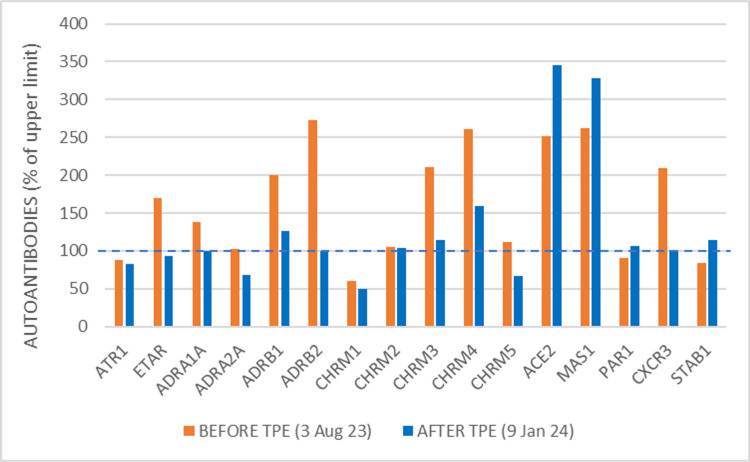
We present the case of a female who developed cerebral venous thrombosis with thrombocytopenia after inoculation with the anti-coronavirus disease 2019 (COVID-19) Vaxzevria vaccine, followed by splanchnic thrombosis and diffuse hemorrhages. Despite receiving treatment, the complications increased, and hence therapeutic plasma exchange (TPE) was attempted, leading to laboratory and clinical improvements and discharge after a period of intensive care. Almost two years after the first episode, in the interim of which the patient complained of only minor symptoms such as asthenia and difficulty concentrating, she developed an epileptic syndrome that required neurological treatment. In addition, her fatigue and difficulty concentrating worsened and other serious symptoms of dysautonomia appeared, such as trembling of her right arm, loss of stability, and postural orthostatic tachycardia. As serum analysis revealed a significant number of alterations in autoantibodies against various G-protein-coupled receptors (GPCRs) and RAS-related proteins, two further TPEs were performed, resulting in rapid and sustained clinical improvement. This report highlights the role of the different types of autoantibodies produced in response to anti-COVID-19 vaccination, which can have functional, regulatory, and possibly pathogenic effects on the vascular and nervous systems.
我们报告了一例女性病例,该女性在接种抗2019冠状病毒病(COVID-19)阿斯利康疫苗后发生脑静脉血栓形成并伴有血小板减少,随后出现内脏血栓形成和弥漫性出血。尽管接受了治疗,但并发症仍在增加,因此尝试进行治疗性血浆置换(TPE),经过一段时间的重症监护后,实验室检查和临床症状得到改善并出院。首次发作后近两年,在此期间患者仅抱怨有乏力和注意力不集中等轻微症状,之后她出现了需要神经科治疗的癫痫综合征。此外,她的疲劳和注意力不集中加重,还出现了自主神经功能障碍的其他严重症状,如右臂颤抖、平衡失调和体位性直立性心动过速。血清分析显示,针对各种G蛋白偶联受体(GPCR)和RAS相关蛋白的自身抗体有大量改变,因此又进行了两次TPE,临床症状迅速且持续改善。本报告强调了接种抗COVID-19疫苗后产生的不同类型自身抗体的作用,这些自身抗体可能对血管和神经系统产生功能、调节及潜在的致病影响。