Carnegie School of Sport, Leeds Beckett University, Leeds, United Kingdom.
Department of Motion Science, Institute of Sport Science, Friedrich-Schiller-University, Jena, Germany.
PLoS One. 2024 May 14;19(5):e0302867. doi: 10.1371/journal.pone.0302867. eCollection 2024.
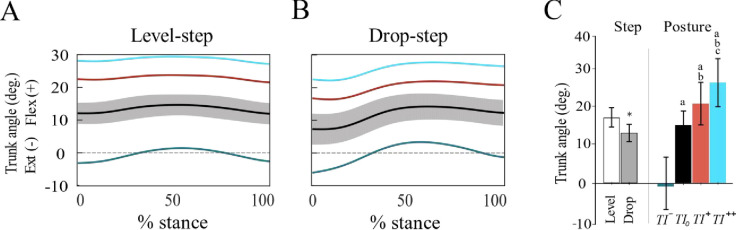
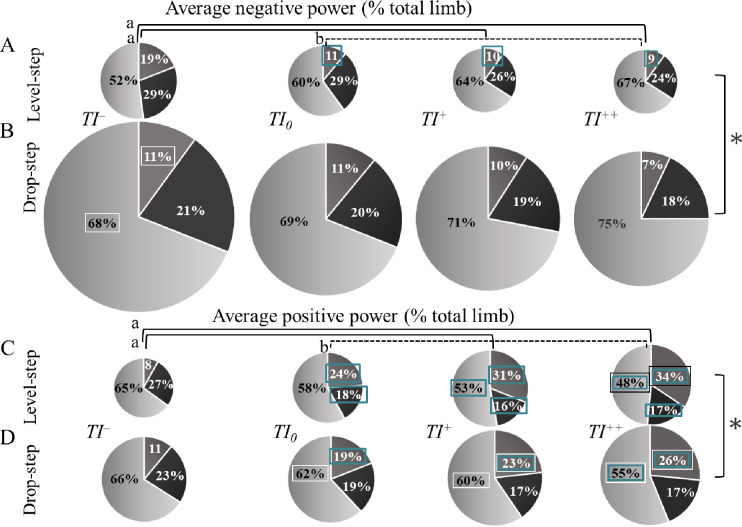
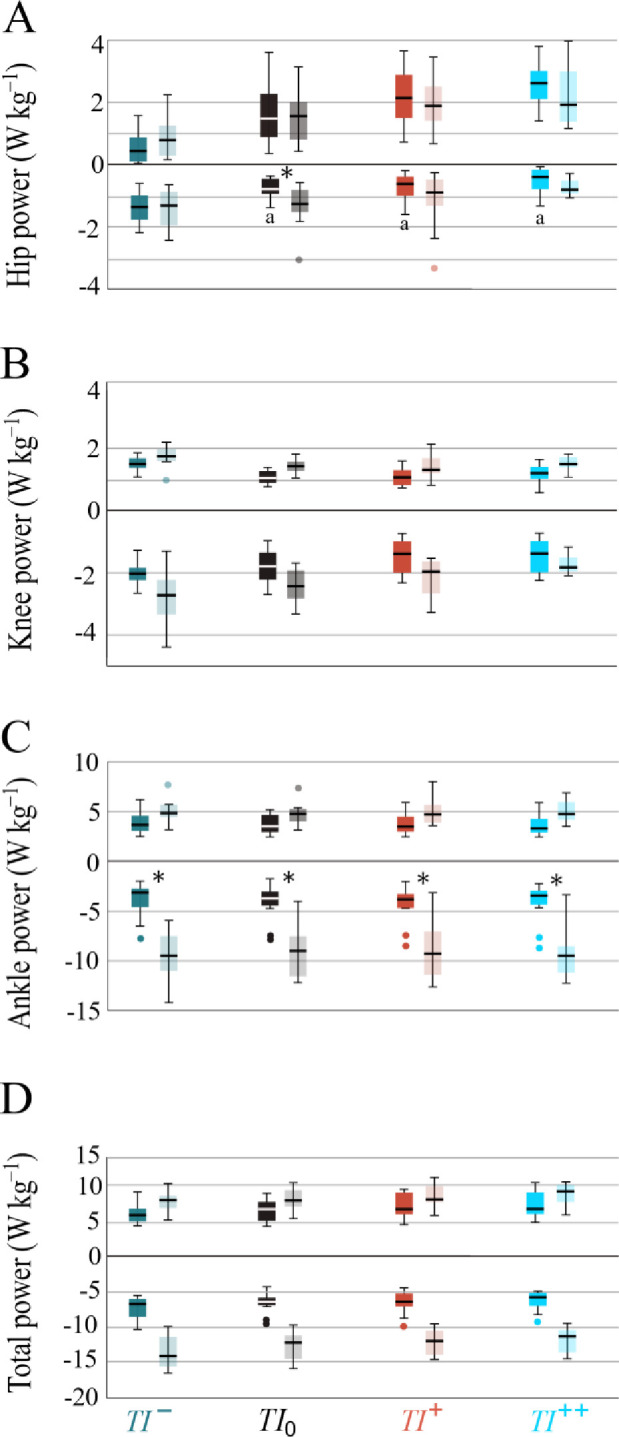
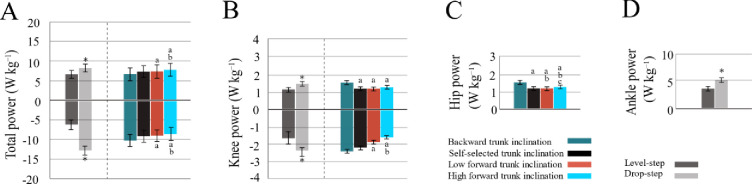
Despite evidence on trunk flexion's impact on locomotion mechanics, its role in modulating lower-limb energetics during perturbed running remains underexplored. Therefore, we investigated posture-induced power redistribution in the lower-limb joints (hip, knee, and ankle), along with the relative contribution from each joint to total lower-limb average positive and negative mechanical powers (i.e., over time) during perturbed running. Twelve runners (50% female) ran at self-selected (~15°) and three more sagittal trunk inclinations (backward, ~0°; low forward, ~20°; high forward, ~25°) on a custom-built runway, incorporating both a level surface and a 10 cm visible drop-step positioned midway, while simultaneously recording three-dimensional kinematics and kinetics. We used inverse dynamics analysis to determine moments and powers in lower-limb joints. Increasing the trunk forward inclination yielded the following changes in lower-limb mechanics: a) an elevation in total positive power with a distoproximal shift and a reduction in total negative power; b) systematic increases in hip positive power, coupled with decreased and increased contribution to total negative (during level-step) and positive (during drop-step) powers, respectively; c) reductions in both negative and positive knee powers, along with a decrease in its contribution to total positive power. Regardless of the trunk posture, accommodating drop-steps while running demands elevated total limb negative and positive powers with the ankle as a primary source of energy absorption and generation. Leaning the trunk more forward induces a distoproximal shift in positive power, whereas leaning backward exerts an opposing influence on negative power within the lower-limb joints.
尽管有证据表明躯干前屈对运动力学有影响,但在受扰跑步过程中,它对调节下肢能量的作用仍未得到充分探索。因此,我们研究了受扰跑步过程中,姿势引起的下肢关节(髋关节、膝关节和踝关节)的功率再分配,以及每个关节对下肢平均正、负机械功率(即随时间变化)的相对贡献。12 名跑步者(50%为女性)在一个定制的跑道上以自我选择的(约 15°)和三个更大的矢状面躯干倾斜角度(向后,约 0°;向前低,约 20°;向前高,约 25°)进行跑步,跑道上同时包含一个水平表面和一个位于中间的 10 厘米可见的落地步。在跑步的同时,我们记录了三维运动学和动力学。我们使用逆动力学分析来确定下肢关节的力矩和功率。增加躯干前倾会导致下肢力学发生以下变化:a)总正功率升高,呈近远侧移位,总负功率降低;b)髋关节正功率系统升高,同时膝关节负功率和正功率(在水平步时)和正功率(在落地步时)的贡献分别降低和升高;c)膝关节负功率和正功率降低,其对总正功率的贡献降低。无论躯干姿势如何,在跑步时适应落地步需要提高下肢的总负功率和正功率,踝关节是能量吸收和产生的主要来源。躯干前倾越厉害,正功率的近远侧移位越大,而躯干后倾对下肢关节的负功率则产生相反的影响。