Centre for Decision Research, Leeds Business School, University of Leeds, Leeds, Yorkshire, LS2 9JT, UK.
Department of Psychology, Royal Holloway University of London, Egham, Surrey, TW20 0EX, UK.
Sci Rep. 2024 May 14;14(1):10989. doi: 10.1038/s41598-024-59189-y.
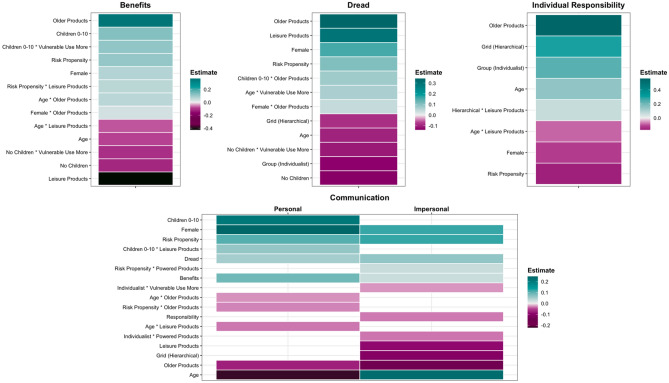
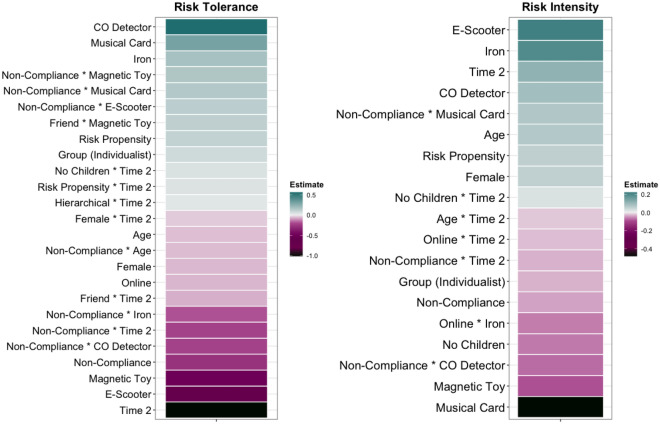
We vary greatly in our perception of risk, not just because of differences between risks themselves, but also because of individual, contextual and cultural differences too. To better understand and predict responses to risk, we need to (a) integrate these components, combining approaches from different psychological disciplines and (b) also consider risk tolerance - how individuals trade-off between risks and benefits. We therefore developed an ICONS (individual, contextual, cognitive, social) framework; using it across two empirical studies (n = 4228) to examine how individuals perceive and respond to the quotidian risks associated with consumer products. Three dimensions underlined risk perceptions: benefits, dread and individual responsibility. Risk tolerance was typically predicted by interactions between individual (demographic, cultural worldview, personality) and contextual (product type/category, harm information) factors. In turn, perceived dread, benefits and individual differences shaped how likely participants were to communicate risk information. Our results demonstrate for the first time how the interaction between individual, cognitive (risk tolerance, intensity), contextual, and social (risk communication) factors is key to understanding and predicting risk perceptions. Together, our findings help explain why societal responses to risks are often difficult to predict and have implications for the spread, and amplification, of risk information.
我们对风险的感知存在很大差异,这不仅是因为风险本身的差异,还因为个体、情境和文化差异。为了更好地理解和预测对风险的反应,我们需要(a)整合这些因素,结合来自不同心理学学科的方法,以及(b)考虑风险容忍度——个人在风险和收益之间的权衡。因此,我们开发了一个 ICONS(个体、情境、认知、社会)框架;在两项实证研究(n=4228)中使用它来检查个人如何感知和应对与消费产品相关的日常风险。三个维度强调了风险感知:收益、恐惧和个人责任。风险容忍度通常由个体(人口统计学、文化世界观、个性)和情境(产品类型/类别、伤害信息)因素之间的相互作用来预测。反过来,感知到的恐惧、收益和个体差异塑造了参与者传播风险信息的可能性。我们的研究结果首次证明了个体、认知(风险容忍度、强度)、情境和社会(风险沟通)因素之间的相互作用是理解和预测风险感知的关键。总之,我们的研究结果有助于解释为什么社会对风险的反应往往难以预测,以及对风险信息的传播和放大的影响。