Lab for Clinical and Integrative Neuroscience, School of Psychology, Trinity College Institute for Neuroscience, Trinity College Dublin, College Green, Dublin 2, Ireland.
Global Brain Health Institute, Trinity College Dublin, Dublin 2, Ireland.
Sci Rep. 2024 May 14;14(1):11036. doi: 10.1038/s41598-024-61045-y.
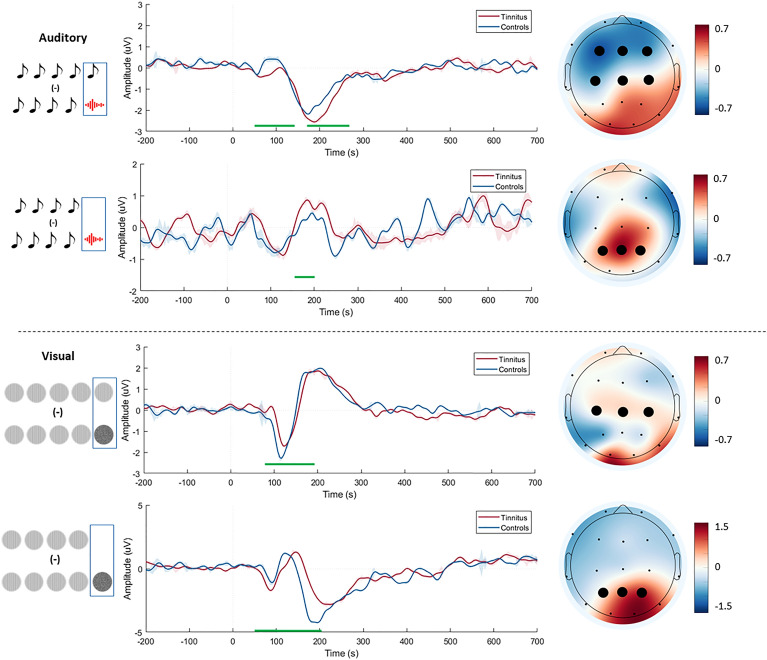
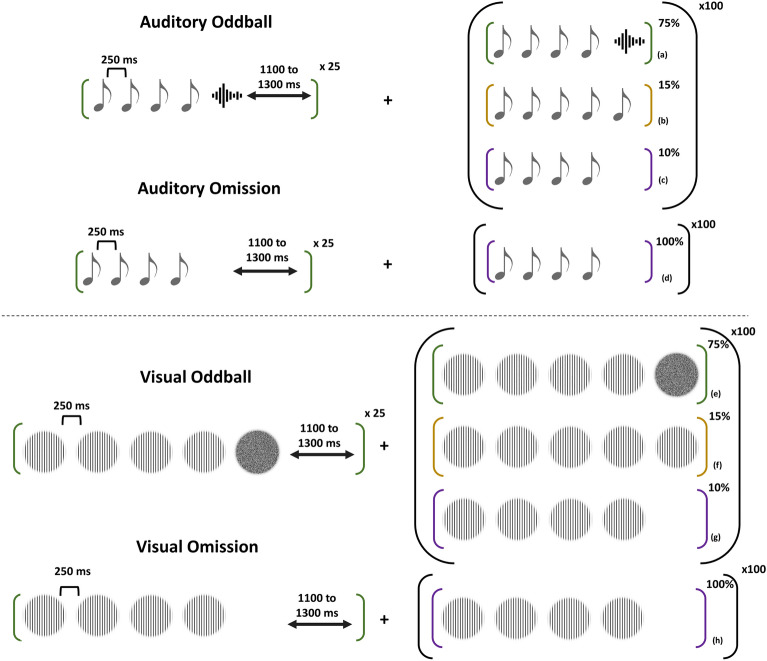
The perception of a continuous phantom in a sensory domain in the absence of an external stimulus is explained as a maladaptive compensation of aberrant predictive coding, a proposed unified theory of brain functioning. If this were true, these changes would occur not only in the domain of the phantom percept but in other sensory domains as well. We confirm this hypothesis by using tinnitus (continuous phantom sound) as a model and probe the predictive coding mechanism using the established local-global oddball paradigm in both the auditory and visual domains. We observe that tinnitus patients are sensitive to changes in predictive coding not only in the auditory but also in the visual domain. We report changes in well-established components of event-related EEG such as the mismatch negativity. Furthermore, deviations in stimulus characteristics were correlated with the subjective tinnitus distress. These results provide an empirical confirmation that aberrant perceptions are a symptom of a higher-order systemic disorder transcending the domain of the percept.
在没有外部刺激的情况下,在感觉域中感知到连续的幻觉,这被解释为异常预测编码的适应性补偿,这是一种大脑功能的统一理论。如果这是真的,这些变化不仅会发生在幻觉感知的领域,也会发生在其他感觉领域。我们使用耳鸣(连续的幻听)作为模型来证实这一假设,并使用听觉和视觉领域已建立的局部-全局Oddball 范式来探测预测编码机制。我们观察到,耳鸣患者不仅对听觉,而且对视觉领域的预测编码变化都很敏感。我们报告了事件相关 EEG 的既定成分的变化,例如失匹配负波。此外,刺激特征的偏差与主观耳鸣困扰相关。这些结果提供了一个经验上的确认,即异常感知是一种超越感知域的高阶系统性障碍的症状。